
You’ve just finished a clean correction, laid down a fresh coating, and watched the surface turn deep and glossy. Then a splash of brake cleaner lands on the panel before the day is over. The finish looks fine for a moment, but the wipe leaves a soft patch, a dull halo, or a surface that no longer feels bonded. That’s the difference between a coating that repels a liquid briefly and one that has reached genuine chemical resistance.
Solvent resistant spray paint is often judged by its label, gloss, and initial dry time. Professionals need a tougher standard. The questions are whether the film has cured, whether it retains adhesion after chemical exposure, and whether its hardness works with the movement of the substrate. Traditional aerosol chemistry still has a place, but modern elastomer and ceramic systems are changing how detailers think about durability.
Why Solvent Resistance Matters in Real-World Detailing
A quick chemical wipe can separate a durable finish from one that only appears cured. Brake cleaner, fuel, degreasers, tar removers, alcohol-based cleaners, and concentrated soaps can reach automotive surfaces during routine service. Marine panels face fuel vapors, saltwater, cleaners, and repeated wetting. Industrial parts may encounter oils, hydrocarbon solvents, and maintenance chemicals that are far harsher than a normal wash.
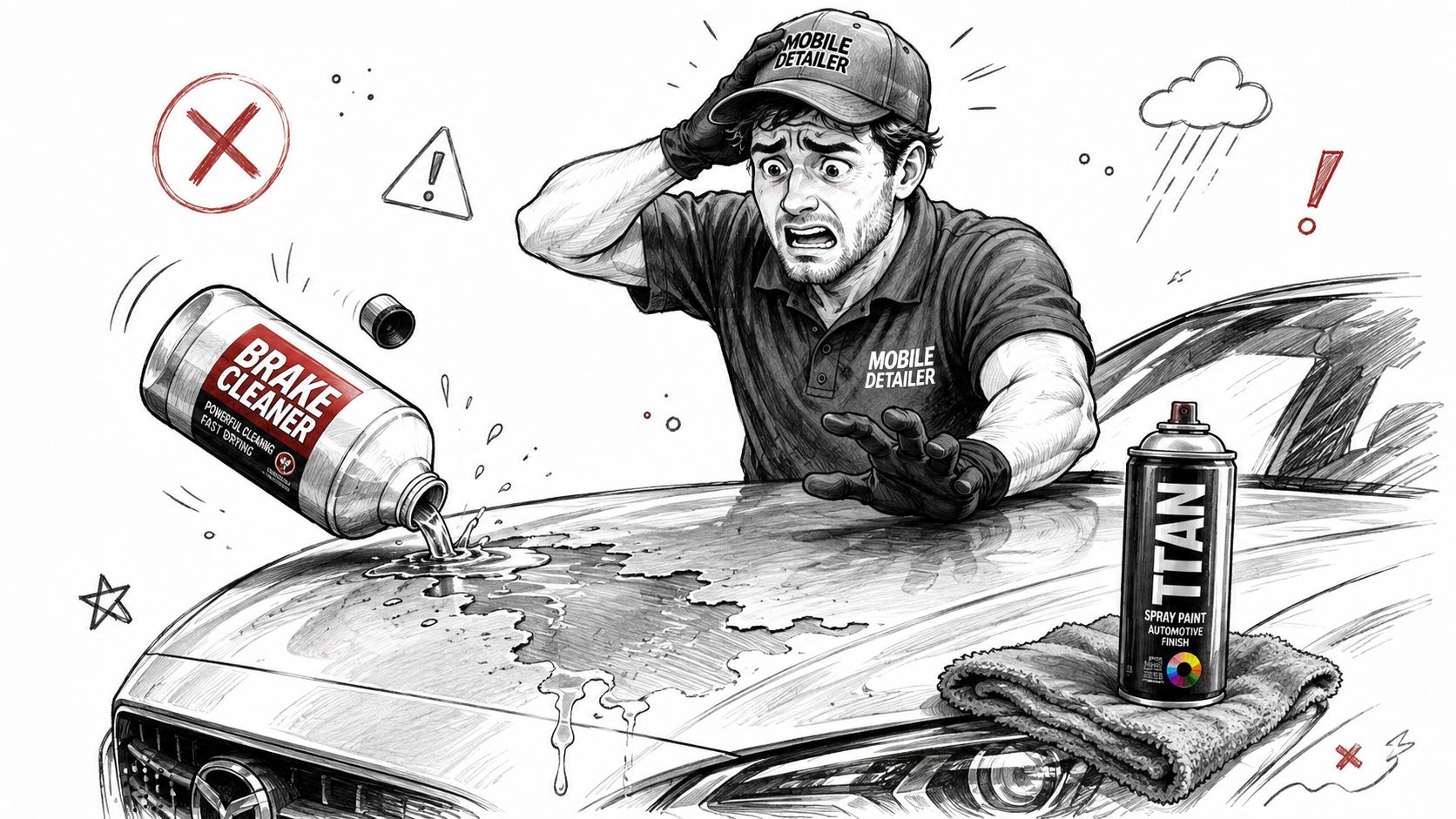
A coating can bead water and survive a brief wipe while remaining vulnerable beneath the surface. If the film has not completed its cure, solvent contact may soften the binder, weaken adhesion, or disturb the top layer. The visible result can appear later as staining, blistering, wrinkling, gloss loss, or premature wear.
A temporary repellent surface isn’t a cured coating
Product labels commonly use terms such as chemical proof, fuel proof, or solvent resistant. Those descriptions do not replace a cured-system evaluation. Actual performance depends on substrate preparation, film build, compatibility, and the time allowed for the coating to cure. A product may perform well on properly prepared metal yet fail over contamination, glossy plastic, uncured paint, or a surface exposed to chemicals too soon.
ASTM-tested cure benchmarks help expose the gap between marketing language and service performance. Initial dry time only describes the film’s early condition. Solvent resistance requires a coating that has developed sufficient cohesion and adhesion to withstand the specified exposure without softening or losing integrity.
Practical rule: Treat solvent resistance as a cured-system property, not an aerosol-can promise.
For detailers comparing products, Titan’s chemical resistant coating shows how elastomer technology and Dark Matter Technology extend the discussion beyond traditional solvent-borne aerosol paint. The evaluation should match the coating to the chemicals involved, temperature changes, substrate movement, and expected impact. Flexibility matters when a rigid film would crack, while cure development still determines how the surface handles solvents.
The cost of failure extends beyond the damaged spot. A compromised coating may require polishing, sanding, spot repair, or complete removal. On a customer vehicle, that means lost time and a difficult explanation. On a marine or industrial asset, it may mean taking equipment out of service. A solvent-resistant specification protects the finish and the workflow built around it.
The Chemistry Behind Solvent Resistant Spray Paint
A coating can advertise solvent resistance and still fail once the cleaner reaches a partially cured film. The formulation behind solvent resistance comes down to polymer architecture. The binder forms the continuous film, grips the substrate, and controls how the coating responds to solvents, impact, heat, and weather. Alkyd spray paints have long been associated with adhesion to metal, hardness, weather resistance, light resistance, and solvent resistance, traits commonly expected from durable solvent-borne formulations.
A weak polymer structure behaves like loose chain links with wide gaps. Solvent molecules can enter those gaps, swell the film, and carry softened material away. A well-formed network creates a tighter barrier. It is not impervious, but its structure gives solvents fewer paths into the film and limits swelling and disruption.
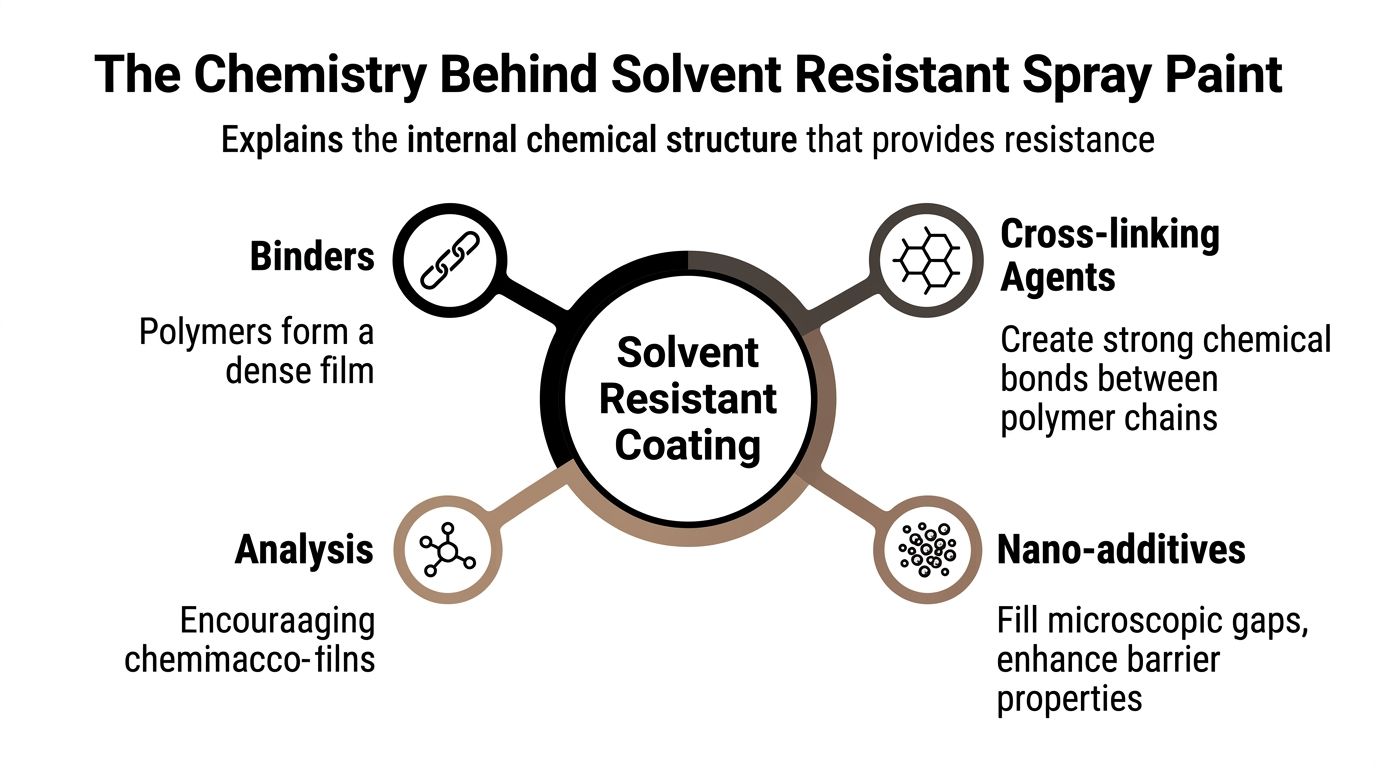
Three parts control the result
- Binders: Polymers form the main film. They provide adhesion, hardness, flexibility, and the primary chemical barrier.
- Cross-linking agents: These create bonds between polymer chains during curing. More complete cross-linking generally improves resistance to softening, although excessive rigidity reduces tolerance for movement.
- Nano-additives: Fine reinforcement can reduce microscopic pathways and improve barrier behavior. Research on carbon nanotube surface coatings has documented improved electrochemical resistance when multi-walled nanotubes are homogeneously incorporated into a nickel phase in aggressive chloride environments, as described in this review of carbon nanotube surface coatings.
Vehicle panels expose that trade-off quickly. A hard, brittle coating may resist a chemical wipe yet crack when a bumper moves, a panel flexes, or metal and paint expand at different rates. Elastomer technology takes a different route. It aims to maintain a durable surface while allowing the film to accommodate movement, rather than forcing every stress into a fracture.
Titan describes its approach through Dark Matter Technology, together with elastomer and ceramic coating products. The underlying concept is explained in Titan’s guide to what polymer coating means. The practical question is whether the selected product has documented cure and resistance data for the intended use. Marketing language alone cannot establish that performance.
VOC rules have also influenced formulation choices. The United Kingdom replaced its 2005 Volatile Organic Compounds in Paints, Varnishes and Vehicle Refinishing Products Regulations in 2012, while Hong Kong introduced VOC controls for regulated products on 1 April 2007 and expanded them to vehicle refinishing paints and coatings from 1 January 2010, as recorded in the UK legislation. The result is a continuing formulation compromise: solvent-borne products must provide usable application and film performance while meeting emissions and labeling requirements.
The aerosol format itself traces back to the first aerosol-can patent filed in 1926 by Erik Rotheim. U.S. EPA aerosol-coating VOC standards were promulgated in 2008, with a later amendment action carrying an effective date of 17 January 2025, as summarized in this spray paint history reference. Modern chemistry therefore has to balance durability, cure development, solvent exposure, emissions, and the movement demands of the substrate.
How Solvent Resistance Is Tested
A cleaner failing to leave an immediate mark does not prove meaningful solvent resistance. Proper testing examines how a cured film responds to controlled rubbing or immersion, then records visible and physical changes. That difference separates temporary repellency from a coating benchmark tied to service conditions.
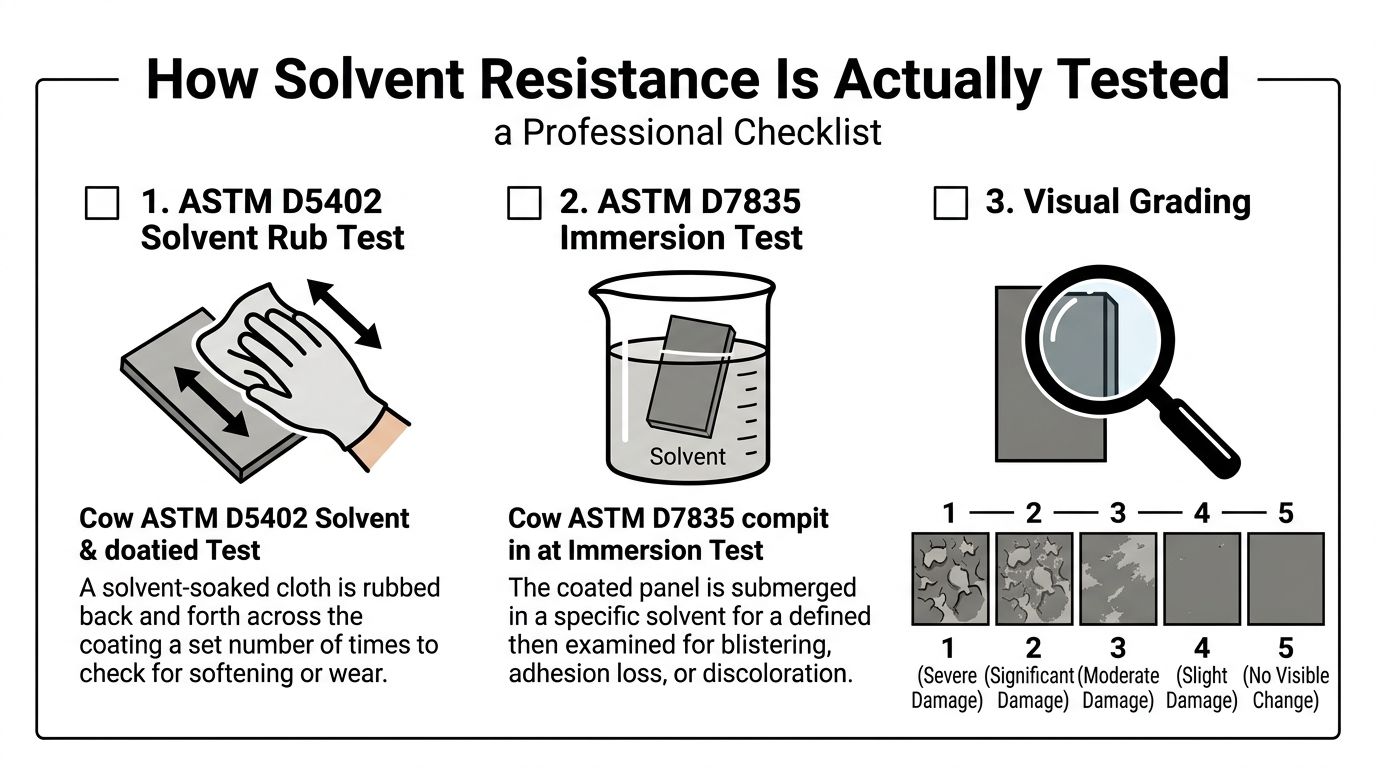
Rub testing shows whether cure is ready
ASTM D5402 describes a solvent-rub method for organic coatings that chemically change during curing. ASTM D7835/D7835M adds a mechanical rubbing-machine variant. Both methods help determine whether a film has reached the cure level required for service, topcoating, or field use, as detailed in the ASTM paint standards collection.
The process is simple in principle. A cloth is saturated with a specified solvent and rubbed over the coating under defined conditions. The evaluator checks for softening, color transfer, gloss loss, film removal, or substrate exposure. A machine-based test improves repeatability when a supplier or laboratory needs consistent pressure and movement.
Military and industrial primer specifications commonly use a 50-pass MEK cloth rub as an acceptance benchmark. Rubbing through to the bare substrate constitutes cure failure. The benchmark does not mean every automotive coating must meet the same requirement. It does show why documentation should identify the solvent, pass count, test conditions, and failure definition.
Ask for the information that affects service
Before choosing solvent resistant spray paint, ask for:
- The test method: Is the result based on ASTM D5402, ASTM D7835, immersion, or an internal procedure?
- The solvent: MEK, gasoline, hydrocarbon fluid, alcohol, and degreaser exposure are not interchangeable.
- The cure condition: How long did the panel cure, and under what conditions?
- The failure point: A slight gloss change differs from softening, adhesion loss, or rubbing through.
- The full system: Primer, basecoat, coating, and topcoat can affect the result.
Solvent resistance can appear before full cure. A film may survive light contact yet lack the hardness or adhesion needed for service. Follow the stated cure schedule, keep aggressive detailing chemicals away during early cure, and test a hidden area when the substrate or product combination is unfamiliar.
Titan’s coating testing resource provides a useful reference for the documentation practitioners should expect. A bare marketing claim is not enough when the application involves fuel, brake cleaner, marine chemicals, or industrial maintenance solvents.
Traditional Spray Paints Versus Modern Elastomer Coatings
Traditional solvent-borne aerosol paint earns its place through speed, familiarity, and a predictable spray format. It can cover prepared metal, trim, brackets, and small repairs efficiently. The weakness appears when the substrate moves, receives impact, or experiences sharp temperature changes before the film has enough flexibility to follow it.
Titan’s Alpha Quartz and Ultra Ceramic Spray represent a different design direction. The aim isn’t to make a surface harder. An elastomer coating can be hard like glass while remaining flexible, allowing the film to absorb movement and reduce the risk of cracking. Flexibility matters because a coating that stays attached through expansion, contraction, and minor impact can last longer than a harder film that fractures.
Independent elastomeric coating data supports the value of measurable flexibility. One product is specified to pass a 1/8-inch mandrel bend at -30°F (-34°C), with 96.9% elongation recovery after 10 minutes and 98.4% after 24 hours, as reported in the Sika product data. Those figures describe recovery after deformation, not merely the absence of visible cracking.
| Attribute | Traditional Solvent-Borne Paint | Titan Elastomer Coatings |
|---|---|---|
| Surface character | Often optimized for a hard, decorative film | Designed to combine a hard surface with flexibility |
| Movement tolerance | Depends heavily on the binder and substrate | Elastomer structure is intended to accommodate movement |
| Temperature changes | Expansion stress can contribute to cracking when the film is rigid | Flexibility helps the coating follow substrate movement |
| Chemical exposure | Performance varies by formula, cure, and topcoat | Must still be verified against the relevant solvent and cure benchmark |
| Best fit | Fast aerosol repairs and conventional refinishing | Applications where flexibility and surface protection matter together |
The broader coating industry now relies on formulation discipline, testing, and workflow control. For teams trying to shorten development cycles or compare chemistry options, how Polymerize streamlines coatings R&D provides useful context on organizing formulation work without treating a marketing label as test evidence.
Elastomer technology isn’t a free pass. Poor preparation, thin application, contamination, or early chemical exposure can still cause failure. The advantage is structural. Instead of asking only how hard the film becomes, the applicator asks whether it can remain hard, bonded, and flexible through the conditions the vehicle or equipment will face.
Why Titan’s Elastomer Technology Outperforms
The key performance gap appears after the initial gloss fades. A rigid film may resist a quick wipe yet crack or lose adhesion when the panel moves. An elastomeric film is designed to keep its surface hardness while accommodating movement, so failure is less likely to begin with brittle fracture. That distinction matters more than the phrase “solvent resistant” printed on a label. Actual resistance still depends on formulation, cure, film thickness, and the relevant ASTM benchmark.
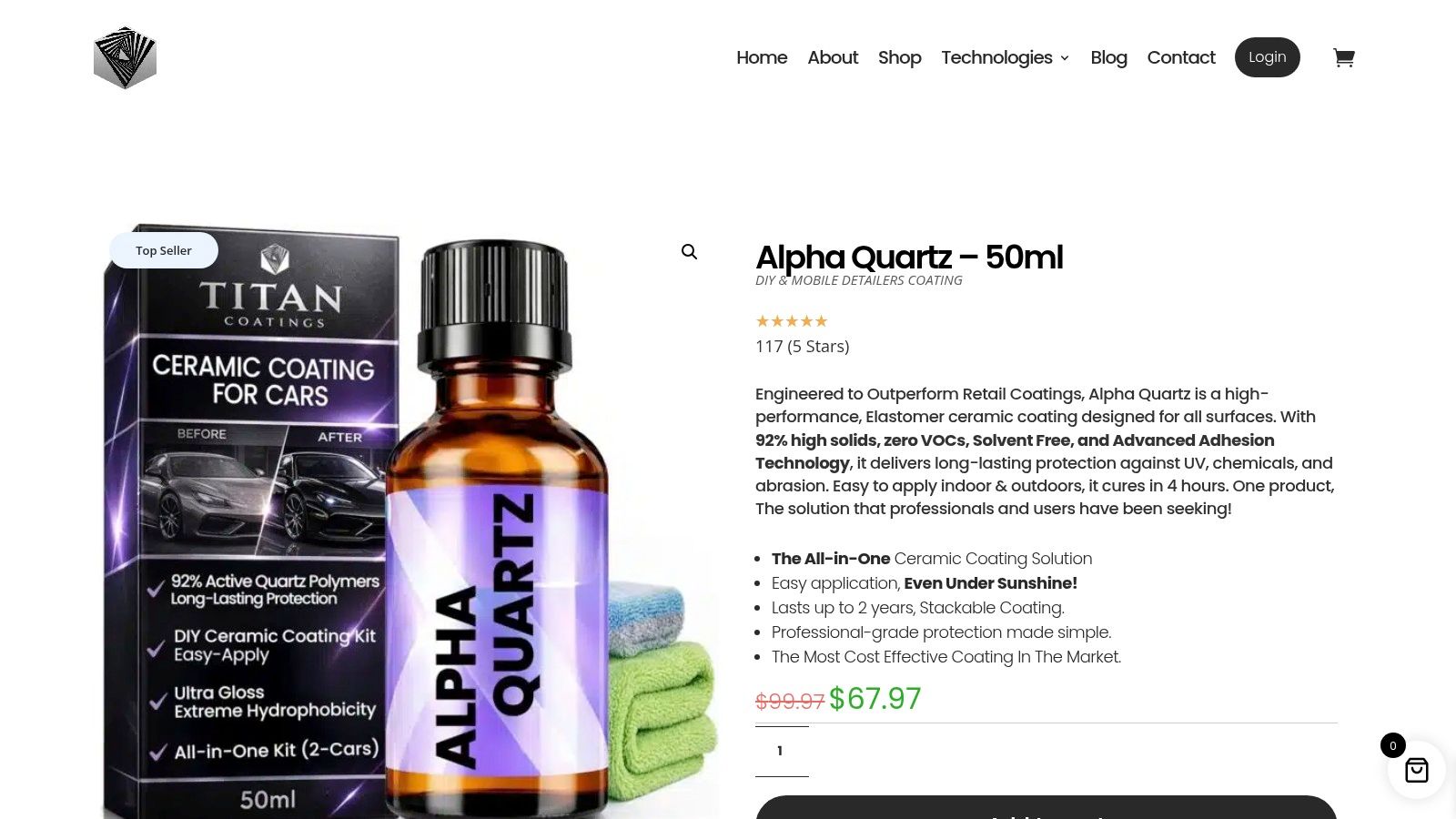
Titan positions Alpha Quartz as an elastomer coating with 92% high solids, zero VOCs, and Advanced Adhesion Technology. Those attributes describe the product design, not independent proof against every solvent. In practice, the useful combination is adhesion, sufficient film build, and flexibility. Hardness alone does not protect a coating that is poorly bonded or exposed before it has cured.
Flexibility changes the failure pattern
Alpha Quartz is intended to remain hard like glass and flexible at the same time. That design can help the coating follow expansion and contraction through temperature changes, while reducing cracking from localized impacts such as insects striking a vehicle’s front end. It does not make damage impossible. It changes how the film responds when the substrate moves or takes a sharp hit.
Ultra Ceramic Spray offers a spray-applied ceramic layer for users who need a simpler application format. Titan associates its Dark Matter Technology upgrade with increased chemical resistance and anti-static effects. The format can make handling easier, but cleaning, decontamination, application thickness, wiping, and cure protection still control the final result.
Apex Glass Coating serves a different substrate. Applied to glass and windshields, it is intended to improve rain visibility by helping water clear from the viewing area. The Apex Glass Ceramic Coating product page gives product-specific application information.
Project complexity also affects the chemistry decision. A prepared panel may suit a spray-applied product, while a large restoration or difficult substrate can benefit from professional control. The comparison in DIY versus professional cabinet spray shows why surface condition, access, ventilation, and finish expectations matter alongside the product label.
Titan says it introduced elastomer coatings using nanotube technology and Dark Matter Technology. Review Titan’s elastomer coating information before committing to a high-exposure job, then request substrate-specific cure and solvent-resistance documentation. Marketing language can identify a formulation direction, but ASTM-tested cure benchmarks and relevant solvent data determine whether the coating fits the work.
How to Apply Titan Coatings for Maximum Solvent Resistance
A coating can’t compensate for a contaminated panel. Start with a clean, dry substrate, remove waxes and oils, and correct loose or failing material before application. Scuff glossy surfaces where the product instructions require it, inspect edges and seams, and make sure the panel is cool enough for controlled application.
Prepare the surface before opening the bottle
For Alpha Quartz, work in a small, manageable area and follow Titan’s product directions for spread rate, leveling, and wipe timing. The goal is an even film, not a heavy application intended to create instant gloss. Excess product can remain uneven, attract contamination, or extend the time needed before chemical exposure.
For Ultra Ceramic Spray, clean the panel thoroughly, mist or apply the product according to its instructions, and distribute it with a clean microfiber. Use a second towel to level residue before it turns difficult to remove. A short-pile microfiber gives control during leveling, while a longer-pile towel can help with the final inspection and removal of remaining high spots.
Treat glass as its own substrate
For Apex Glass Coating, polish or clean the windshield until it is free of traffic film, oils, and wiper residue. Apply in controlled circular motions if the product directions call for that method, then level the coating without leaving visible smears in the driver’s line of sight. Glass needs a final inspection under changing angles because a coating can look clear in one position and hazy in another.
Cure before chemistry: A surface that feels dry isn’t automatically ready for brake cleaner, fuel, or strong degreaser.
Protect the vehicle from rain, washing, dust, and aggressive chemicals during the stated cure period. Don’t judge readiness by touch alone. If a project involves a solvent that isn’t listed in the technical documentation, test a concealed area or spare panel after full cure rather than gambling on the customer’s finish.
Mobile application requires tighter control
Shade, airflow, and panel temperature matter outdoors. Keep towels sealed from dust, avoid applying over a hot surface, and organize clean and used microfiber separately. For broader bodywork or damaged panels, the step-by-step auto body repair instructions offer useful preparation context, although coating-specific instructions still take priority.
Titan’s guide to applying ceramic coating to a car should be checked alongside the product directions. The best solvent resistance comes from the whole process, clean preparation, compatible layers, even film formation, complete cure, and controlled first service.
Choosing the Right Coating for Your Project
Start with the substrate and the exposure, not the finish name. For flexible protection across suitable automotive, marine, or other prepared surfaces, Alpha Quartz fits projects where hardness and movement tolerance need to coexist. Its elastomer character is relevant when panels face temperature swings, vibration, or minor impacts.
Choose Ultra Ceramic Spray when a spray-applied ceramic layer suits the workflow and you need a practical product for a prepared hard surface. It’s still important to verify compatibility with wraps, PPF, existing coatings, plastics, and painted substrates before full application. Use Apex Glass for windshields and other glass areas where clarity and rain visibility are the priority.
Keep the solvent question specific. Identify the chemical, allow the complete cure, and look for rub or immersion data that matches the intended service. A coating that handles a mild wipe may not tolerate fuel, MEK, brake cleaner, or continuous immersion. Titan’s shop and its YouTube resources can help you review product use, but technical documentation and a controlled test panel should guide high-risk applications.
APEX NANO – Titan Coatings offers ceramic, elastomer, glass, and spray-applied coating options for demanding automotive, marine, aviation, and defense-related surfaces. Visit APEX NANO – Titan Coatings to compare Alpha Quartz, Ultra Ceramic Spray, and Apex Glass, then choose the system that matches your substrate, solvent exposure, and cure requirements.
0 Comments