
A ceramic coat applicator must match the coating's viscosity and working conditions, not just feel soft. Single-layer automotive ceramic coatings are typically about 1–2 microns thick, while professional multi-layer systems commonly reach 2–5 microns, so controlled transfer matters more than maximum product saturation.
You're halfway through a coating job when the panel starts to haze. The bottle is premium, the paint correction was clean, and the lighting looked good. Yet the finish shows dark streaks and cloudy high spots after leveling. In many cases, the coating didn't fail. The applicator did not release it evenly, or the temperature shortened the time available to level the film.
Elastomer coatings such as Alpha Quartz offer a more forgiving direction than traditional silica-based products because flexibility can help a cured coating accommodate movement and temperature stress. They still need proper preparation and a suitable applicator, but the pad should be selected according to how the product behaves on the panel, not by brand reputation alone.
Why Your Ceramic Coat Applicator Makes or Breaks the Job
A detailer can spend hours washing, decontaminating, polishing, and panel-wiping a vehicle, then lose the finish during the final application step. The usual scene is familiar. The first door looks smooth, the second door begins to drag, and the hood develops a hazy patch that only becomes obvious when the inspection light moves across the paint.
The coating may be perfectly usable. The problem is often a pad that absorbed too much product at the start, released it unevenly, or began dragging after the coating started curing inside its face.
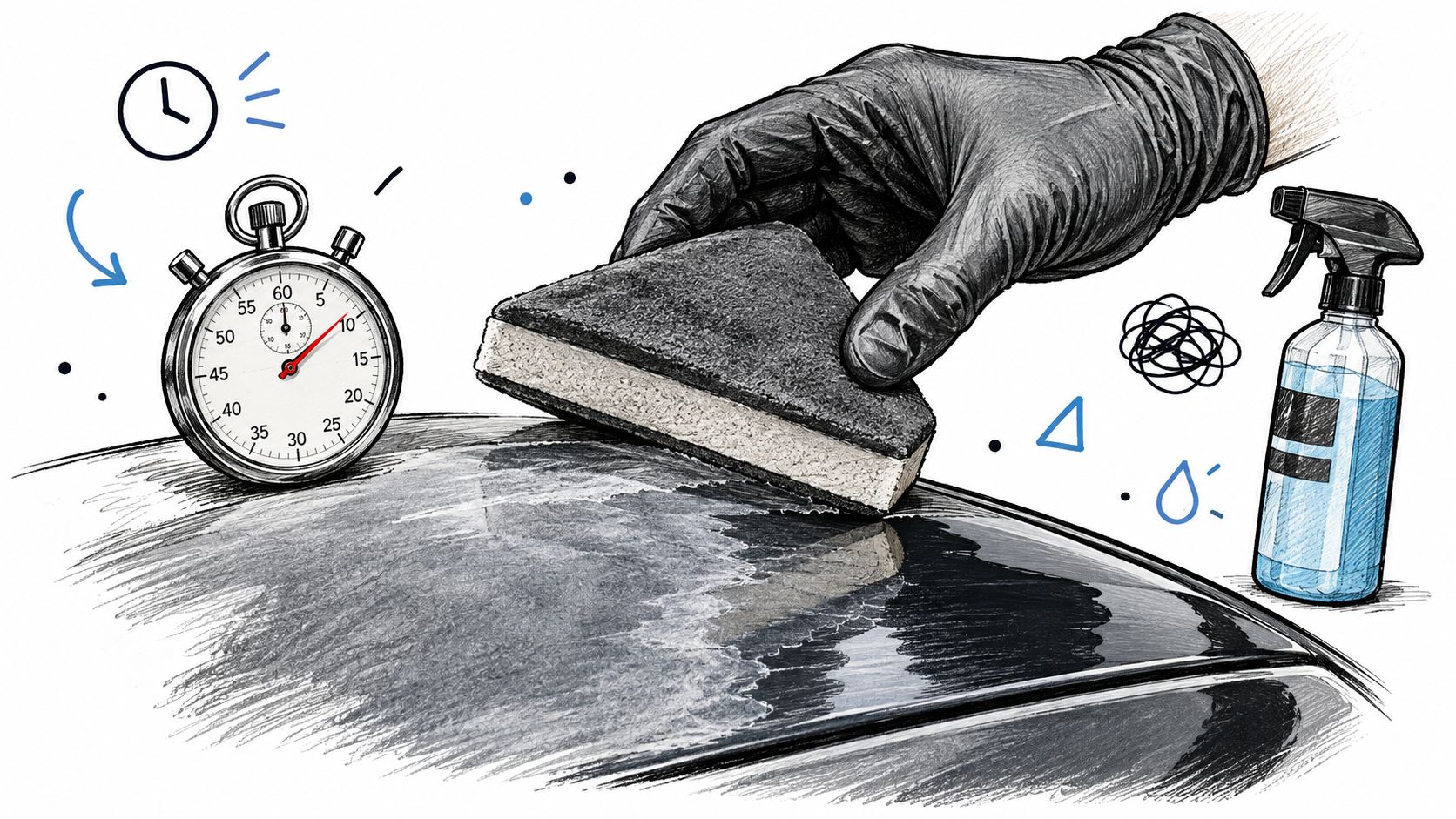
The pad is a metering tool
A ceramic coat applicator does more than move liquid from the bottle to the paint. It meters the coating, spreads it across the section, and keeps enough material at the paint interface for uniform wetting. The installer then has to level the excess before the surface viscosity rises and the coating begins to harden.
Automotive clear coat is generally about 35–50 microns thick, while the cured ceramic layer is only a few microns, according to this overview of ceramic coating thickness. That difference explains why flooding the pad is a poor strategy. More product does not automatically create more useful protection. It creates more liquid to control and more material that can cure as a high spot.
Practical rule: Choose the applicator that gives you predictable release, not the one that holds the most coating.
What goes wrong in the bay
A highly absorbent applicator can starve the surface as the pad pulls coating into its pile or foam core. A pad with poor leveling characteristics can leave lines behind as the coating flashes. A contaminated face can drag grit across freshly coated paint, while cured silica in the fibers can turn a previously soft applicator into an abrasive tool.
The right pad lets you work a manageable section with consistent pressure and overlapping passes. It also gives you a clear visual signal when the coating begins to flash. That control is more valuable than theoretical capacity because the finished layer depends on uniform deposition, not saturation.
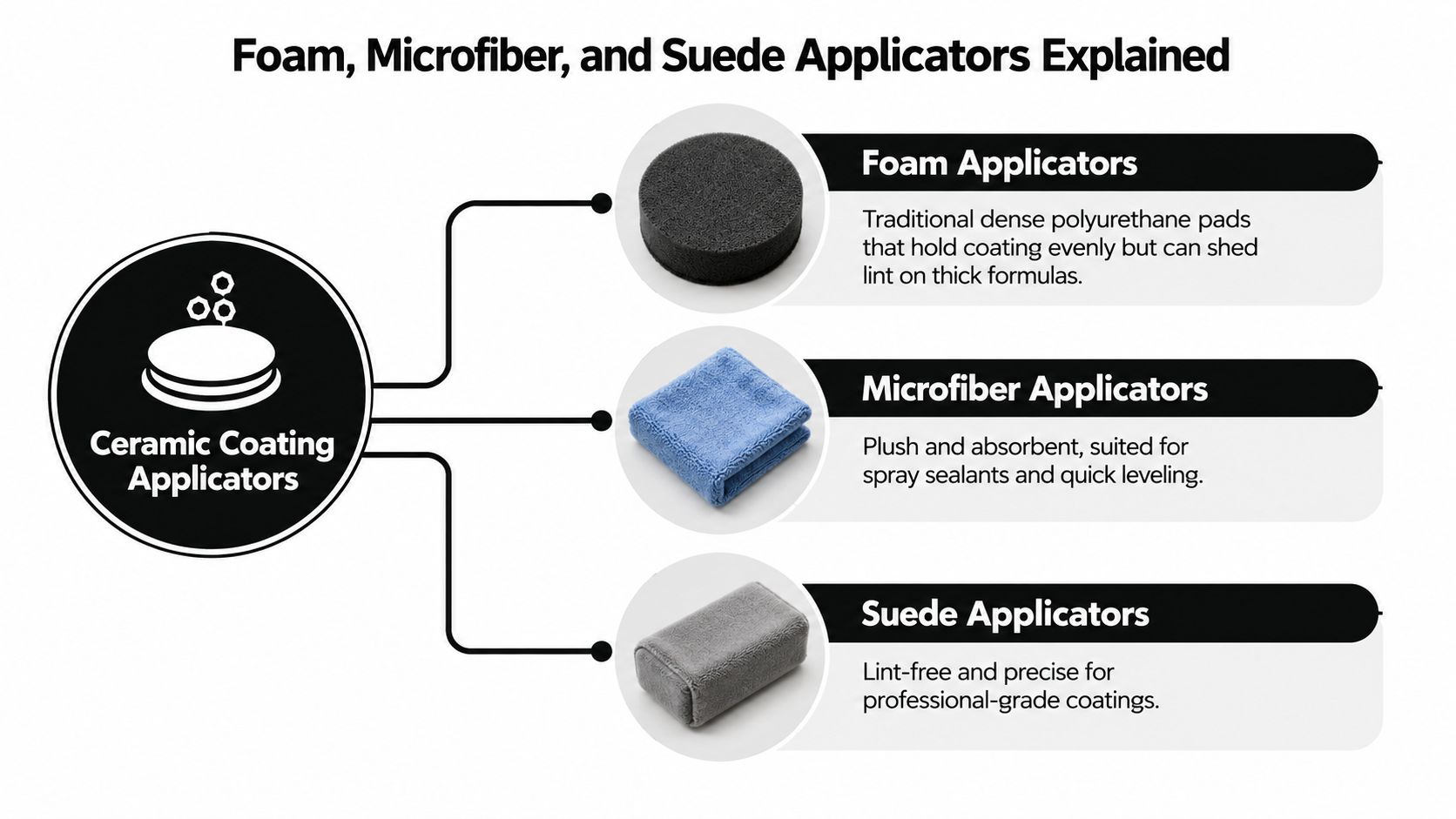
Foam, Microfiber, and Suede Applicators Explained
The three common applicator families behave differently because their faces and cores hold liquid in different ways. Start by identifying the coating's viscosity, then decide whether you need cushioning, absorbency, or the cleanest possible release.
Foam applicators
Dense foam is the familiar starting point for many installers. Its smooth face can carry a controlled amount of coating, and its compressibility helps it conform to mild curves without collapsing. Foam often suits medium-viscosity products and gives a beginner a stable platform for crosshatch passes.
The weakness is retention. Product can remain in the cell structure, particularly when the pad is pressed hard or overloaded. That retained material may release later as a heavy line, and the installer can mistake the extra wetness for better coverage.
Microfiber applicators
Microfiber combines polyester and polyamide fibers. Polyamide supports absorbency and fine-particle attraction, while the blended structure provides a soft contact surface for delicate paint. Technical guidance reports that high-quality microfiber can absorb approximately 7–8 times its own weight in liquid, compared with about 3 times for cotton, as explained in this technical discussion of microfiber absorption.
That capacity is useful for smooth spreading, but it can also increase consumption. If the coating disappears into the pile instead of remaining at the paint interface, the pad may feel wet while the panel receives an uneven film. A microfiber applicator with a hydrophobic barrier between the face and foam core can reduce that pull-through. One commercially described construction is associated with detailer-observed savings of up to 50%, although the result depends on viscosity and formulation.
For pad options, compare the construction of these microfiber applicator pads rather than judging them by softness alone.
Suede applicators
Suede-style faces have low absorption and a smooth texture. They keep more coating at the interface, reduce pile drag, and limit lint transfer. That makes them particularly useful for high-viscosity or solvent-rich formulations where a plush face could introduce resistance or hold too much liquid.
A suede-wrapped block needs a clean, flat working face. It offers precision, but it won't hide poor loading or excessive pressure. Use light overlapping passes and replace the wrap when it becomes contaminated or begins to drag.
The Physics of Applicator Performance and Film Control
Film control starts with the amount of liquid that reaches the paint, not with the label on the bottle. A single-layer automotive ceramic coating commonly cures into a film of roughly 1–2 microns, while professional multi-layer systems may reach about 2–5 microns. At that scale, small changes in transfer can affect gloss uniformity, solvent release, and the visibility of defects.
A pad that absorbs too aggressively can create a starved area. The coating reaches the panel, but not as a continuous, evenly wetted layer. A pad that releases too much can leave ridges, edge accumulation, streaks, and high spots. Those defects aren't useful extra protection. They're excess material waiting to cure unevenly.
The flash window controls the result
After application, solvents evaporate and cross-linking begins. As the surface viscosity rises, the coating becomes less willing to flow back into a level film. Delaying the wipe allows applicator lines and puddled edges to harden in place.
Research on automotive films prepared at a target dry-film thickness of 5–7 micrometres illustrates how tightly deposited material must be controlled, as shown in this automotive UV-cured film study. The study isn't a direct test of every detailing coating, but it reinforces the working principle. Film build is not an abstract specification. It starts with the liquid volume deposited by the applicator.
A hydrophobic barrier between a microfiber face and foam core changes that transfer path. It keeps more coating near the surface, which can improve release consistency and reduce waste. The result still depends on coating viscosity, pad saturation, hand pressure, and panel temperature.
Ceramic Coat Applicator Comparison
| Applicator Type | Best For | Absorbency Level | Product Control | Lint Risk | Cost Range |
|---|---|---|---|---|---|
| Foam | Medium-viscosity coatings and curved panels | Low to medium | Steady, but can retain product in the core | Low when clean | Entry to professional |
| Microfiber | Smooth spreading and quick leveling | Medium to high | Good with a barrier, less predictable without one | Low to medium | Entry to professional |
| Suede | High-viscosity and solvent-rich coatings | Low | Precise release at the paint interface | Very low | Professional-oriented |
The coating application methods from Titan can help installers compare the pad motion and leveling stage with the product being used. The central test is simple. If the applicator leaves a wet, even trail and allows a clean wipe within the flash window, it is doing its job.
Choosing the Right Applicator for Your Coating and Conditions
A soft pad isn't automatically a good pad. Coating viscosity and panel temperature determine how quickly the liquid spreads, how long it stays workable, and how much pressure the installer can use before the film moves out of the working zone.
High-viscosity products usually benefit from a smooth suede face or a low-absorption microfiber construction. The reduced pile drag keeps the coating at the paint interface. A medium-pile terry face can make more sense when cushioning and debris capture matter, especially on larger panels where the operator needs a little more forgiveness from the contact surface.
Match the face to the product
Use this decision path before opening the bottle:
- Thick or solvent-rich coating: Start with a clean suede face. It limits absorption and gives the installer a more direct feel for the wet film.
- Moderate-viscosity coating: Use dense foam or a barrier-backed microfiber pad. Both can provide steady transfer when loaded sparingly.
- Spray ceramic coating: Microfiber can offer smooth distribution and quick leveling, provided the face doesn't become saturated.
- Elastomer coating: Follow the product's stated method, then choose a flat pad that spreads the material without collapsing or creating heavy edges.
Adjust for heat and humidity
A single flash instruction can't work identically in every bay. Panel temperature, ambient temperature, relative humidity, dew point, airflow, and direct sunlight all influence the time available for leveling. Industrial coating guidance commonly recommends keeping the substrate at least 3°C above the dew point, while application guidance often places relative humidity around 40–70%, as outlined in this ceramic coating temperature and humidity guidance.
On a hot panel, shrink the working section and inspect sooner. In cool, humid conditions, watch for delayed flashing and avoid assuming that a longer wait will improve the finish. Record panel temperature, humidity, section size, product amount, flash cue, and wipe timing. Those notes turn a difficult job into a repeatable process.
The chemistry and compatibility guidance is useful when the coating's behavior doesn't match the applicator you normally use. Change one variable at a time so you know whether the improvement came from the pad, the loading amount, or the environment.
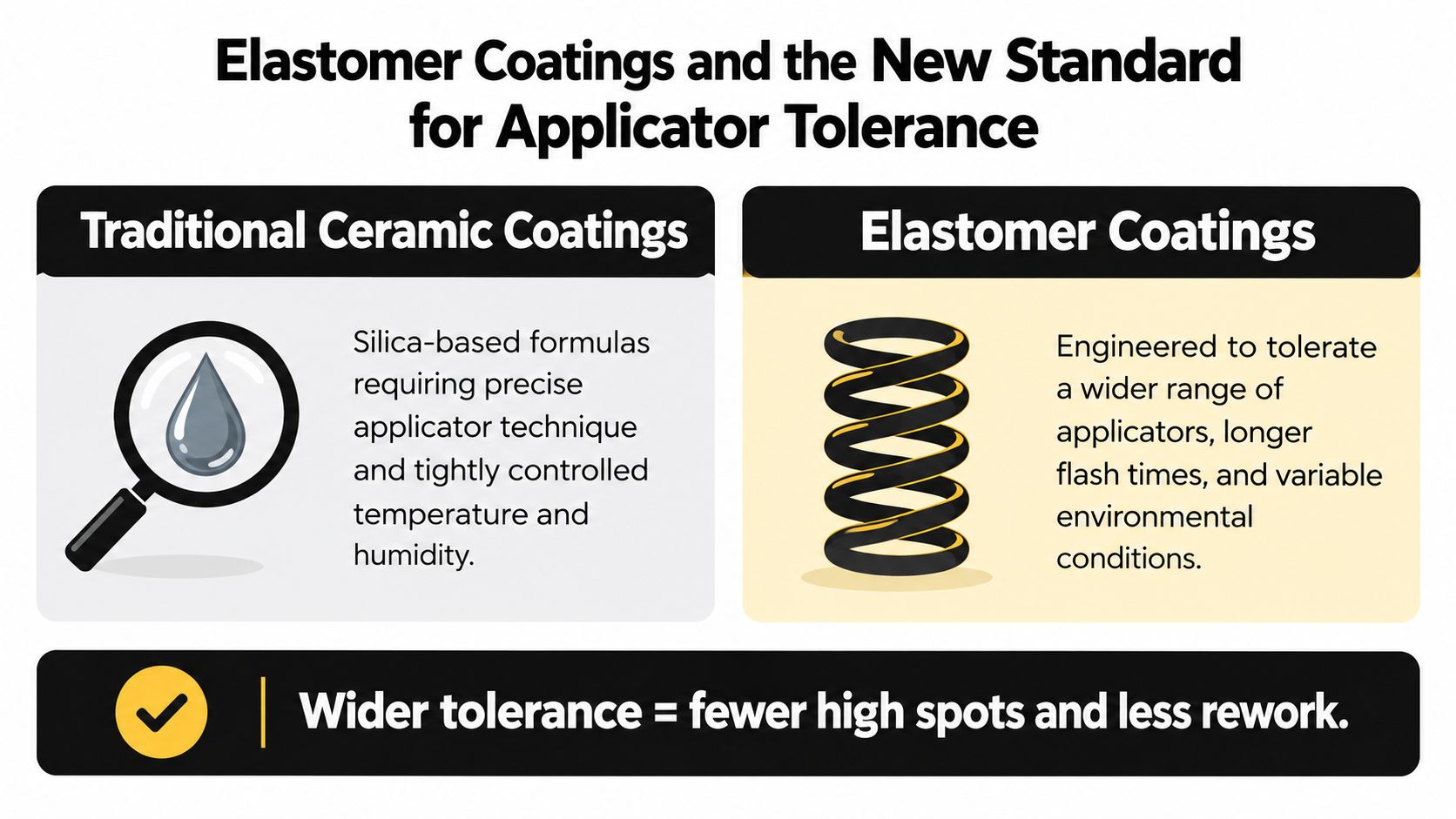
Elastomer Coatings and the New Standard for Applicator Tolerance
Traditional silica-based coatings reward controlled application and expose rushed leveling quickly. Elastomer coatings use a different materials approach. Their film can remain hard while accommodating some movement, which matters as the coated substrate expands and contracts with temperature changes, as explained in this overview of coating flexibility.
Applicator tolerance still depends on coating behavior. A thicker product may drag through a tight or dry applicator, while a thinner product can flood a soft face and create heavy edges. Temperature changes that balance. Cooler coating can spread more slowly, while warmer coating may level quickly and leave less time to correct overlap. The pad must carry enough material for an even film without absorbing or releasing it unpredictably.
Titan introduced elastomer coatings using nanotube technology and its Dark Matter technology. The practical appeal is clear for mobile detailers and DIY installers. A flexible coating may be less vulnerable to stress from substrate movement than a rigid film, although the result depends on formulation, cure state, film thickness, substrate, and exposure conditions.
Hard protection still needs flexibility
Carbon nanotubes can affect mechanical and thermal performance in polymer composites. The outcome depends on nanotube size, aspect ratio, loading, dispersion, and alignment. A reviewed PAN composite example found that adding 5% multiwalled carbon nanotubes shifted the onset of decomposition by 24°C compared with unfilled PAN, according to this review of carbon nanotube polymer nanocomposites. That example does not establish the same performance for every commercial coating. It does show why nanotube technology must be judged as part of a formulation, not treated as a label.
Temperature cycling stresses the bond between coating and substrate. Flexible resin components can help a coating accommodate repeated expansion and contraction, reducing the risk of cracking or delamination during thermal stress, as discussed in this research on thermal cycling stability.
Alpha Quartz in practical use
Alpha Quartz follows this elastomer-focused approach. Its flexibility is intended to help the coating remain resilient through changing conditions, including movement between frozen and hot environments and impacts such as insects striking the surface. It still requires clean preparation, controlled spreading, and prompt leveling. For DIY users and mobile detailers, that tolerance can matter when coating temperature and viscosity vary from one job to the next.
Glass requires a separate approach. APEX Glass Ceramic Coating is intended for windshields and glass, where water repellency can support clearer visibility during rain, ice, and snow. A clean glass-specific applicator and thorough residue removal matter more than plushness because windshield streaks affect what the driver sees.
For a simpler spray workflow, Ultra Ceramic Spray provides another application format to consider. Spray products still require clean paint, even coverage, and appropriate microfiber leveling. Inspection remains necessary.
Application Protocol and Applicator Maintenance Best Practices
Good applicator work begins before the first drop touches paint. Check the face under strong light, remove lint and debris, confirm that the pad is clean and dry, and make sure the coating has been mixed according to its product directions. A contaminated applicator can compromise a corrected panel in seconds.
Build a repeatable routine
- Prepare the panel. Wash, decontaminate, correct defects where necessary, and remove polishing residue with the appropriate panel-prep product.
- Check the environment. Measure panel temperature and humidity. Keep the surface above the dew point and avoid direct sun or a panel that feels hot to the touch.
- Load sparingly. Apply enough product to establish a continuous wet trail without flooding the face. If liquid runs off the block, the pad is carrying too much.
- Work a manageable section. Use overlapping horizontal and vertical passes with light, consistent pressure. Smaller sections are safer when heat or humidity shortens the flash window.
- Level on the visual cue. Watch for the coating to shift from wet and oily toward a haze or rainbow effect. Follow the product's direction rather than relying on a universal timer.
- Inspect immediately. Use angled or diffused lighting to find streaks, high spots, lint, and uneven gloss before the film becomes difficult to move.
Protect the applicator
Keep separate pads for different products and surfaces. A glass applicator shouldn't move back to paint, and a pad used with a solvent-rich coating shouldn't be assumed clean because it looks dry.
Once silica-containing coating cures in the fibers, the face can become abrasive. Reusing it for leveling may introduce micro-marring, so replace the pad when it drags, deforms, sheds material, or releases product unevenly. Place used applicators in sealed bags until they can be discarded or assessed, keeping dust and premature curing away from other tools.
The Titan coatings shop provides product categories for installers comparing coating formats and application needs. The useful habit is to match each product with a dedicated, inspected applicator rather than forcing one pad to handle every job.
Frequently Asked Questions About Ceramic Coat Applicators
Can you reuse a ceramic coating applicator?
Only when it hasn't contacted cured coating and remains clean, soft, flat, and free of debris. Once silica product hardens in the fibers, reuse can create drag and micro-marring.
How many sections can one applicator cover?
A pad face commonly handles one to two panel sections before debris or residue affects release, based on the practical guidance provided for ceramic coating applicators. Replace it sooner if the surface begins to drag.
Does applicator color matter?
No. Color helps you assign pads to products or identify contamination. It doesn't determine absorption, leveling, or coating compatibility.
Should mobile detailers choose portability or precision?
Choose both. A lightweight microfiber pad with a hydrophobic barrier offers easy transport and controlled release, while a smooth suede face gives precise contact for coatings that resist flowing.
How do you know the pad is failing?
Look for uneven wetting, visible lint, a sticky or dragging face, edge accumulation, or a sudden need to increase pressure. Increasing pressure usually makes the problem worse by squeezing product out of the working zone.
Which Titan products suit different workflows?
Alpha Quartz is the elastomer option for installers seeking a flexible coating approach. APEX Glass is made for glass and windshield work, while Ultra Ceramic Spray suits a spray-based workflow. Always match the applicator and wipe method to the specific product directions.
APEX NANO, Titan Coatings offers ceramic, glass, spray, and elastomer coating options for automotive and other coated surfaces, so you can pair the product format with the applicator control your conditions require. Visit APEX NANO – Titan Coatings to review the available coatings, choose the right application method, and build a more repeatable detailing process.
0 Comments