
A ceramic coating for tires is worth it on exposed sidewalls and rubber trim when the product is tested for rubber, and it does not belong on the tread or the shoulder contact zone. Treat those as two different jobs, because a film that shelters rubber from sun and ozone is not the rubber that has to grip the pavement.
Say it's Sunday evening and the car looks finished until you crouch by the rear wheel. The sidewall is grey and a little chalky, with fine lines near the bead after a summer of sun, wash soap, and road spray. You're holding a bottle that promises a hard, glossy finish. Before that liquid touches rubber, the zone decides whether the job is protection or a handling risk.
Is a Tire Ceramic Coating Worth It? Verdict by Tire Zone
Those dull sidewalls make the purchase feel urgent. The useful answer is narrower than the bottle copy. Exposed sidewall rubber and rubber trim are fair candidates once the label names rubber or tire use and a test patch has survived real driving. The tread is off limits. So is the shoulder, where the tire meets the road.
| Tire zone | Coating suitability | Reason |
|---|---|---|
| Sidewall rubber | Good candidate after a test patch | Exposed to ozone and UV, so a flexible barrier film reduces direct weathering |
| Rubber trim and wheel arches | Good candidate after a test patch | Weathered rubber and plastic trim benefit, but the label must cover rubber |
| Wheels and rims | Suitable for listed products | Non-contact surface; some Titan sealants list wheels among approved surfaces |
| Tread | Do not coat | Friction with the road sets grip, braking and wear, and any film changes it |
| Shoulder and contact edge | Do not coat | Overspray or migration can reach the contact patch and change surface friction |
The global ceramic tire coating market was valued at USD 1.54 billion in 2024, according to Growth Market Reports. That much shelf space is why two bottles can share the word ceramic and still behave nothing alike. A film on the sidewall can slow weathering. It doesn't rewrite tread grip, tread life, or braking distance. Those come from the compound, the pattern, inflation, load, and the road under the car.
Three questions before you buy
Is the surface living in sun and ozone? Outer sidewalls and exposed trim are. The tread face isn't the problem this film is built to solve.
Can you keep the film off the contact patch? Tape, a steady hand, and no overspray onto the shoulder.
Does the label name rubber or tire use? If it only lists paint, wheels, and trim, don't guess. Confirm tire use before a sidewall gets a coat.
Practical rule: Yes to all three means the coating is worth a test patch on the inner sidewall, not a full set done on hope.
How Tire Rubber Ages and What a Coating Blocks
Rubber left in the sun behaves like skin that loses its suppleness. It goes dull, then stiff, then cracked. Ozone, oxygen, heat, and UV attack the polymer chemically, while flexing and abrasion add mechanical damage.
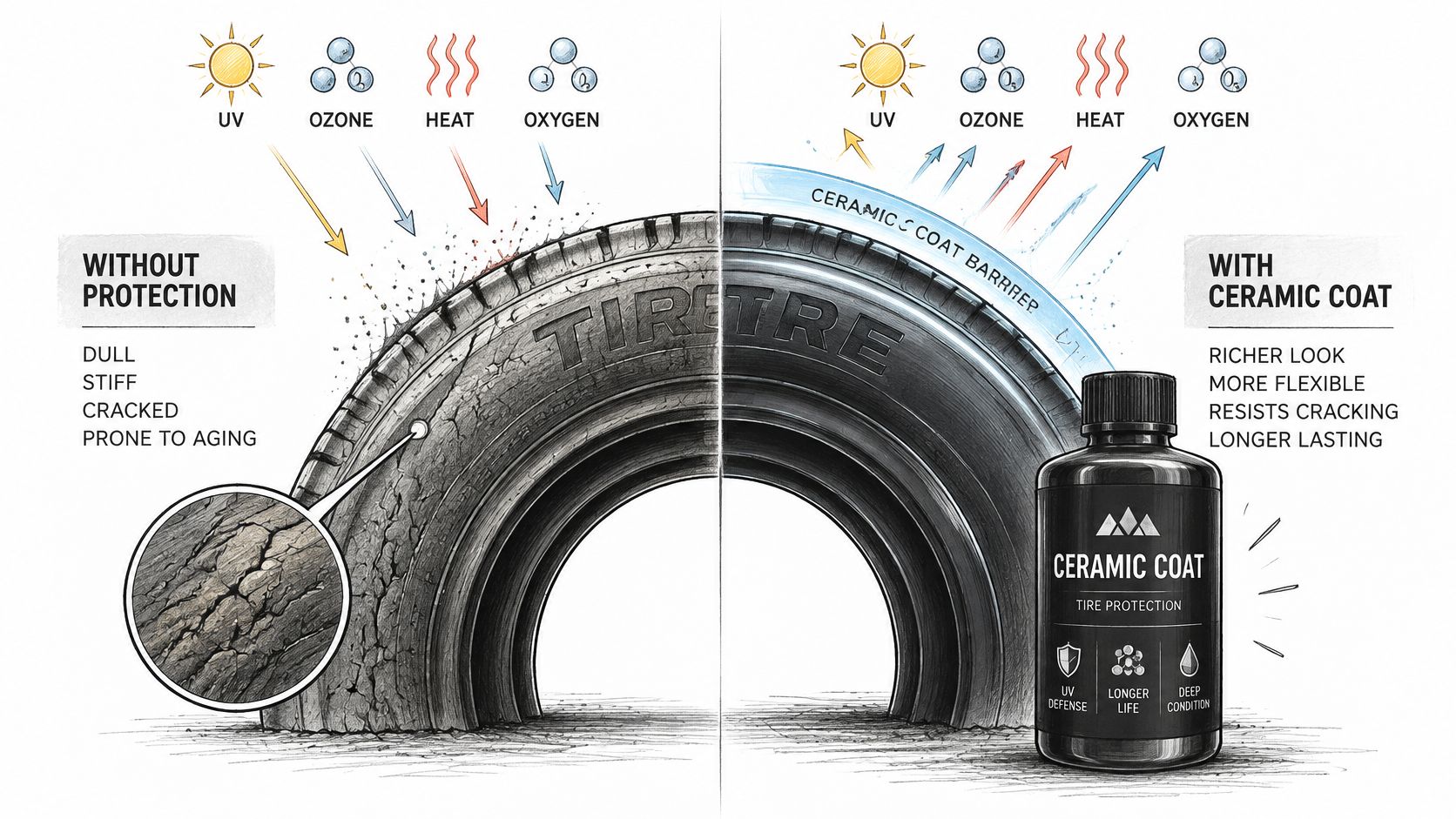
Weathering doesn't wait for a full season to show up in a bond test. Under combined ozone and UV exposure, one tire-material study reported indexed H-pull-out force falling from 100 to 46 after 10 minutes and to 35 after 30 minutes, in research carried by Taylor & Francis. A sidewall film has to be judged on adhesion after that kind of exposure, not on how black the tire looks an hour after you buff it.
An outer film is a barrier against contaminants and weather. That is not the silica mixed into a tread compound. A Fraunhofer report describes silica fillers, used with silane coupling agents, as a way tire makers pushed back on the trade-off between rolling resistance, wet grip, and abrasion. Ceramic on a retail bottle doesn't mean that internal chemistry. The film also can't stop tread wear from road friction, fatigue inside the rubber, or a curb strike. What you can check tonight is on the surface.
- Fine cracking near the bead: short lines that don't wipe off.
- A chalky grey film: oxidation a damp finger sometimes lifts.
- A sidewall that won't darken when wet: the surface has already gone porous.
If those signs sit on the sidewall only, a flexible barrier is a fair test. Our notes on UV protection ingredients cover what in a film blocks sunlight.
Why Elastic Coatings Handle Temperature Swings
Take one tire through a real year. In a hard frost the rubber contracts. In July it expands. Every mile it flexes under the car. A rigid film cracks where it can't follow that movement. An elastic film moves with the rubber, so flexibility is what lets the protection stay put instead of splitting at the first cold morning.
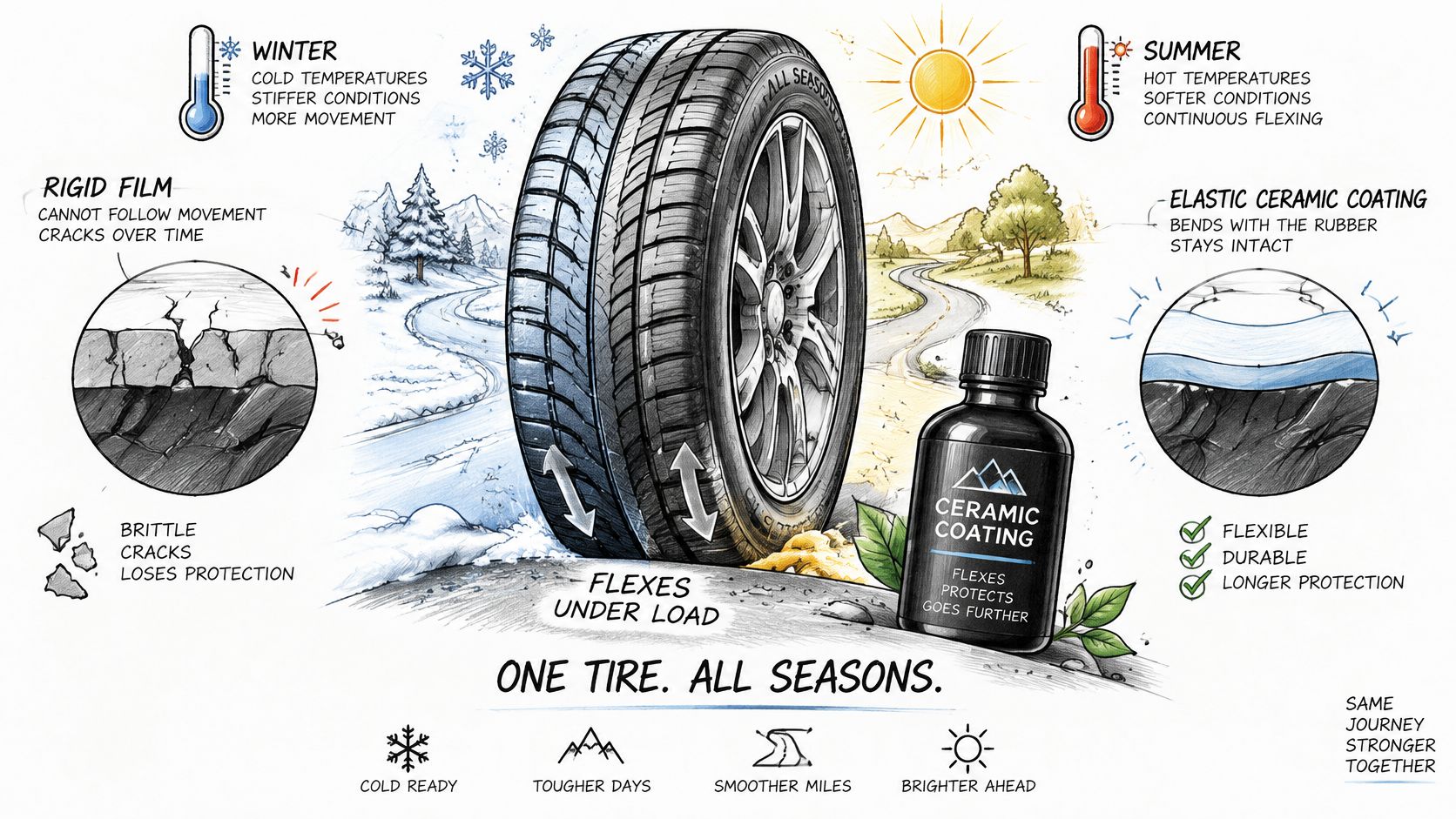
We developed elastomers for industrial and defense applications, then adapted them for automotive, aviation, and marine surfaces. On a sidewall the aim is a film that feels hard, like glass, and still flexes in use. Nanotube reinforcement can add strength without forcing the whole film to act like a brittle solid. A long single-walled carbon-nanotube elastomer composite survived 4,500 strain cycles before failure, in work from the American Chemical Society. Nanotube-reinforced styrene-butadiene rubber kept storage modulus largely stable at about 1.9 to 2.1 MPa from 0% to 10% loading, in a TechConnect brief.
Heat still punishes the rubber under the film. A study of natural rubber, styrene-butadiene rubber, and a 60/40 blend aged samples at 70 °C and 110 °C because those temperatures closely simulate tire service, and higher aging temperature harmed fatigue-crack-growth resistance in every material, according to Wiley. High-heat stability doesn't promise cold flexibility either. One polyurethane nanocomposite study measured glass-transition temperatures near −21 °C, including −21.4 °C for polyurethane with silica and carbon nanotubes, in a chapter from Springer.
Our claim that these elastomer coatings won't crack between frozen and hot conditions is a product claim, and it has to be checked against our own test data. For a DIY-friendly elastomer coat, Alpha Quartz 50ml Ceramic coatig is solvent-free, with 92% high solids, zero VOCs, and a 4 hour cure indoors or outdoors. How that flex is built is spelled out in our notes on coating flexibility.
Ceramic Coating vs Dressings and Protectants
Most tire-care bottles fall into four families, and they don't buy you the same months. A dressing is mostly shine. A protectant adds a shorter UV shield. A sealant bonds for a longer service stretch. An elastomer coating builds a film meant to outlast the wipe-on options, if prep and cure are real. We manufacture elastomer-based ceramic coatings for automotive surfaces, so the last row isn't a mystery category. It's a different product type with a different job.
| Option | Typical protection | Finish | Application effort | Best use |
|---|---|---|---|---|
| Elastomer ceramic coating | Product-specific, often months | Hard, glossy film | High, needs full prep and cure time | Long-term sidewall and rubber trim protection |
| Water-based tire dressing | Days to a few weeks | Wet or satin shine | Low, wipe on | Quick presentation before events |
| Silicone tire dressing | Days to about a week | Very glossy, may sling | Low | Show finish with little weathering benefit |
| UV protectant spray | Several weeks | Satin to matte | Low to moderate | Regular upkeep on dry rubber |
| Ceramic sealant spray | Up to 12 months on paint per label; tire use to confirm | Smooth, low residue | Moderate, spray and buff | Trim and wheels after a test patch |
Read the rows by the car you drive. A water-based dressing is the right call the night before a show, when you want a wet look and you'll wash it off soon. A silicone dressing looks even glossier and often slings onto paint the first hot drive, with little weathering benefit. A UV protectant spray fits a monthly habit on dry rubber that you don't want glossy.
ULTRA Ceramic Spray is a water-based flexible membrane sealant listed for paint systems, wraps, PPF, glass, wheels, and plastic trim, plus some household items. Tires are not named. The table's "up to 12 months" figure is a paint-label claim, so confirm it on the product page before you quote it, and confirm tire use with the label before any sidewall. For faded arches, a plastic trim restorer approach is a separate decision from the tire face.
Divide the bottle price by the months printed on that product's label, then add the prep time you'll spend each round. On a daily driver in sun or road salt, a sealant or coating with real prep usually beats a weekly dressing on cost.
How to Prepare and Apply a Tire Coating Step by Step
Prep is the bond. Skip it and the film peels in sheets that look like a failed dye job.
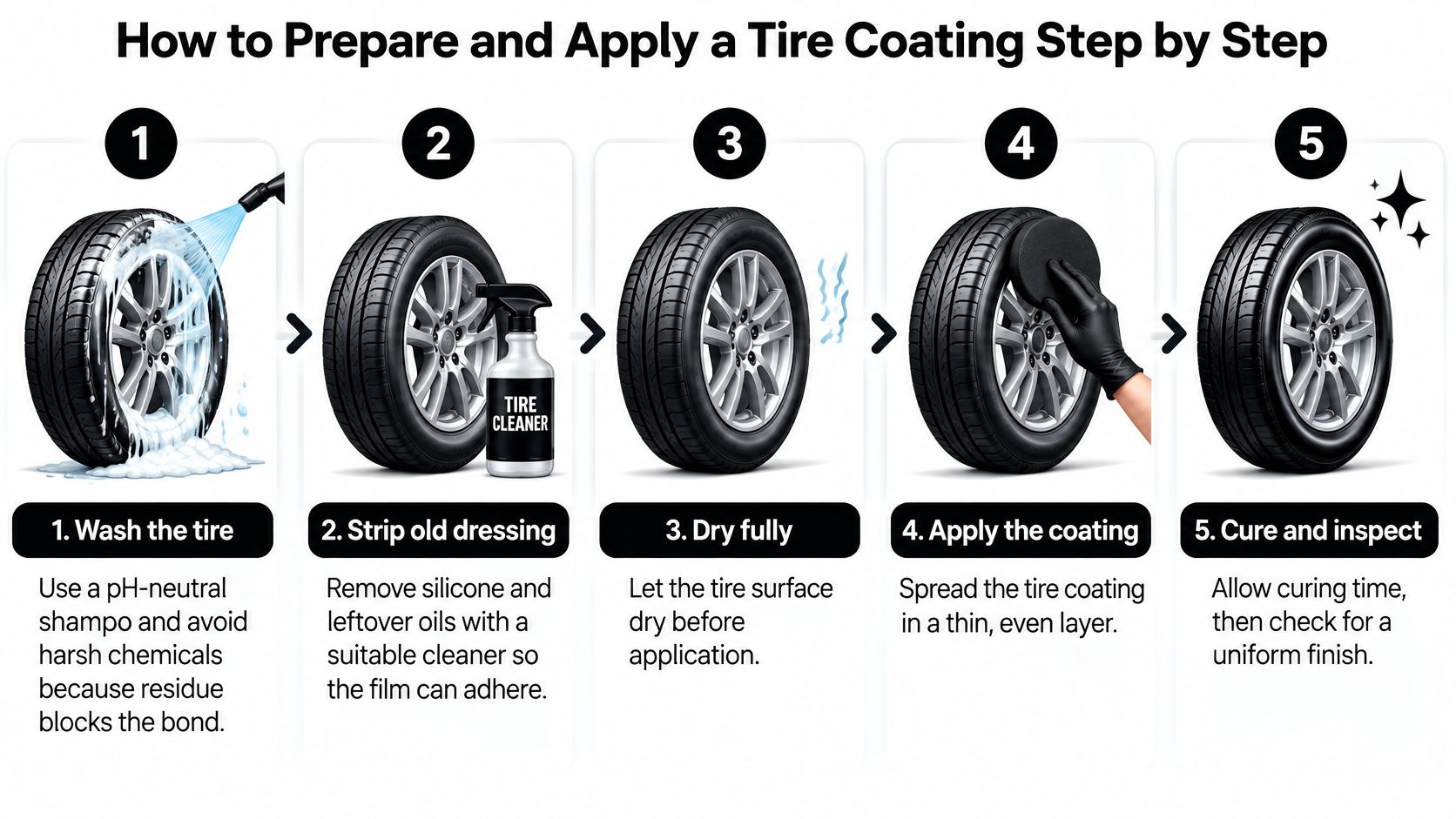
- Wash with a pH-neutral shampoo. Harsh chemicals and leftover soap film block the bond. Rinse until the runoff is clear, including the bead and the inner sidewall you'll use as a test patch.
- Strip old dressing or silicone. A dedicated cleaner has to cut petroleum and silicone oils. If the towel still comes away slick, you're not ready. Oils are the usual reason a new film hazes and lifts.
- Dry the tire completely. Trapped water under a coating becomes a pale map after cure. A blower or a clean towel into the lettering beats waiting and hoping.
- Tape the tread face, the shoulder edge, and the rim. The contact patch stays bare. Mask a finger's width past the shoulder so a run can't creep onto the road surface.
- Lay a thin, even film in one direction. Use an applicator, not a flooded tire. Drips pool in the lettering and cure as thick ridges you'll feel with a fingernail.
- Honor the dwell time on that bottle. Sitting time isn't optional decoration. Wiping early smears a half-set film. Wiping late makes you scrub a film that has already grabbed.
- Buff in two towels. A fresh short-pile microfiber levels the film. A long-pile microfiber lifts haze. Inspect under diffused light, not direct sun, or streaks hide until the next morning.
- Keep it dry for the cure window on the label. Some of our coatings take 12 to 24 hours for initial curing, and the vehicle shouldn't be washed for 7 days so the chemistry can finish bonding. Treat that window as provisional until it matches the bottle in your hand.
- Inspect after cure. The sidewall should be non-tacky, crack-free, and even when you flex it with your thumb. Tack means it isn't finished. A crack at the lettering means the film was too heavy or the rubber was still dressed.
A spray sealant, worked once
Ultra 4.0 is the spray example, and it is a single coat. You don't layer it. Spray it onto a new short-pile cloth, work it into the surface, then buff with long pile and check under diffused light. Stay out of weather for at least 6 hours. That wait is shorter than the multi-day cure on some of our other coatings, which is another reason the label, not a general rule, sets the clock. Use it where the label lists the surface. Wheels and plastic trim are named. Sidewall rubber is not, so a tire test waits on that confirmation.
The slip that ruins the job is coating over dressing residue. The film grabs the oil, not the rubber, then peels and hazes after the first hot drive. If you're unsure the tire is bare, strip it again. Surface prep details live in our guide to coating surface preparation.
Safety Limits Every Tire Coating Must Meet
A water-beading sidewall is not a safer tire. Braking, cornering, and wet grip come from the tread compound, the tread design, inflation, load, and the road. No sidewall film improves them by default. Gloss and hydrophobicity are appearance and contamination checks. They are not a stopping-distance test.
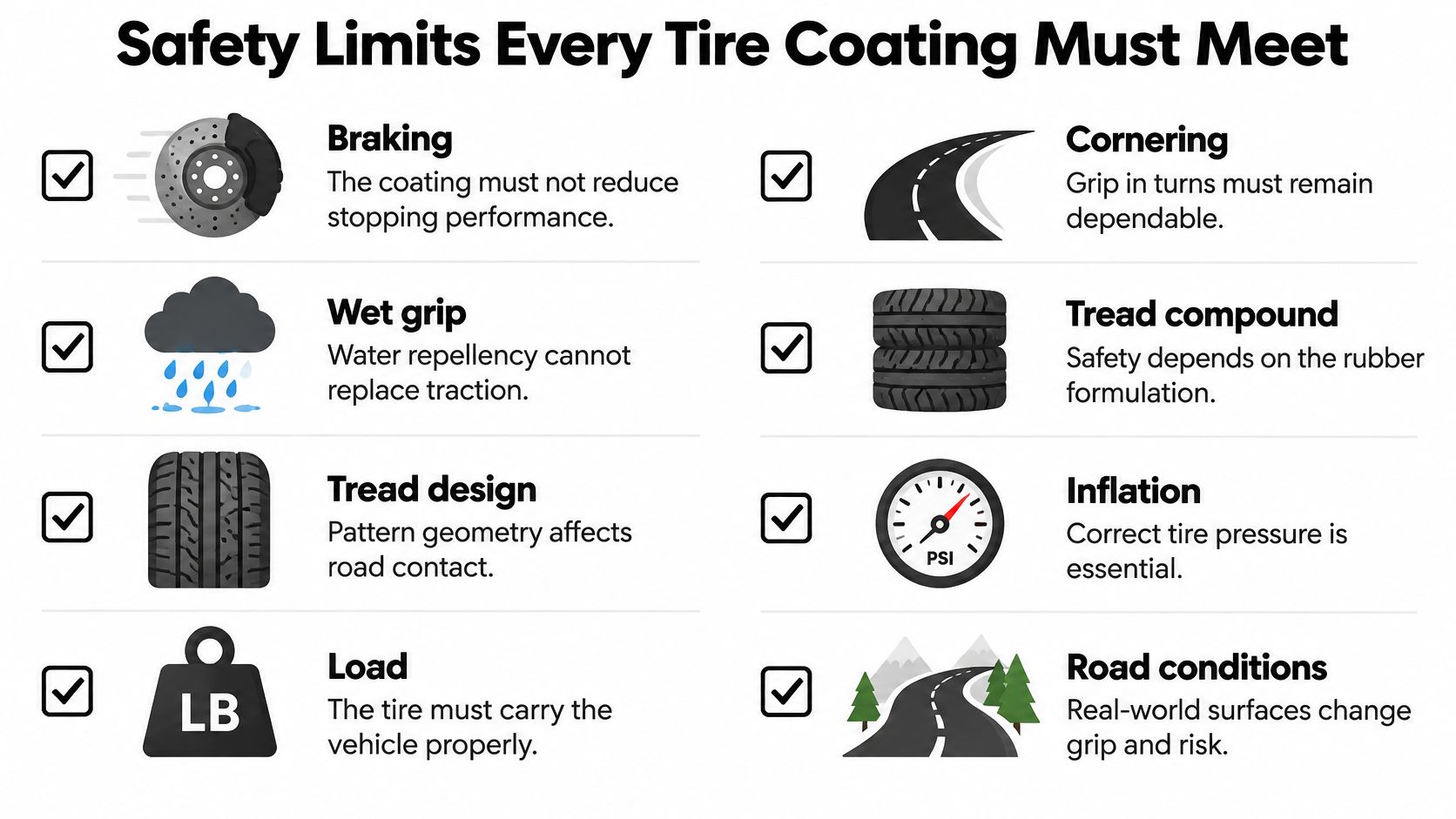
Overspray and migration are the primary risk. A film that creeps onto the contact patch changes surface friction in a place you can't see once the car is on the ground. Tire wear particles come from friction between tires and roads, and regulators are moving toward abrasion limits under the EU's Euro 7 framework, as noted in comments filed with the Basel Convention technical guidelines. A coating that alters tread friction isn't a cosmetic extra. It's a change to the part of the tire the rules are starting to measure.
What a fair test actually records
Don't blend everything into one durability score. Report each result on its own.
- Appearance after exposure: gloss or color retention, cracking, and chalking after accelerated UV and ozone.
- Staying power: adhesion and mass loss, then flexing and wash-cycle tests.
- Mechanical behavior: abrasion, flex fatigue, chemical resistance, and wet friction, each listed separately.
- Your own driveway check: an untreated and a treated sidewall after several weeks of driving, with notes on residue transfer, sling, surface tack, and whether the color held.
Wet grip claims need a controlled tire test under a defined water film, the kind of comparison set out in UN ECE Regulation No. 117 against a reference tire. A visual once-over in the bay doesn't qualify. We use third-party ISO and ASTM testing and real-world analysis in some of the harshest climates, and we're an ISO 9001 certified company. Ask for the reports on the exact product before you buy. Our chemical resistance test notes show the kind of separation that belongs in a spec sheet.
If the only proof on the label is a photo of a beading sidewall, you don't have a safety result yet.
Choose Your Tire Protection and Test a Small Area
You can settle this on the car you have, without coating a full set first.
Check the label, then patch the inner sidewall. Tire or rubber has to be named. Watch that patch through two weeks of driving, rain, and washing. Residue transfer, sling, tack, or a crack ends the test.
Leave the tread and the shoulder bare. Grip-safe tire care belongs there. Anything that changes friction stays off the contact edge, including overspray from a trim job beside the wheel.
Buy glass as its own product. The Apex Glass ceramic coating is for windshields and side windows. It's straightforward to use, and it's meant to improve visibility in rain so the drive is less stressful and you're less tied to the wipers. Durability is listed by glass area on that page, so read the area you're coating rather than borrowing a paint number.
Maintenance stays gentle. Wash with a pH-neutral shampoo, and skip harsh chemicals and abrasive cleaners. A warranty applies when a certified professional installs the coating, and that installer provides it based on the layering and the products used. If a coating degrades, a certified installer has to inspect the vehicle, tell you what they find, and restore the coating as needed. The full range is in our shop. If you want a spray sealant to trial, start on wheels and listed trim, not on the tread.
A tested coating on the right zones, washed gently, is the protection that gets through the seasons.
APEX NANO – Titan Coatings builds elastomer ceramic coatings for sidewalls, trim, and glass, with the flexibility a tire needs and a separate glass coat that keeps the windshield clearer in the rain. If you're ready to match a product to the zone you're protecting, visit APEX NANO – Titan Coatings and choose a coating you can test on a small patch first.
0 Comments