
A chemical spill rarely announces itself. A small leak reaches a seam, a splash dries on a flange, or road salt sits behind a bracket overnight. The steel may still look serviceable the next morning, but the coating has already started doing the work that determines whether the asset survives or fails.
That's why choosing a chemical resistant coating for steel isn't just a matter of picking the hardest finish on a product page. The coating must match the chemical exposure, the steel preparation, the required film thickness, the curing conditions, and the movement caused by impact or temperature change. A rigid film can resist scratches yet crack when the substrate expands. A flexible film can absorb movement but fail if it lacks adhesion or chemical stability.
The Hidden Cost of Steel Failure
A mobile detailer once brought in a steel service cart with what looked like a cosmetic problem. The upper surface had staining around a chemical bottle, and the owner expected a quick polish followed by a fresh protective layer. Once the loose coating was removed, the true issue appeared. Corrosion had traveled beneath the film from a small impact near the edge, turning a local defect into a much larger repair area.
That pattern appears across workshops, marine equipment, processing areas, tanks, pipelines, and structural steel. The first visible symptom may be bubbling, discoloration, flaking, or a rough edge. By then, the coating has stopped functioning as a continuous barrier, and the repair usually involves more than another coat. It may require abrasive cleaning, profile correction, replacement of damaged steel, downtime, and a new inspection cycle.
The commercial pressure behind better protection is clear. The chemical resistant coating market was estimated at USD 7.7 billion in 2025 and is projected to reach USD 11.0 billion by 2035, with an estimated CAGR of about 3.5% from 2026 to 2035, according to Grand View Research coverage of the chemical resistant coating market. These systems protect steel and other industrial substrates from acids, alkalis, solvents, hydrocarbons, and corrosive process fluids.
Failure starts at the weakest detail
A broad, flat steel panel is rarely the first place a coating fails. Edges, welds, bolt heads, corners, scratches, and poorly cleaned areas create the vulnerable points. Chemical exposure then exploits the smallest discontinuity.
For an owner, the cost is operational as much as material. A protected tank or piece of equipment can remain in service, while a failed asset may interrupt production, create a contamination concern, or force an emergency repair. A coating decision therefore affects service continuity, not just appearance.
Practical rule: Choose the coating system around the worst exposure the steel will experience, not the easiest part of the job.
Titan's corrosion resistant coating guidance is relevant to this decision because it frames protection as a system rather than a decorative finish. The same principle applies to automotive steel, where a detailer may focus on gloss but still need to account for salt, fuel, cleaners, stone impact, and repeated washing.
The right question isn't “Which coating is hardest?” It's “Which coating can keep its barrier intact after chemical contact, movement, impact, cleaning, and time?”
How Chemical Resistance Works
A steel coating succeeds only while it keeps the environment away from the metal. The barrier must slow water, oxygen, ions, solvents, and corrosive chemicals before they reach the substrate. That performance depends on the coating's chemistry, cure, adhesion, film continuity, and ability to tolerate movement without opening a path to the steel.
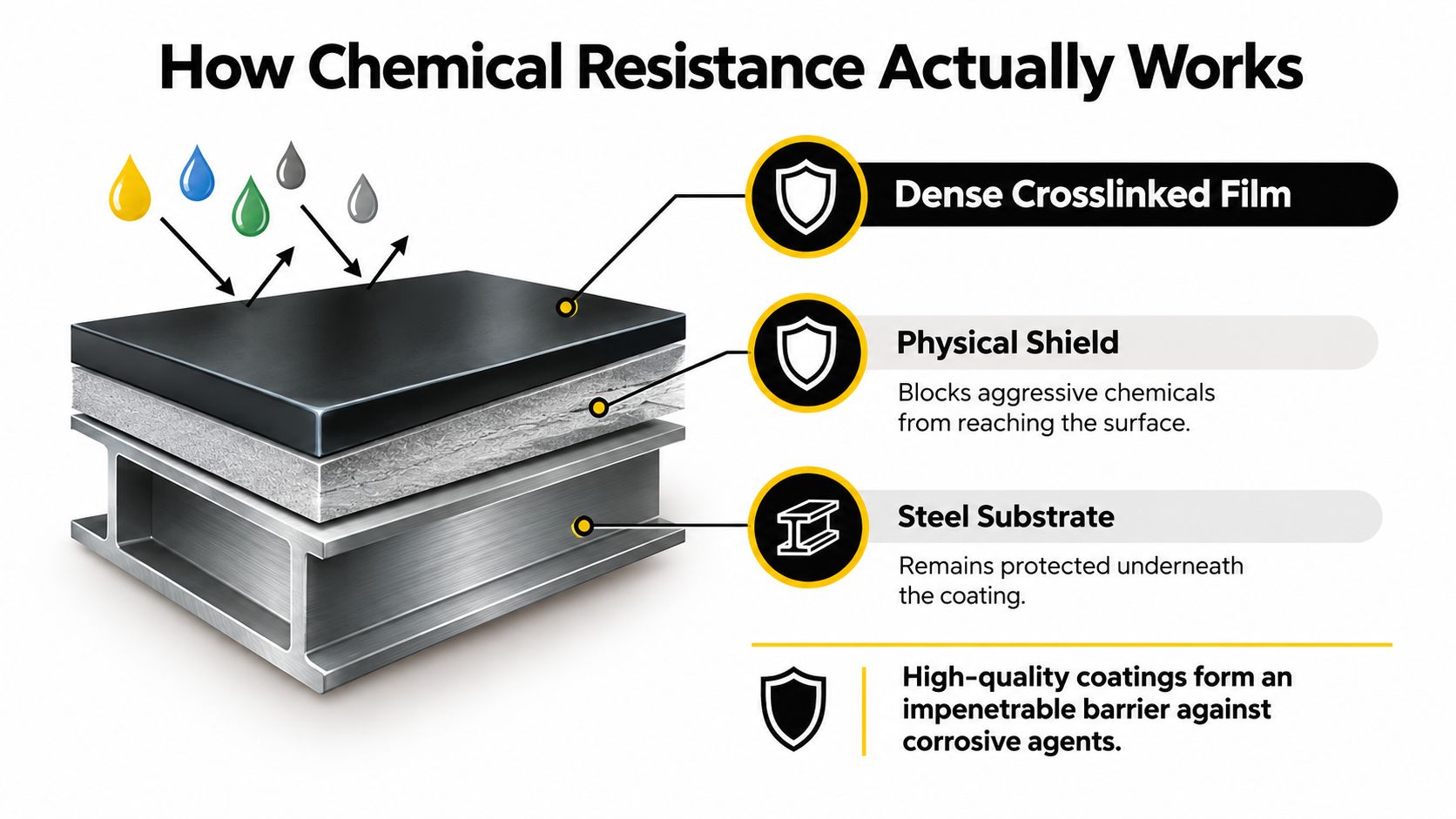
A dense, crosslinked film limits the routes that liquids and dissolved contaminants can use. A high-performance epoxy may combine modified bisphenol F and novolac epoxy resins with a cycloaliphatic amine cure. One technical data sheet describes a 100% solids, two-component system with a 2:1 mix ratio by volume. Because the formulation has limited solvent loss during cure, it can form a substantial barrier for exposure to fuels, oils, non-oxidizing acids, and process chemicals, as described in the technical data for the 100% solids epoxy system.
Thickness changes the diffusion path
Film thickness affects how far water, oxygen, and ions must travel before reaching steel. Guidance based on ISO 12944 indicates that a 200 to 240 μm dry-film system may suit polluted coastal or industrial atmospheres with a 5 to 10 year service-life target. For very high marine or industrial corrosivity and immersion exposure, the guidance identifies 280 to 320 μm, as outlined in this epoxy coating and ISO 12944 guidance.
More material does not automatically create a better coating. Excessive build can introduce curing, solvent-entrapment, or adhesion problems. Insufficient build leaves edges, welds, scratches, and other irregularities with less protection. A reliable application therefore needs a film-build plan, compatible primer or intermediate coats where specified, and dry-film-thickness checks.
Hardness also has a limit. A rigid film may resist chemicals well while the steel remains stable, yet crack when the substrate flexes, receives an impact, or cycles through temperature extremes. A flexible system may preserve the barrier through movement, but its resistance, adhesion, and wear performance still depend on the formulation and exposure. The practical target is a coating that balances chemical resistance with enough flexibility to survive service.
The same barrier principle appears on glass in a different form. Apex Glass Coating- 50ml is described as a hydrophobic glass and windshield coating with deep pore bonding and water-repellent performance. Its stated purpose is to improve visibility, reduce wiper use, and last up to 2 years. It is not a replacement for a steel corrosion system, but it shows how surface chemistry changes the way water contacts a substrate.
Resistance has a time limit
The label “chemical resistant” describes expected performance under defined conditions, not permanent immunity. Formulation changes can produce trade-offs, and a coating that performs well during short splash exposure may behave differently during prolonged immersion. The distinction matters for tanks, equipment, vehicle components, and any steel exposed to repeated contamination.
The interface beneath the film matters as much as the film itself. Poor cleaning, weak adhesion, incomplete cure, or a defect at the steel boundary can give chemicals a route beneath an otherwise sound surface. For automotive applications, guidance on corrosion resistance for bumpers reinforces the broader point that the substrate and exposure should determine the treatment.
A useful chemical resistance testing resource helps frame evaluation around the actual chemical, contact time, temperature, concentration, and mechanical conditions involved. Rain, salt, cleaners, fuel, and road contamination all challenge a surface, but steel and glass require different formulations and test methods. Select the system for the full exposure, then verify application thickness, cure, adhesion, and flexibility before relying on the barrier.
Comparing Coating Technologies for Steel
Traditional epoxy remains a practical reference for industrial steel. It bonds well, resists many chemicals, and can form a substantial barrier when the film is applied and cured correctly. Epoxy-phenolic and phenolic lining systems show why the contents of a tank or container must guide coating selection. Sherwin-Williams describes epoxy-phenolic linings for alkaline products in the pH range of 7.0 to 9.0, while phenolic linings are recommended for acidic packs in the pH range of 3.0 to 7.0, according to its steel container lining information.
Epoxy's widespread use reflects those practical strengths, not universal suitability. A system that performs well on a stable panel can fail on steel exposed to vibration, impact, thermal cycling, or repeated flexing.
Rigid systems versus flexible systems
Hardness helps a coating resist scratching, abrasion, and chemical attack. It also creates a failure risk when the steel moves. Temperature changes make steel expand and contract, while handling and impact introduce short, concentrated loads. A rigid film may bridge a small defect at first, then crack or detach when stress accumulates at that point.
That trade-off is easy to miss in a product comparison. Maximum hardness does not automatically produce the longest service life. The coating must retain adhesion and continuity while the substrate changes beneath it.
Elastomer technology addresses that weakness by combining a glass-like hard surface with flexibility that can accommodate movement. Titan describes its elastomer coatings as using nanotube technology and Dark Matter technology. Broad claims about being the first company to use a particular approach require independent support, so the field result matters more than the origin story. Check whether the applied film stays attached and continuous after impact, thermal movement, and chemical exposure. Titan's advanced coating technology information provides one manufacturer example of this flexible-protection approach.
| Technology | Main strength | Main risk |
|---|---|---|
| Two-component epoxy | Strong adhesion and broad chemical resistance | Can be vulnerable to movement, poor cure, or impact damage |
| Epoxy-phenolic lining | Chemistry-specific protection in containers and tanks | Must be matched to the product and service conditions |
| Elastomeric coating | Flexibility alongside a hard protective surface | Performance still depends on preparation, thickness, and cure |
| Hybrid or conductive systems | May improve interfacial or electrochemical behavior | Added ingredients do not automatically improve barrier life |
Research into hybrid systems includes graphene-modified mica, conductive nickel particles, and responsive inhibitor release. MOF-based epoxy systems have also been examined for higher polarization resistance in hydrochloric acid. These findings indicate a promising development direction, not proof that every hybrid formulation will outperform a conventional coating in service. Laboratory performance still has to be weighed against application control, repairability, substrate movement, and long-term exposure.
A useful way to compare advanced systems is similar to a small business ad tools comparison. Define the exposure and failure tolerance first, then compare evidence, limitations, application demands, and maintenance requirements. The most impressive label is rarely enough.
For a car owner or mobile detailer, Alpha Quartz 50ml Ceramic Coating is described as an elastomer ceramic coating for all surfaces, with protection against UV, chemicals, and abrasion. The practical test is not hardness alone. It is whether the film preserves its protective continuity when the steel or coated surface experiences movement, temperature extremes, and mechanical impact.
Surface Preparation Essentials
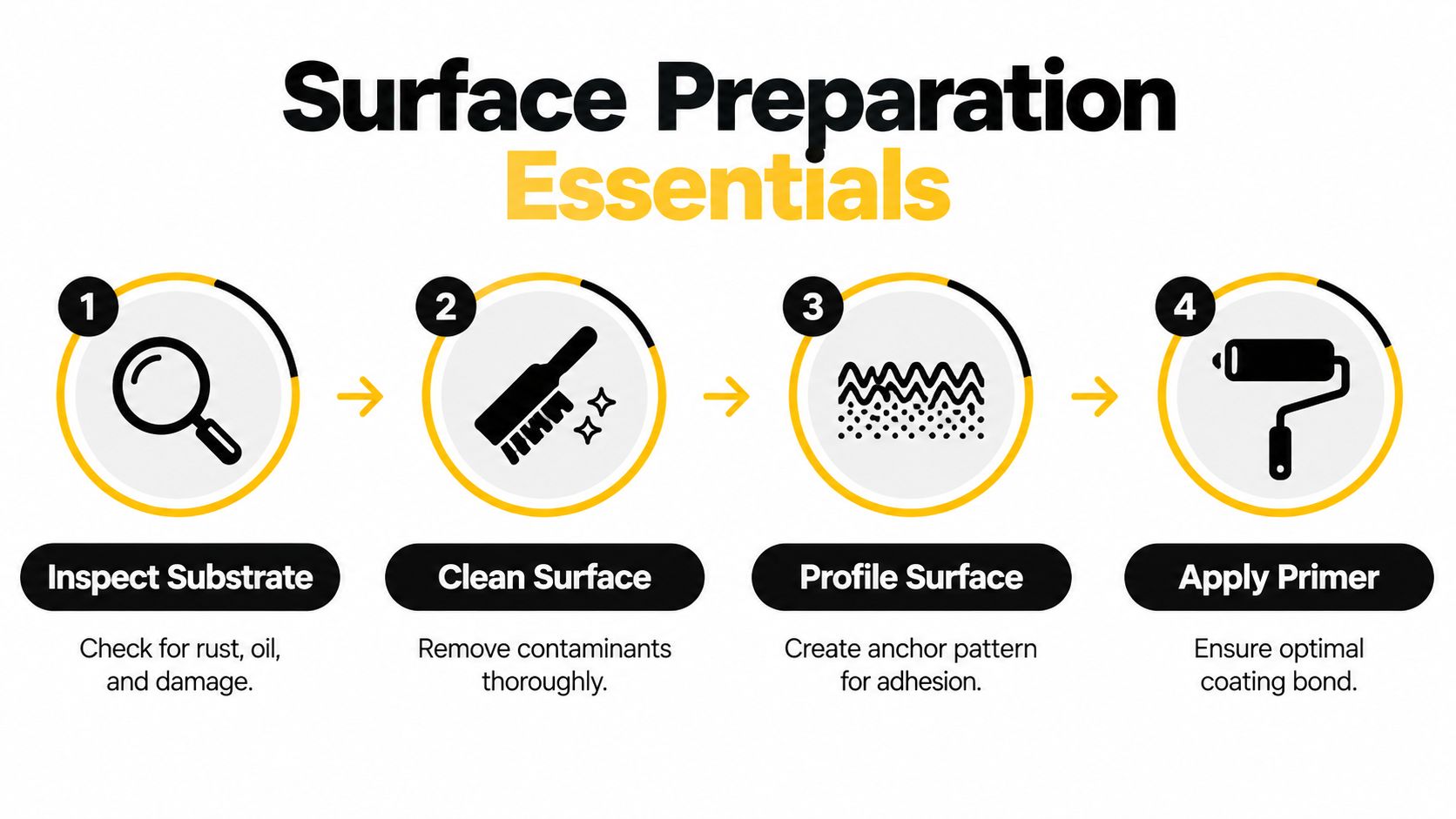
A coating can't compensate for oil, loose rust, embedded contamination, or a weak substrate. The surface has to provide a stable foundation before the first mixed component reaches the steel.
Inspect before cleaning
Look closely at welds, edges, seams, fasteners, drain points, and areas where chemicals collect. Check for rust scale, old delamination, oil, silicone, adhesive residue, impact damage, and moisture. If the steel has already lost section or the old coating is lifting, mark those areas for repair rather than burying them under a new layer.
A simple inspection should answer three questions:
- What is the substrate? Bare steel, aged coating, galvanized material, and previously repaired areas may need different preparation.
- What caused the failure? Chemical exposure, trapped moisture, impact, poor adhesion, or inadequate film build can require different corrections.
- What will the coating face? List chemicals, temperature changes, abrasion, immersion, cleaning agents, and expected handling.
Remove contamination completely
Use a cleaning method appropriate to the contamination. Degreasing may be necessary before mechanical abrasion, because sanding oil into the surface can make adhesion worse. High-pressure cleaning and power-tool cleaning have produced strong substrate results in field work involving epoxy on heavy equipment, but the correct method depends on the coating condition and the steel profile required.
For small automotive metal parts, residue from labels or trim products can be just as troublesome as industrial oil. A practical sticker residue removal guide can help explain why adhesive contamination needs to be removed before a new protective layer is considered.
Create the anchor profile
A coating needs more than a visually clean surface. It needs a controlled texture that gives the film mechanical purchase. Abrasive blasting, power-tool cleaning, or another approved method should create the profile specified by the coating manufacturer. Remove dust afterward, because loose abrasive particles can become weak inclusions beneath the film.
Prime and verify
Primer selection should follow the coating system, not personal preference. Apply it within the stated recoat window and verify that the surface is dry and free of condensation. Titan's coating surface preparation resource provides a useful reference for treating preparation as a defined process rather than a quick wipe-down.
For detailing applications, ULTRA Ceramic Spray is described as Ultra 4.0, a concentrated, water-based flexible membrane sealant for paint systems, wraps, PPF, glass, wheels, plastic trim, household items, and personal items. Its listed application range reinforces a broader point: even an easy-to-use product still needs a clean, compatible surface.
The Advantage of Advanced Elastomers
The most damaging assumption in coating work is that hardness alone equals durability. I've seen hard finishes resist a fingernail while failing at a bend, an edge, or an impact point. The surface looked protected until the substrate moved.
Titan's elastomer approach is built around the opposite balance. The stated concept combines a surface that is hard like glass with flexibility that allows the coating to move with the substrate. Titan also associates this technology with nanotubes and Dark Matter technology. Those descriptions should be evaluated through product documentation and testing, but the engineering logic is sound: a coating that can accommodate movement has a better chance of staying continuous than one that fractures under stress.
Why flexibility matters
Steel expands and contracts as temperatures change. Automotive panels also flex under vibration, impact, washing, and road use. A coating that cannot tolerate that movement may develop microcracks that are too small to notice but large enough to admit moisture and chemicals.
An elastomeric layer is intended to stretch and recover rather than splitting immediately. That matters when a coated surface moves from frozen conditions to intense heat, or when a small impact transfers force into the film. Flexibility doesn't make preparation optional, and it doesn't guarantee unlimited chemical resistance. It addresses one failure mode, substrate movement, which rigid systems may handle poorly.
Hardness still has a job
A flexible coating that remains soft or easily marked won't provide a practical finish for equipment or vehicles. The useful target is a balanced film with surface hardness, adhesion, chemical resistance, and elasticity. That balance can reduce the trade-off between a coating that looks durable in a showroom and one that survives handling in the field.
Titan's elastomer coating information presents this type of protection for users who need an application that can handle changing conditions. Alpha Quartz is positioned for DIY users and mobile detailers because it's described as easy to apply indoors or outdoors, while its elastomer design is intended to remain flexible when exposed to temperature changes or impacts such as insects striking a vehicle surface.
The sensible test is not whether a product uses advanced language. Check how it bonds, how it cures, what chemicals it has been tested against, how thick it should be applied, and what happens when the surface is scratched or flexed.
Maintenance Strategies for Longevity
A chemical resistant coating for steel needs maintenance because exposure continues after application. Dirt holds moisture against the surface. Salt concentrates around seams. Process residue sits in corners. Repeated cleaning can also degrade a film if the chemical is incompatible or the operator uses excessive abrasion.
The first maintenance task is visual inspection. Walk the asset under consistent lighting and examine edges, welds, fasteners, drains, impact zones, and areas below containers or hoses. Look for:
- Blistering: Raised areas can indicate moisture, trapped contamination, or loss of adhesion.
- Cracking: Fine lines may reveal movement, excessive film stress, or impact damage.
- Chalking or dulling: Surface change can indicate weathering or chemical attack.
- Discoloration: Staining may show that a chemical has contacted the film or penetrated a defect.
- Exposed steel: Any visible substrate deserves prompt attention, especially where water or chemicals remain present.
Clean without attacking the film
Use a cleaning agent compatible with the coating chemistry. Don't assume that a product safe for glass, paint, or plastic is automatically safe for an industrial epoxy or elastomer. Test an unfamiliar cleaner on a small, inconspicuous area, follow the coating manufacturer's dilution guidance, and avoid leaving concentrated chemicals on the surface longer than necessary.
Rinse away salts and process residue rather than allowing them to dry repeatedly. A soft tool is usually preferable to aggressive scraping when the aim is to preserve the barrier. If contamination has bonded strongly, identify the contaminant before increasing chemical strength or mechanical force.
Repair small damage early
A chip or scratch is easier to control before corrosion develops beneath the surrounding film. Clean the damaged area, remove unstable coating, prepare the exposed steel, and use a compatible repair material. Feathering the edge helps prevent a sharp transition that can lift during later cleaning or impact.
Do not merely apply a spot coat over rust, oil, or a loose edge. That creates the appearance of repair without restoring the bond. For larger assets, keep a record of inspection points, cleaning products, repairs, and film-thickness checks. That history helps identify whether failures are caused by chemistry, impact, preparation, or application.
Treat visibility as part of surface protection
Automotive and marine users often maintain several surfaces with different requirements. Steel components may need a chemical-resistant barrier, while glass needs water management and optical clarity. The Apex Glass Coating product discussed earlier is designed for hydrophobic glass and windshield performance, so its maintenance should follow glass-coating care rather than industrial-steel procedures.
A clean windshield can reduce visual distraction during rain, particularly when water is moving across the glass at speed. Apply the coating only after careful glass cleaning and decontamination, then use compatible maintenance products so the water-repellent layer isn't stripped prematurely. The product's stated benefit is improved visibility and reduced wiper use, but safe driving still depends on working wipers, clear glass, and appropriate speed.
Independent qualification gives maintenance teams a stronger basis for decisions than marketing language. Common tests include adhesion, corrosion resistance, thermal stability, durability, and chemical compatibility, as summarized by Element's surface and coatings testing guidance. Fraunhofer IFAM lists methods including DIN EN ISO 9227 salt spray, DIN EN ISO 6270-2 condensation-water climate, DIN EN ISO 2812 liquid resistance, DIN EN ISO 4624 peel adhesion, and DIN EN ISO 12944-6 laboratory performance testing in its corrosion test overview.
For internal carbon-steel process vessels, ISO 18796-1 defines minimum technical requirements for coating or lining protection in aggressive environments exposed to marked pressure and temperature changes. That makes temperature cycling part of the specification conversation, not an afterthought, as shown in the ISO 18796-1 document.
APEX NANO – Titan Coatings offers coating options for automotive, marine, aviation, and other demanding surfaces, including flexible protection designed to balance hardness with movement. Visit APEX NANO – Titan Coatings to review the product range, application information, and coating approach before choosing a system for your steel, glass, or detailing work.
0 Comments