
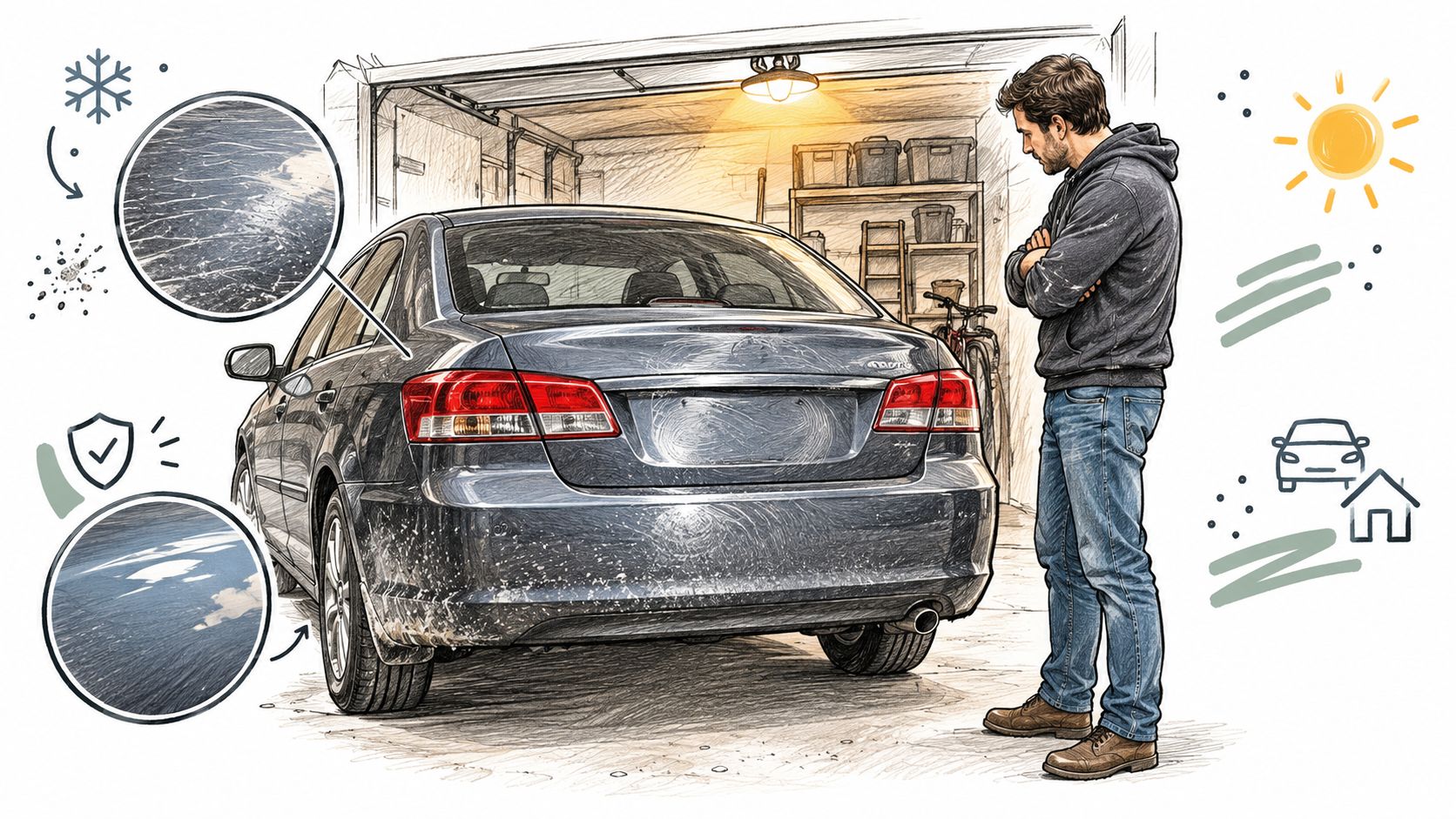
The sedan rolled into my bay after a winter of salt, ice, and road grime, then months of hot sun. Its owner expected cracking across the hood, but the finish showed only light marring that faded after a warm microfiber pass.
That moment changed how I explained resin regeneration to detailers. A coating that merely resists stress can still fail when the panel expands, contracts, flexes, and takes repeated impacts. An Elastomer coating takes a different approach. Its flexible network can reorganize after minor stress, helping the film remain hard like glass while retaining the flexibility that keeps it from cracking.
The Day a Coating Refused to Crack
The owner had already prepared himself for bad news. He expected the hood to show the familiar signs of a difficult season, fine lines around the edges, dull patches where salt had dried, and micro-cracks where freezing mornings had met warm afternoon sun. Instead, the surface looked tired but intact.
I washed the panel, dried it carefully, and worked a warm microfiber across the light marring. The haze softened. The hood didn't need aggressive polishing, and there was no network of fractures catching the inspection light. The coating had taken punishment, then recovered enough to preserve the barrier and the gloss.
Shop-floor lesson: A finish that survives stress isn't necessarily a finish that stays rigid. Sometimes durability comes from controlled movement.
That distinction gives the resin regeneration process its meaning in coatings. In industrial ion exchange, regeneration restores a resin after its active sites have loaded with unwanted ions. The process relies on reversible exchange, so the resin can return to a usable form rather than being discarded after one service cycle. This history reaches back to early water-softening systems around 1910, synthetic organic ion exchange resins emerged in 1935, and copolymerization-based resin synthesis advanced the field by the 1940s. DuPont's ion exchange fundamentals explains the background behind that reversible model.
Automotive coatings borrow the same restore-and-reuse logic in a different physical setting. A regenerative coating doesn't replace missing paint, erase a deep gouge, or reverse every chemical etch. Instead, it uses a polymer network designed to absorb minor abrasion and thermal movement, then reorganize when conditions allow.
That matters to a detailer because a vehicle isn't a static panel. The hood flexes, the clearcoat expands, bugs strike the nose, brushes introduce fine marks, and winter temperatures pull the substrate in one direction while sunlight pushes it in another. A rigid film may look impressive during application and still become vulnerable when the body beneath it moves.
Titan Coatings positions its Elastomer technology around that challenge, using nano tubes technology and Dark Matter tech in its coating platform. Its stated approach is to keep the film hard like glass while preserving flexibility, so temperature changes from frozen conditions to hot panels are less likely to turn ordinary movement into cracking. The sedan in my bay made that principle tangible. The coating hadn't escaped stress. It had managed stress and remained functional.
What the Resin Regeneration Process Actually Means
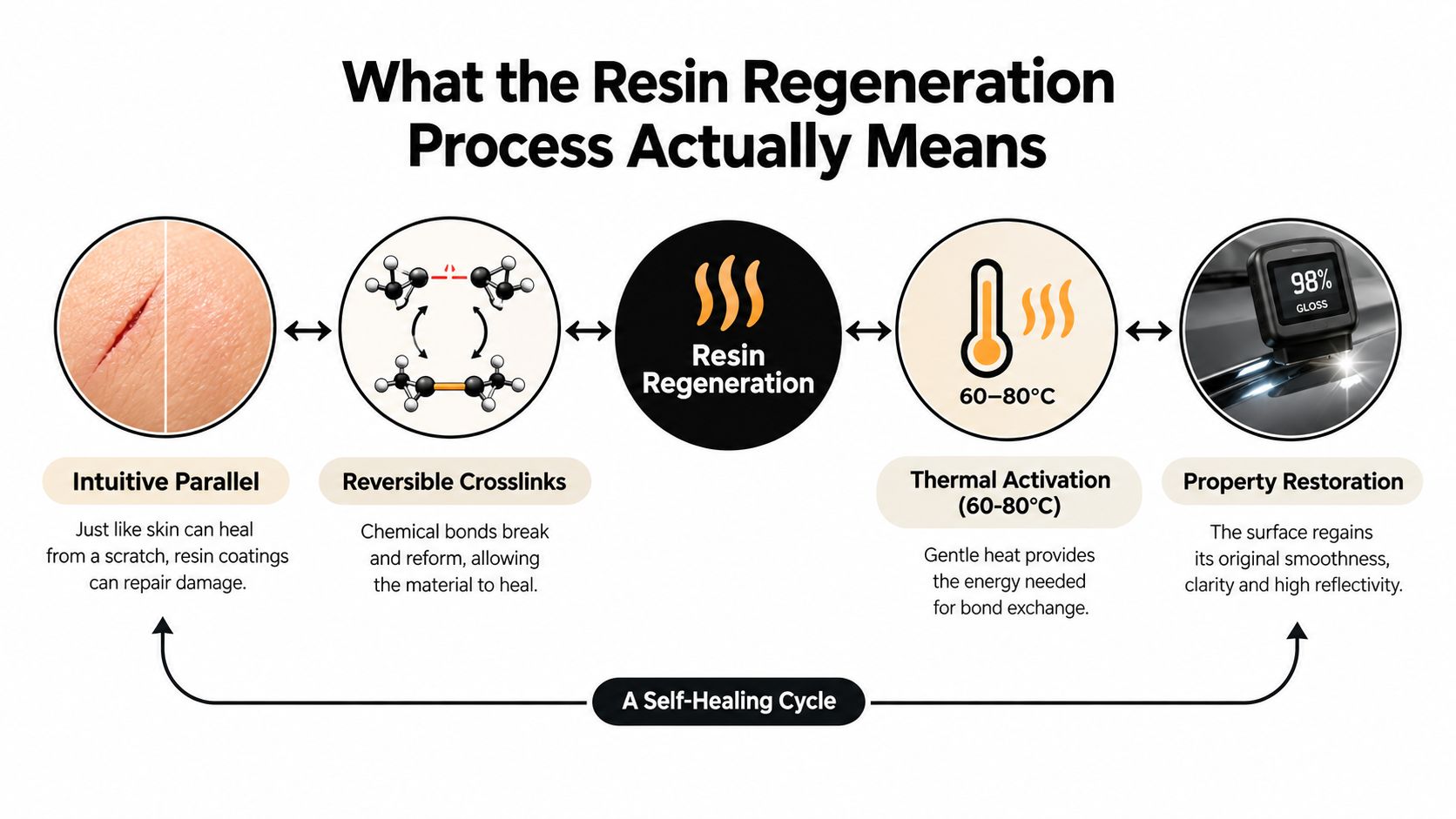
Start with an idea every detailer understands. A minor mark can become less visible when a material softens, flows, and settles back into a smoother surface. That isn't the same as adding new material. The existing film changes its arrangement.
A regenerative resin uses connections between polymer chains that behave more like reversible fasteners than permanent welds. Under stress, some links can loosen or exchange partners. When heat or another suitable stimulus gives the chains enough mobility, those links form again in a more stable arrangement.
Chemists may describe these mechanisms through dynamic covalent chemistry or supramolecular interactions. You don't need to memorize the terms to understand the shop result. Dynamic bonds can break and reform, while supramolecular forces allow polymer segments to associate and separate without destroying the entire network.
The coating remains a continuous film, but its internal structure isn't frozen in place. That is where Elastomer resin behavior differs from a purely brittle glass-like layer. The network can distribute movement across the panel rather than concentrating every expansion or impact into one fracture point.
What regeneration can and can't repair
A useful way to think about the resin regeneration process is to separate surface recovery from material replacement.
- Light marring: Fine marks may become less visible when the upper network reflows and re-entangles.
- Thermal stress: Flexible segments can accommodate expansion and contraction instead of forcing the film to split.
- Surface properties: Smoother molecular arrangement can help restore gloss and water behavior after minor disruption.
- Deep damage: A cut through the coating, paint, or substrate still removes material and won't be recreated by bond exchange.
The distinction becomes important when choosing a product. Alpha Quartz 50ml Ceramic coatig is described as an Elastomer ceramic coating for all surfaces, with 92% high solids, zero VOCs, a solvent-free formulation, and Advanced Adhesion Technology. The catalog also states that it cures in 4 hours and is designed to resist UV, chemicals, and abrasion.
For readers who want a broader look at resin materials in demanding work environments, Labs USA phenolic resin offers useful context on how resin systems are selected for surface performance. Automotive Elastomers aren't identical to laboratory work-surface materials, but the comparison reinforces a practical point. Resin chemistry determines how a surface balances hardness, movement, chemical exposure, and recovery.
Titan's Elastomer coating technology applies that balance to vehicle protection. The film still needs correct preparation, even coverage, appropriate curing conditions, and sensible maintenance. Regeneration is a property of the network, not permission to skip decontamination or apply over unstable paint.
Inside the Regeneration Cycle for Coatings
In a water-treatment vessel, regeneration follows a controlled sequence. Backwash loosens the bed and removes suspended solids. Chemical injection displaces the loaded ions. A slow rinse gives the regenerant time to move through the resin structure, and a fast rinse clears the remaining chemical before service resumes. A practical industrial benchmark uses about 10% sodium chloride, with service runs commonly lasting 12 to 48 hours. The full cycle often takes less than 2 hours, uses about 7 times the resin volume in water, and restores roughly 60% to 80% of total capacity, as described in ResinTech's ion exchange guide.
An automotive coating has no resin bed to backwash, but the logic of staged recovery still helps explain what happens.
Four stages of molecular recovery
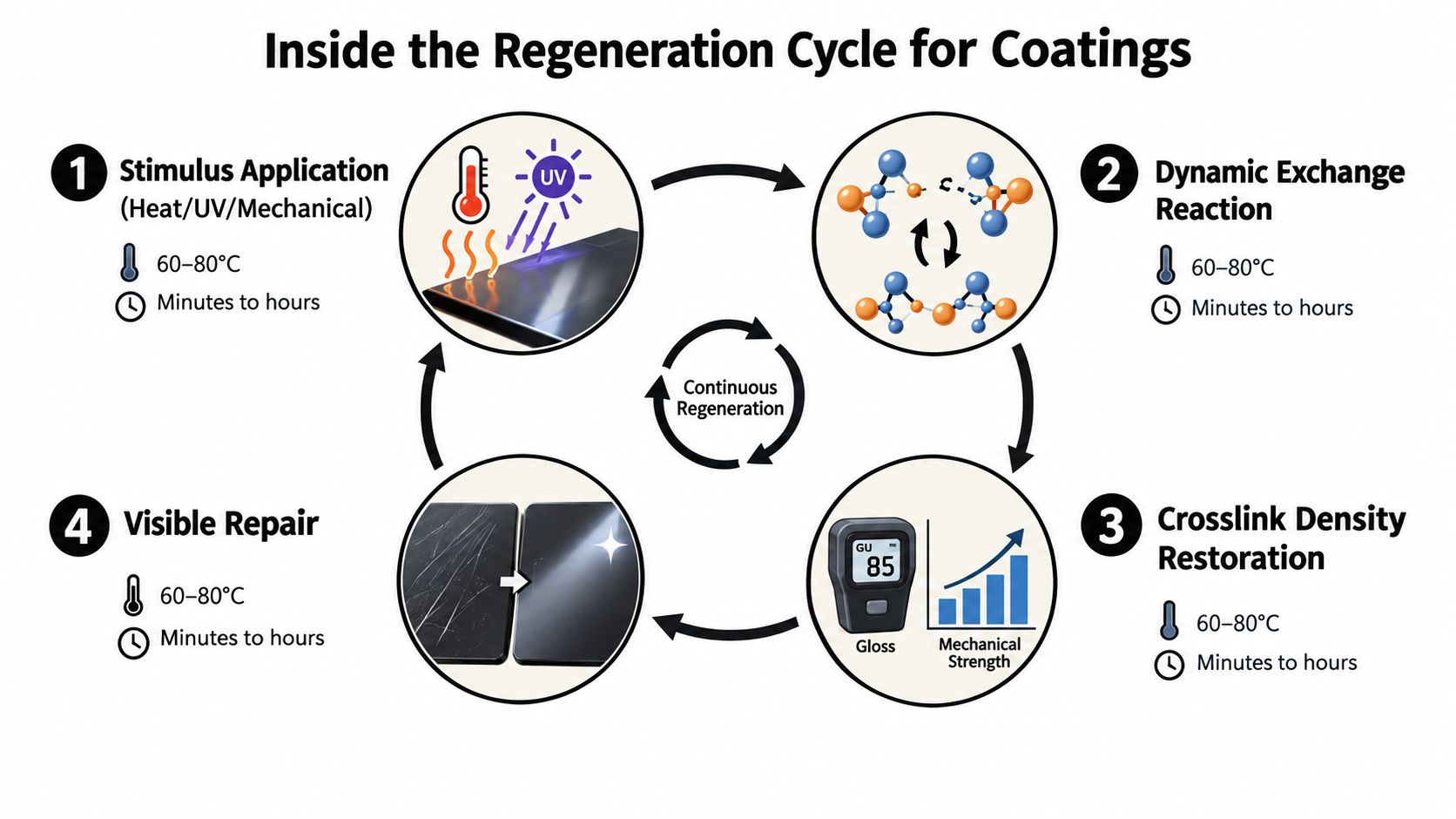
Activation begins when heat, UV exposure, or mechanical flex gives the polymer segments enough energy to move. A sun-warmed panel may provide the trigger, while a controlled warm environment can make recovery more consistent.
Dynamic exchange follows. Reversible links loosen and reform, allowing stressed sections of the film to redistribute tension. The network doesn't become liquid, and it shouldn't. The goal is controlled mobility.
Property recovery occurs as the polymer chains settle into a more balanced arrangement. Crosslink distribution, surface energy, and local smoothness can improve after the stress event, which can make fine marring less visible and restore some water-shedding behavior.
Stabilization leaves the panel with a coherent protective film again. The coating must still face the next wash, impact, contaminant, or temperature cycle, but it isn't just waiting for the next crack to spread.
A strong-base anion resin in industrial treatment may use about 4% sodium hydroxide, while weak resins can operate close to stoichiometric efficiency, according to the Water Technologies Handbook. The coating comparison isn't chemical equivalence. It illustrates why concentration, contact time, temperature, and flow control matter in regeneration systems. In an Elastomer film, the corresponding variables are stimulus intensity, exposure, chain mobility, and network design.
Practical rule: Recovery should be controlled, not forced. More heat or more product doesn't automatically create a stronger regenerated film.
During an abrasive wash, minor surface disruption can give the network a reason to reorganize. During freeze-thaw movement, flexible segments help distribute strain before the coating reaches a fracture point. After a warm period, the same network may settle into a smoother state. Product evaluation should therefore include more than a gloss check. Titan's coating testing resources are relevant because testing connects appearance with adhesion, flexibility, chemical resistance, and repeated environmental stress.
ULTRA Ceramic Spray illustrates the maintenance side of this idea. Ultra 4.0 is described as a highly concentrated, water-based flexible membrane sealant for paint systems, wraps, PPF, glass, wheels, plastic trim, household items, and personal items. It belongs in the conversation as a flexible surface-maintenance product, not as a substitute for repairing deep damage.
Why Elastomer Resin Outlasts Brittle Ceramic
A traditional ceramic coating can deliver a hard, glossy surface, but hardness alone doesn't explain how it will behave on a moving substrate. A glass-like SiO2 or SiC network has limited chain mobility. When the panel expands in heat or contracts in cold, the coating may have fewer ways to distribute that movement.
An Elastomer regenerative resin starts from a different failure model. Flexible spacers and mobile segments let the film absorb some strain, while reversible bonds can reorganize after minor disruption. The result isn't softness in the ordinary sense. It is a coating that aims to combine a glass-like feel with the flexibility needed for real panels.
The common 9H pencil hardness conversation can also distract from what owners experience. A hardness rating addresses a specific test condition. It doesn't, by itself, explain resistance to thermal movement, impact, substrate flex, chemical exposure, or the ability to reduce the visibility of minor marks after activation.
The comparison that matters in the bay
| Property | Brittle Ceramic (SiO2/SiC) | Elastomer Regenerative Resin |
|---|---|---|
| Surface feel | Hard, glass-like finish | Hard, glass-like finish with flexible behavior |
| Panel movement | Limited chain mobility can concentrate stress | Flexible segments can distribute stress |
| Thermal cycling | Expansion and contraction may promote micro-cracking | Network movement can reduce crack formation |
| Minor marring | Usually remains until corrected mechanically | May become less visible after suitable activation |
| Deep cuts | Requires physical repair or refinishing | Requires physical repair or refinishing |
| Long-term evaluation | Hardness and gloss are important, but incomplete | Flexibility, adhesion, gloss, and recovery all matter |
Consider a panel moving from -20°C to +60°C. Those conditions appear in the requested comparison because they represent the kind of severe swing that exposes differences in film behavior. A brittle network has less room to accommodate the change. An Elastomer network is designed to move with the substrate and use reversible connections when conditions allow the chains to re-engage.
This doesn't make every Elastomer coating immune to failure. Poor preparation, excessive film thickness, contamination, sharp impacts, and deep scratches can still defeat the system. It does mean that the coating's durability conversation includes crack resistance and recovery, not just initial hardness.
The difference is easy to miss during a showroom inspection. Both films may look glossy on day one. After repeated movement, the more useful question becomes whether the coating keeps its barrier and appearance without turning small stress marks into permanent cracks. Titan's discussion of coating flexibility is useful for detailers who want to judge that property directly rather than treating hardness as the entire durability story.
Where Regeneration Shows Up in Real Driving
A bug strike is a small impact followed by a chemical problem. Proteins and sugars dry onto the front bumper, then heat from the sun bakes the residue into the surface. On a rigid film, removal can become a scrubbing exercise. On a flexible regenerative layer, heat can increase chain mobility and help the upper surface reorganize after careful cleaning.
That doesn't mean a bug deposit disappears without washing. It means the coating can remain smoother and less vulnerable to permanent disruption when the contaminant is removed correctly. The detailer still pre-rinses, uses an appropriate wash solution, and avoids grinding dried residue into the film.
Three scenes from an ordinary week
The winter morning. A car leaves a warm garage and meets freezing air. The panel contracts, the coating follows, and the network carries the strain through flexible segments. As the surface warms later, reversible bonds can settle into a more stable arrangement.
The tunnel wash. Brushes and trapped grit introduce repeated fine abrasion. Each pass may be too small to justify polishing, but the marks accumulate. A regenerative film can reduce the visual persistence of minor marring when warmth and time provide conditions for reorganization.
The bird deposit. Acids and organic material sit on the clear surface until the owner notices them. The coating's barrier buys protection, but it doesn't cancel dwell time. Prompt removal prevents a small contamination event from becoming deep etching that no resin network can reassemble.
This is why I tell mobile detailers to read the surface after cleaning, not only before it. If light haze diminishes after the panel warms, the film may be using its recovery behavior. If the same dull patch remains through cleaning and warmth, the issue may involve contamination, etching, oxidation, or permanent coating damage.
Visibility creates another practical use case. Apex Glass Coating- 50ml is described as an advanced hydrophobic glass and windshield coating with deep pore bonding and water-repellent performance. The catalog states that it enhances visibility, reduces wiper use, and lasts up to 2 years. For a driver, the benefit isn't abstract chemistry. It's a cleaner view when rain spreads across the windshield and the glass needs less frantic wiper work.
Apex Glass also shows why product choice should follow the surface. Windshield glass needs optical clarity, strong water behavior, and careful preparation. Painted panels, wraps, PPF, wheels, and trim each move and weather differently. The same restore-and-reuse idea may guide the formulation, but application technique still determines whether the film bonds evenly.
The Limits of Regeneration Every Detailer Should Know
The sedan's clean hood wasn't proof of unlimited self-healing. It was evidence that the coating had recovered from stress within its design range. Regenerative bonds can reform, but repeated disruption can reduce the network's available mobility and effective crosslink structure over time.
A detailer sees the limit when a customer asks for “more coating” after a deep swirl pattern appears. Adding material doesn't level a gouge that has cut through the existing film. It also doesn't reverse acidic etching that has remained on the panel long enough to alter the surface beneath it.
Damage that exceeds the network
- Heavy wash marks: Aggressive brushes and poor lubrication can create defects too deep for surface reflow.
- Chemical etching: Dried mineral deposits, acidic contamination, and neglected bird residue can change the substrate itself.
- Physical gouges: A sharp object removes material. Bond exchange can't reconstruct paint that isn't there.
- Cold-soaked damage: A stiff, cold panel may not provide enough mobility for immediate recovery.
- Contaminated surfaces: Dirt trapped under a maintenance layer prevents uniform contact and can hide the true condition.
Activation also deserves realistic treatment. Many Elastomer systems need a warm panel or another suitable stimulus before chains can move efficiently. Sunlight may help, but a cold garage can preserve the appearance of a mark until the surface warms. That delay isn't necessarily failure, but it does mean a quick inspection in winter can mislead both owner and installer.
Watch for a pattern rather than one isolated symptom. Persistent water-spotting, dullness that doesn't improve after a warm day, increased drag during drying, and angled micro-cracks under shop lighting all suggest that the film may be losing functional recovery.
Inspection habit: Check the panel clean, dry, and warm enough to reveal its normal behavior. Don't diagnose a coating from a dirty cold surface.
When the coating no longer responds, correction or replacement may be more appropriate than another maintenance layer. Titan's coating failure analysis guidance can help detailers organize the diagnosis around preparation, adhesion, environmental exposure, application, and damage depth. That approach protects the customer from a common mistake, treating every visible defect as a product shortage.
Maintenance, Longevity, and the Road Ahead
A regenerative Elastomer layer doesn't eliminate care. It changes the goal from constant correction to controlled replenishment and observation. You still wash away abrasive grit, remove bug residue promptly, protect high-wear areas, and inspect the finish before a minor issue becomes permanent.
A practical routine begins with a biweekly pH-neutral wash, followed by careful drying that avoids dragging contamination across the panel. A quarterly booster spray can support surface behavior, while an annual inspection helps identify high-wear zones around the hood, front bumper, mirrors, door edges, and lower panels. Those intervals are maintenance recommendations, not guarantees. Climate, parking, driving, washing, and contamination determine how the film behaves in practice.
The product roles should also stay clear:
- Alpha Quartz serves as the foundational Elastomer layer for the prepared surface.
- Apex Glass addresses glass and windshield visibility, with a hydrophobic film designed for that specific substrate.
- Ultra Ceramic Spray provides a water-based flexible membrane approach for routine surface maintenance across compatible materials.
That layered view is more useful than chasing a single “permanent” claim. A base coating protects the broad surface, a glass coating handles optical and rain conditions, and a maintenance sealant helps keep stressed areas easier to clean. Readers comparing systems can also review this practical overview of Nanak Car Wash ceramic coating to see how coating benefits are explained from a professional car-wash perspective.
The wider resin regeneration process points toward a shift in coating design. Protective films are moving away from passive barriers that sit on the paint and toward active surface systems that respond to heat, flex, abrasion, and recovery conditions. Detailers who learn to read hydrophobic decay, persistent marring, sheen recovery after warmth, and angled micro-cracking can make better decisions about washing, boosting, correcting, and recoating.
Titan Coatings describes its Elastomer coatings as hard like glass and flexible, which is the core reason flexibility matters. Temperature changes are less likely to create cracking when the film can accommodate movement, and minor stress has a better chance of recovery than it would in a purely brittle layer. Proper ceramic coat maintenance remains essential because regeneration extends a coating's working range, it doesn't replace preparation or care.
For a detailer, the most convincing proof is still the panel in the bay. Wash it, warm it, inspect it from multiple angles, and watch whether the surface recovers without aggressive correction. That observation turns resin regeneration from a marketing phrase into a practical method for choosing and maintaining a coating.
APEX NANO – Titan Coatings develops coating systems for automotive, aviation, marine, and defense applications, including flexible Elastomer technologies designed for demanding surfaces and environments. Visit APEX NANO – Titan Coatings to explore coating options for your next installation and match the system to the surface, stress pattern, and maintenance plan.
0 Comments