
You can usually tell when a wheel has crossed the line from dirty to neglected. The brake dust is baked on, the spoke faces look dull under a fresh coat of paint or ceramic, and the inner barrel still carries that gray film that a quick spray never touches. That’s where a rim cleaner kit earns its keep, because the job isn’t just washing, it’s removing contamination without chewing up the finish underneath.
A good kit matters even more on coated or clear-coated wheels. Aggressive chemistry, the wrong brush head, or leaving product to dry on a hot rim can leave behind residue, staining, or gradual wear that shows up later as a finish that no longer looks crisp. Modern wheel care has moved away from brute force and toward controlled cleaning plus protection, which is why the kit approach beats grabbing whatever bottle is on the shelf.
Why Your Wheel Finish Depends on the Right Rim Cleaner Kit
A client rolls in with freshly coated alloys that still look sharp from ten feet away, but the front wheels already carry the first hard ring of brake dust. I’ve seen that same setup go wrong when someone reaches for a strong cleaner and a stiff brush, then scrubs every spoke like they’re sanding a fence. The wheel gets clean fast, but the finish starts losing its clarity long before the owner notices why.
That’s the issue with wheel care. The finish on a wheel is not indestructible, and repeated exposure to harsh chemistry or abrasive agitation can wear down coatings, clear coats, and polished surfaces. If you’re deciding what to use next, a dedicated product such as Titan’s brake dust cleaner makes sense only when the rest of the workflow is equally disciplined, because the cleaner is just one part of the system.
The wheel finish is what you’re really protecting
Kärcher’s rim-cleaning guidance recommends 1 to 3 minutes of dwell before rinsing, then a wheel brush or even a soft toothbrush for tight gaps where grime still sits, and it specifically notes that acid-free rim cleaners are preferred when a stronger cleaner is needed. That lines up with what I see in the field, because the worst damage usually doesn’t come from one aggressive wash, it comes from repeated shortcuts on the same vehicle over time. Brake dust packs into narrow wheel crevices, and if the chemistry or tool choice is off, the finish underneath takes the punishment even when the rim looks clean on the day of service. Kärcher’s rim cleaning guidance
Practical rule: If the wheel is coated, painted, or freshly corrected, use the least aggressive cleaner that still breaks the contamination properly.
The other change in the market is simple. Wheel care is no longer treated as a one-bottle task, it’s a maintenance process. That’s why kits keep replacing random bottles and random brushes, because the actual goal is to keep a wheel easier to service next time, not just make it look acceptable once.
Essential Components of a Professional Rim Cleaner Kit
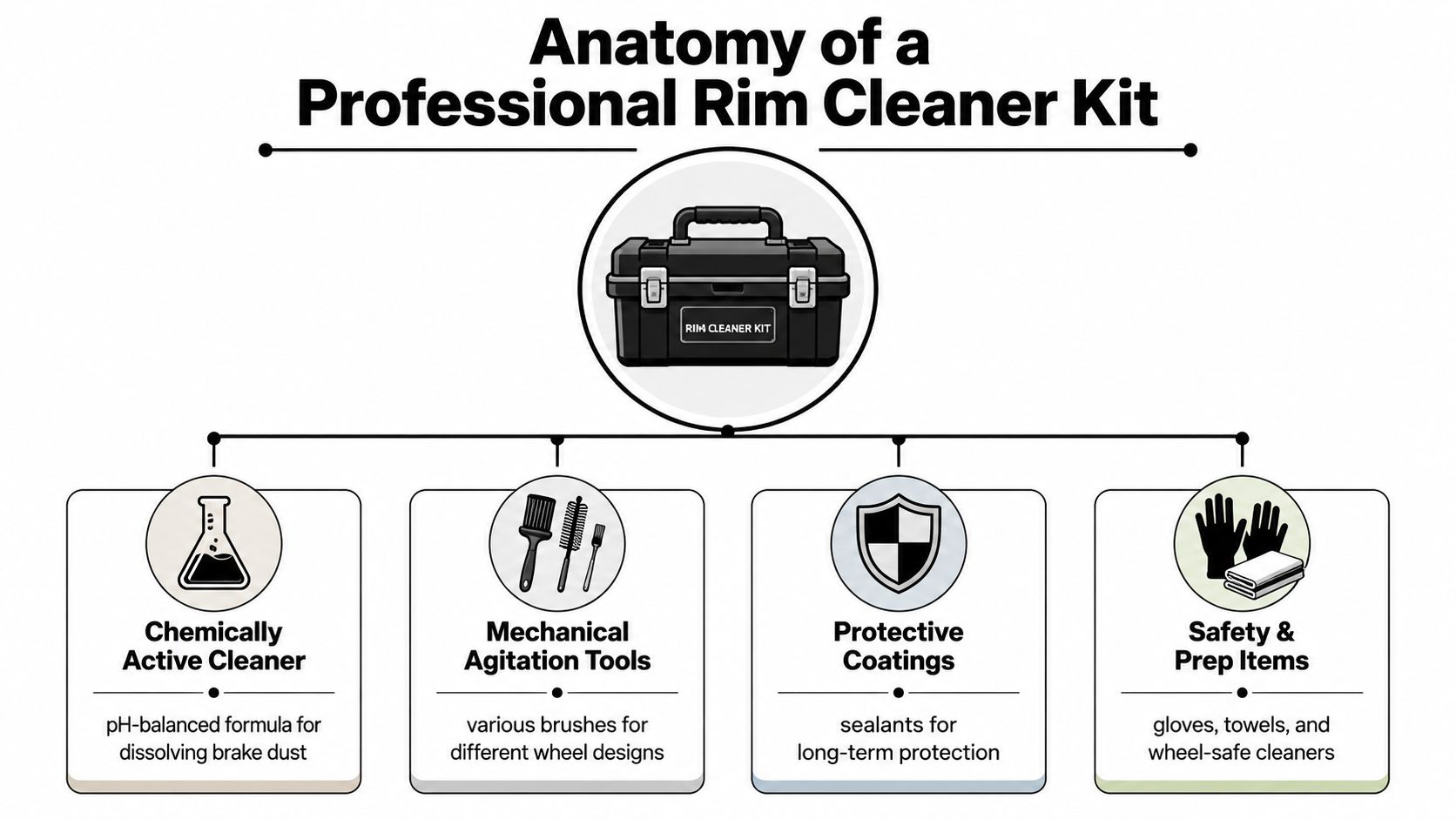
A professional kit follows the job from start to finish. The cleaner breaks down contamination, the brushes reach the spots a spray misses, the towel clears away residue, and the protection step makes the next wash less punishing on the finish. That is why a kit with a cleaner, wheel brush, tire shine, applicator, and drying towel, like the five-item setup shown in one commercial example, feels more useful in daily work than a lone bottle sitting on a shelf. REV Auto wheel care kit example
Why brush geometry matters more than hype
A spray bottle does only so much once the wheel design gets busy. Deep spokes, recessed lug pockets, and barrel edges all call for different reach, and brush shape starts to matter more than a louder claim on the label. A dedicated set like Titan’s car wheel cleaning brushes makes sense because access is the difference, not just chemistry.
Chemical Guys’ wheel-cleaner comparison groups products by pH balance, formula type, and price per 16 oz, which shows how standardized the category has become in serious consumer detailing. That standardization helps, but it can also hide a simple truth, the cleaner itself will not make up for poor tool access. Chemical Guys wheel cleaner comparison
A clean wheel face means little if the barrel still carries baked-on dust. The kit earns its value in the places your hand can’t see easily.
I have seen one of the biggest workflow mistakes show up on long-distance deliveries and relocations. If you are arranging door-to-door Hawaii car transport, the car can arrive with road film and wheel contamination that need a proper process, not a quick wipe, before the finish looks right again.
Choosing the Right Chemistry for Coated and Uncoated Wheels
A wheel that looks fine from five feet away can still be getting damaged by the wrong cleaner. On coated and clear-coated wheels, the mistake usually isn’t visible after one wash, it shows up after repeated use when an aggressive formula starts dulling the surface or stressing the finish. That is why a rim cleaner kit needs to be treated as a maintenance system, not just a bottle that strips brake dust on contact.
Chemistry choice starts with the wheel surface, not the brand name on the label. pH-balanced and acid-free formulas are the safer default for delicate finishes, especially when you’re working on coated, clear-coated, or polished wheels. Liqui Moly’s rim cleaner sits at pH 7 to 8, while stronger professional wheel cleaners can run much higher, including pH 13.5 in one Kärcher product and pH 13.56 in a Meguiar’s wheel and tire cleaner, so the gap between mild and aggressive chemistry is real. Liqui Moly rim cleaner datasheet, Kärcher professional rim cleaner datasheet, Kärcher RM 667 product page
Match the cleaner to the wheel, not the other way around
Here’s the decision framework I use on site. Aluminum and steel rims can handle a wider range, but chrome, painted, anodized, and polished wheels deserve a gentler first pass. Kärcher’s consumer guidance separates acid-free cleaners, soap and water for lighter contamination, and stronger products for stubborn grime, which matches how a careful detailer should think about material sensitivity. Kärcher wheel care guidance
| Wheel Type | Recommended pH Range | Cleaner Profile | Best For |
|---|---|---|---|
| Coated or clear-coated wheels | Around 7 to 8 | pH-balanced, acid-free | Routine maintenance and safer repeated use |
| Aluminum or steel wheels | Neutral to high-alkaline, depending on contamination | Mild to strong professional formula | Moderate to heavy brake dust |
| Chrome or polished finishes | Neutral and material-friendly | Gentle cleaner with soft agitation | Preserving shine and avoiding haze |
| Heavily contaminated uncoated wheels | Stronger professional formulas | High-alkaline cleaner with careful dwell | Thick brake dust and road film |
Some products make the process easier by giving you a visual cue. Liqui Moly says its cleaner changes color as it works, with the optimum effect reached when it becomes completely purple, and Würth describes a similar red-to-violet shift before rinsing after 3 to 5 minutes depending on soil level. That kind of indicator helps turn guesswork into timing, which matters when you’re trying to avoid overworking a finish. Liqui Moly rim cleaner datasheet
Strong cleaners have a place, but only on the right wheel and only when the contamination justifies them. If you are deciding whether to reach for a stronger prep product first, this guide on using degreaser on wheels is worth reading because the wrong order can strip protection faster than it removes grime.
For quick education and content planning, I’ve even seen creators use highlight creation for creators to show how a cleaner behaves in real time, and that visual timing is often more useful than a long product description.
The Complete Rim Cleaning Workflow From Prep to Finish
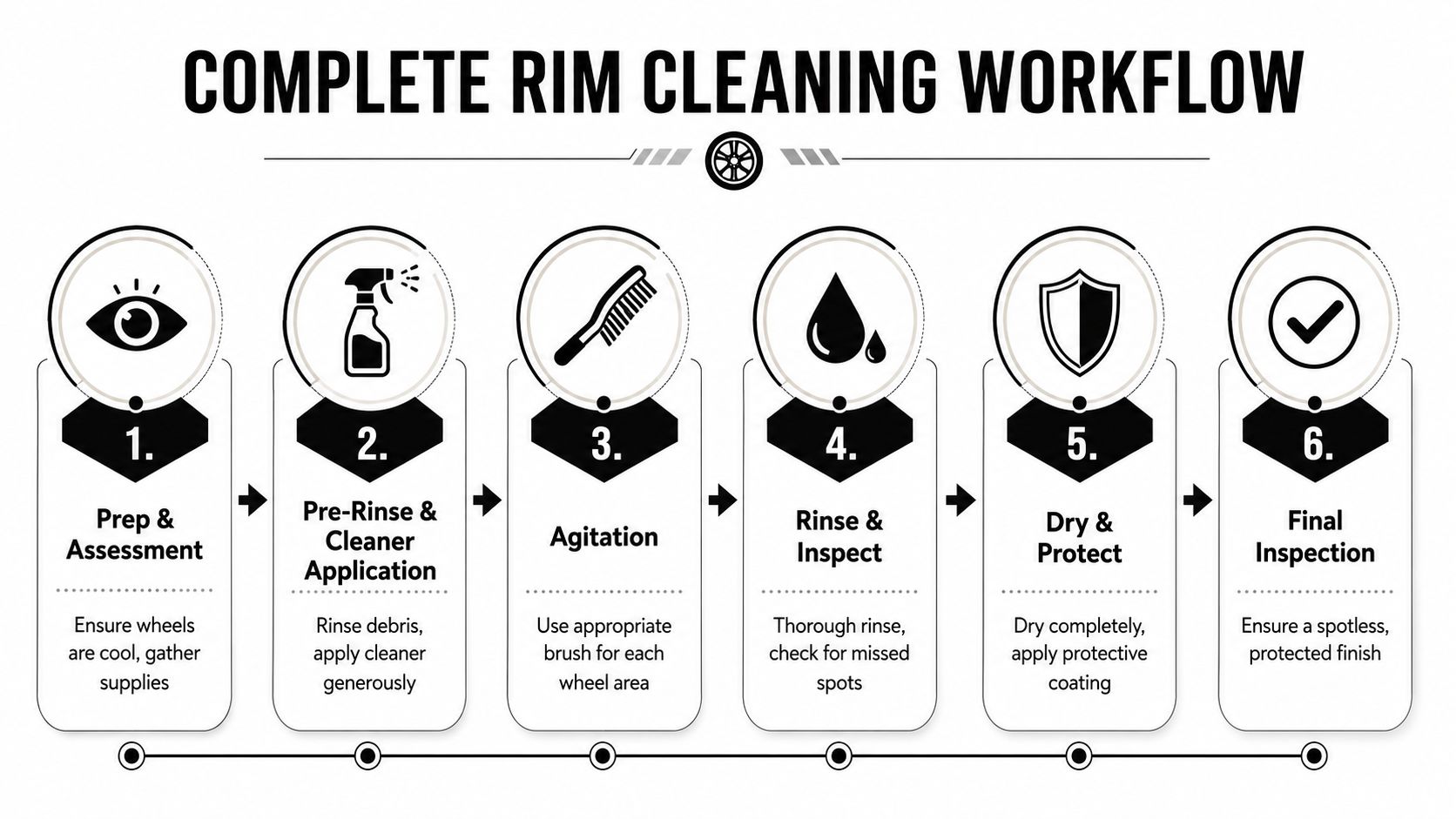
A wheel clean starts before the spray bottle comes out. Work on cool, dry wheels in shade whenever possible, because heat shortens working time and makes some cleaners flash off before you can agitate them properly. Clean one wheel at a time, keep the surface wet long enough to do the job, then rinse before the product starts leaving residue on the finish.
A simple sequence that holds up in the field
Start with a strong rinse to clear loose grit from the face, barrel, and lug pockets. If you skip that first pass, you grind dirt into the finish with the brush and increase the chance of marring. Apply the cleaner evenly, then watch the wheel instead of guessing. A color-change product gives you a better read on when the chemistry has finished reacting than a fixed timer does, and that matters more on hot, dusty wheels than on lightly soiled ones. Würth rim cleaner product page
Once the cleaner has had time to work, use the right tool for each zone. A soft, flagged wheel brush belongs on the face and spokes, a slim detailing brush fits the lug recesses and valve area, and a longer barrel brush needs enough flex to reach deep without packing contamination back into the coating. If the wheel has intricate spoke edges, a small round brush gives better control than a large, stiff one. That is where a lot of damage starts, because aggressive agitation on a coated or clear-coated wheel slowly wears the protection layer even when the surface looks clean.
After agitation, rinse until the runoff is clear. Do not leave cleaner sitting in the corners or behind the spokes, especially on wheels with fresh sealant or delicate clear coat. If you are dealing with baked-on contamination, Titan’s brake dust removal guide is a useful reference for matching the amount of agitation to the amount of buildup.
Work one wheel at a time. If the product dries on the surface, especially on a warm wheel, you have turned a cleaner into a residue problem.
Finish with microfiber towels that suit the job. A short-pile towel clears standing water from the face quickly, while a plusher towel helps around spoke backs, trim edges, and tight recesses where water likes to hide. Drying matters because leftover moisture can pull dust back onto the finish and leave spots that make the next wash harder. Done properly, the workflow protects the coating, reduces the need for stronger chemistry later, and keeps expensive wheels easier to maintain over time.
Protecting Your Wheels After Cleaning With Elastomer Coatings
Cleaning a wheel well and leaving it bare is only half a job. The surface is now exposed, decontaminated, and ready for protection, which is exactly where a coated maintenance strategy starts making sense. Titan Coatings’ Alpha Quartz is a high-performance Elastomer ceramic coating with 92% high solids, zero VOCs, and Advanced Adhesion Technology that cures in 4 hours and can be applied indoors or outdoors. Alpha Quartz product page
Why flexibility matters on expensive wheel finishes
Titan’s elastomer coating approach is built for a hard finish that still flexes under stress. That matters on wheels because temperature swings, curb heat, and everyday impacts don’t treat rigid protection kindly, and a more flexible coating helps the surface handle movement without cracking as easily. The value is that the wheel you just cleaned stays easier to wash the next time, because the coating reduces how hard contamination can bond in the first place.

The application side is straightforward enough for mobile detailers and DIY users who don’t have a full studio setup. A freshly cleaned wheel gives the coating the clean substrate it needs, and that’s why the rinse, dry, protect sequence matters as much as the cleaner itself. For rim-specific coverage, Titan’s ceramic coating for rims fits naturally into the same maintenance logic.
If the customer wants a lighter maintenance layer between full applications, Titan’s Ultra Ceramic Spray works as a practical follow-up option, especially on surfaces that need easier upkeep rather than a full coating reset. Ultra Ceramic Spray product page
Troubleshooting Common Rim Cleaning Mistakes and Pro Tips
The most common mistake I see is product drying on a hot wheel. Once that happens, residue becomes harder to remove than the original dirt, and the cleaner can leave behind spots that force you into extra agitation you never wanted in the first place. That’s why shade, cool surfaces, and sequence matter more than trying to rush the whole car at once.
Fix the problem you actually have
Another problem is brush mismatch. Complex spoke designs need a brush that fits the geometry, and the inner barrel needs access tools that won’t just smear loosened dust around the same zone. If the cleaner’s color-change indicator never activates, the wheel may be too cold, too dirty, or coated in a film that needs a pre-rinse and a second pass before the chemistry can do its work. Titan’s clear coat repair guidance for rims
Stronger chemistry is not a shortcut. If the dwell is wrong, the wheel is hot, or the finish is sensitive, aggressive product just creates a new problem.
Hydrophobic protection helps reduce the amount of grime that sticks in the first place. Titan’s Apex Glass on adjacent surfaces can make the area around the wheel easier to maintain between washes, which matters on vehicles that pick up road film fast in wet weather. It doesn’t replace wheel cleaning, but it can make the next session noticeably less punishing.
A better workflow is always the same. Process the wheel in order, let the product work within its window, rinse thoroughly, and protect the finish before contamination gets a chance to settle again. That’s the difference between chasing the same dirt every week and managing wheel care like a system.
If you want a wheel-care setup that goes beyond one-time cleaning, visit APEX NANO – Titan Coatings and look at the coatings and maintenance products built for wheels, glass, and daily driving protection. A proper rim cleaner kit works best when it’s paired with a finish that’s easier to maintain, and Titan Coatings offers that kind of system for detailers who want cleaner wheels to stay cleaner longer.
0 Comments