
A mobile detailer had just finished coating a black hood when a sudden drizzle moved across the driveway. The treated panel sent water into tight beads and fast sheets, while the untreated car beside it held onto road film.
That driveway test captures what a self-cleaning nano coating can and can’t do. A nano-structured film can reduce how strongly water, oils, pollen, and organic grime adhere, which means less scrubbing between washes. It doesn’t turn a vehicle into a maintenance-free object, and it won’t remove every mineral deposit or heavy contamination without proper cleaning.
For a detailer, the useful question isn’t whether the coating sounds futuristic. It’s whether the surface keeps its behavior after heat, cold, abrasion, chemicals, wipers, bugs, and imperfect customer washing. That’s where chemistry, surface texture, application discipline, and flexibility start to matter.
Why Self Cleaning Nano Coating Is the New Talking Point
The customer in the driveway usually notices the result before the mechanism. Rain lands on the bonnet, breaks into rounded droplets, and moves toward the panel edge instead of spreading into a dirty film. On a windshield, that same water behavior can improve the driver’s view during rain, provided the glass was prepared correctly and the coating is designed for glass.
A working definition is straightforward. A self-cleaning nano coating is a thin, nano-engineered surface film designed either to repel contamination or to help break down organic grime when light activates a photocatalyst. Some systems focus on low surface energy and water repellency. Others use photocatalytic materials such as titanium dioxide, which can chemically oxidize organic residues under UV or solar illumination.
The driveway test is more useful than the brochure
A daily driver gives the coating a difficult assignment. The paint sees dust, traffic film, insects, bird residue, detergent, sunlight, temperature swings, and repeated contact from washing mitts. Glass has its own problems, including mineral spotting, wiper movement, and visibility demands during wet weather.
Self-cleaning coatings have been studied for automotive surfaces such as rearview mirrors and windshields, where water and dirt runoff can reduce maintenance demands, as documented in the automotive self-cleaning surfaces review. That use case matters because a clean-looking hood is cosmetic, while a clearer windshield directly affects driving comfort.
Practical rule: Sell easier maintenance, not the fantasy of zero maintenance.
The technology has moved well beyond a laboratory novelty. A 2011 review had already noted that several companies had commercialized self-cleaning coating products, while a 2024 review assembled a corpus of 39,011 articles published from January 1, 2000, through December 31, 2022, showing how quickly the research base expanded (research review). For a mobile operator, that history means the key decision is product matching, not whether the concept exists.
That distinction is central to understanding whether car paint protection works. The coating has to suit the substrate, the climate, the customer’s washing habits, and the application environment. A good result starts before the bottle is opened.
How the Cleaning Actually Happens Under the Surface
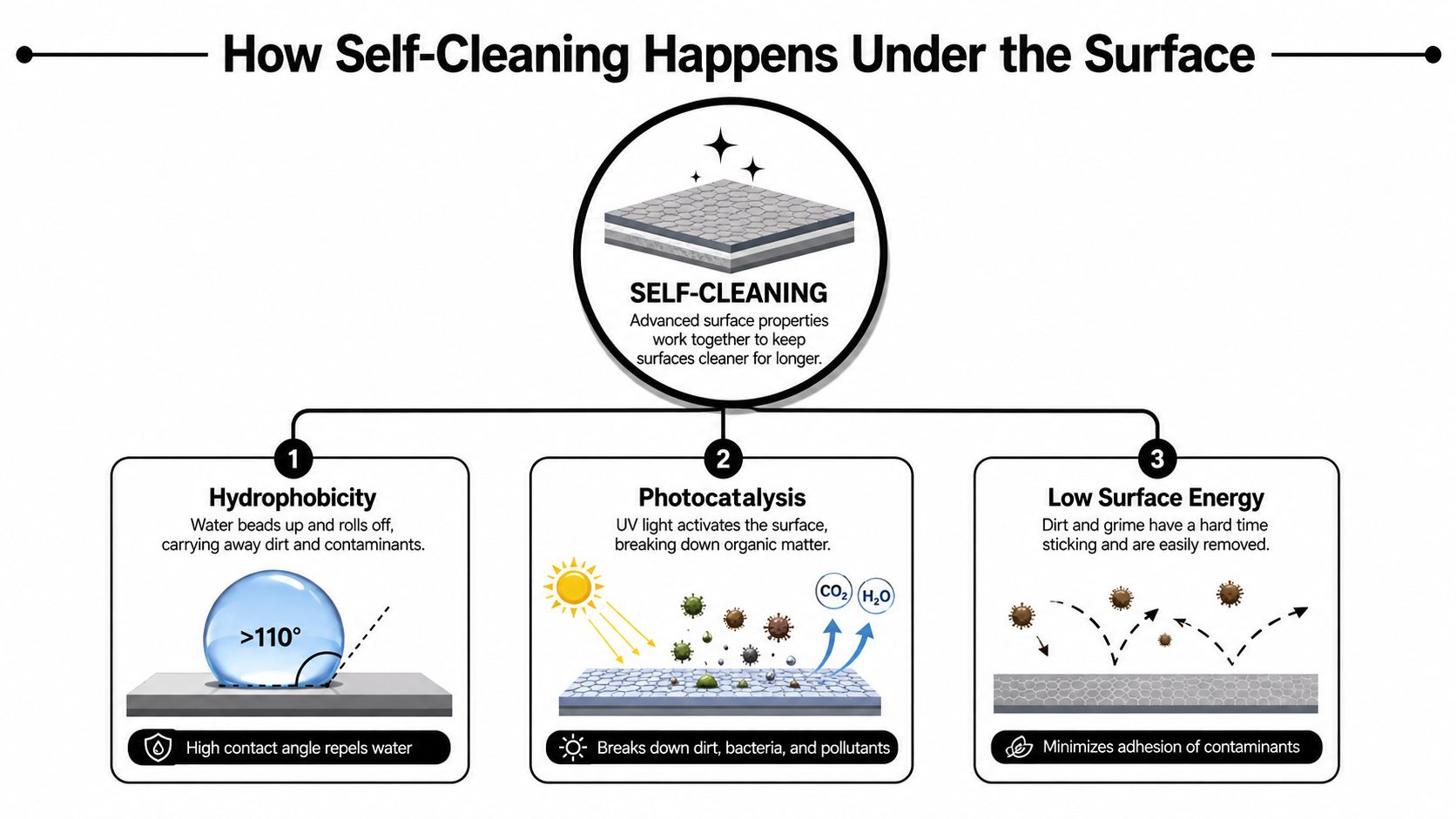
Three surface behaviors get grouped under the same marketing phrase, but they don’t do the same job. Hydrophobicity pushes water away. Photocatalysis helps break down organic contamination. Hierarchical texture changes how water contacts the surface and can preserve repellency under wear.
Hydrophobicity and contact angle
Put a drop of water on untreated glass and it tends to spread. Put the same drop on a low-energy coated surface and it pulls itself into a rounder shape. The angle formed where the droplet meets the surface is the contact angle, and a higher angle generally means less wetting.
A surface above 150 degrees is commonly described as superhydrophobic. At that point, water can behave like a small ball on a lotus leaf, collecting loose dust as it moves. The effect is valuable on paint and trim because less water remains in place to carry dissolved dirt into drying marks.
Hydrophobicity doesn’t chemically destroy grime. It makes attachment weaker and runoff easier. Hard-water minerals, baked-on traffic film, and heavy biological deposits can still require decontamination.
Photocatalysis does a different job
Titanium dioxide remains the benchmark photocatalytic phase because UV or solar illumination can trigger reactive oxygen species. Those reactive species oxidize organic grime instead of merely pushing it aside, according to the review of titanium dioxide self-cleaning nanocomposite coatings.
Standard TiO2 is mainly UV-responsive. Visible-light performance can be improved through approaches such as heterojunctions, graphene coupling, crystal-facet engineering, or doping. That distinction matters for windshields and exterior glass because shade, weather, and vehicle orientation change how much useful light reaches the surface.
Texture controls the water path
The third mechanism is physical design. Micro and nano textures can create a hierarchical surface that traps air beneath a droplet. Water touches less of the solid surface, so it rolls or sheds instead of spreading across the panel.
The product may look perfectly smooth to the customer, but its performance can depend on features far smaller than the eye can see. This is why Titan’s advanced coating technology should be evaluated by the behavior it maintains after use, not just the first beading demonstration.
A detailer can think of the three mechanisms this way:
- Hydrophobic coating: Water beads and moves away.
- Photocatalytic coating: Light helps break down organic contamination.
- Textured superhydrophobic coating: Surface architecture reduces contact and supports rapid runoff.
Self Cleaning Nano Coating vs Ceramic, Wax and Elastomer Options
A conventional ceramic coating can offer strong hardness and chemical resistance, but hardness alone doesn’t guarantee a long service life on a vehicle. Wax is forgiving and easy to refresh, but it normally gives up long-term resistance. Sealants sit between those categories, while elastomer coatings approach the problem from a different direction.
The practical comparison comes down to three questions. Will the film tolerate movement, will it survive temperature changes, and can the installer apply it evenly on a driveway without creating high spots or missed areas?
| Coating Type | Hardness | Flexibility | Typical Contact Angle | Best For |
|---|---|---|---|---|
| Wax | Soft surface film | High | Moderate to high | Short-term gloss and simple refreshes |
| Sealant | Moderate | Moderate | Moderate to high | Routine protection with accessible application |
| Traditional ceramic | Hard, glass-like finish | Low to moderate | High | Gloss, chemical resistance, and structured installs |
| Self-cleaning photocatalytic coating | Varies by binder and formulation | Varies | Hydrophilic or hydrophobic, depending on design | Organic grime reduction and easier rinsing |
| Elastomer nano coating | Hard like glass with flexible membrane behavior | High | High, depending on formulation | Vehicles exposed to movement, impacts, and temperature swings |
Hardness is only half the conversation
A rigid film resists scratching, but a vehicle panel expands and contracts. The bonnet can heat rapidly in sunlight, then cool after sunset or during a cold-weather wash. If the coating and substrate move differently, stress can accumulate at the interface.
Titan Coatings positions its Elastomer Membrane Technology as the first elastomer coating technology introduced to the market using nano tubes technology and Dark Matter tech. The stated design goal is a coating that stays hard like glass while retaining flexibility, so the membrane can accommodate movement rather than behaving like a brittle shell.
That flexibility is also relevant at the front of the vehicle. Insects strike at speed, pressure washing creates localized force, and washing introduces repeated mechanical contact. A flexible membrane doesn’t make the surface invulnerable, but it addresses a failure mode that a purely hardness-led product can overlook.
Match the chemistry to the customer
A weekend enthusiast may accept a longer installation and strict curing conditions. A mobile detailer often needs controlled flash behavior, manageable wipe-off, and a product that can work across varied locations. A fleet operator may value repeatable maintenance more than maximum initial gloss.
Before choosing, compare the trade-offs in ceramic coating versus nano coating. The strongest product on paper isn’t automatically the strongest choice for a customer who parks outdoors, drives through winter weather, or won’t follow a specialized wash routine.
Reading the Numbers That Actually Matter
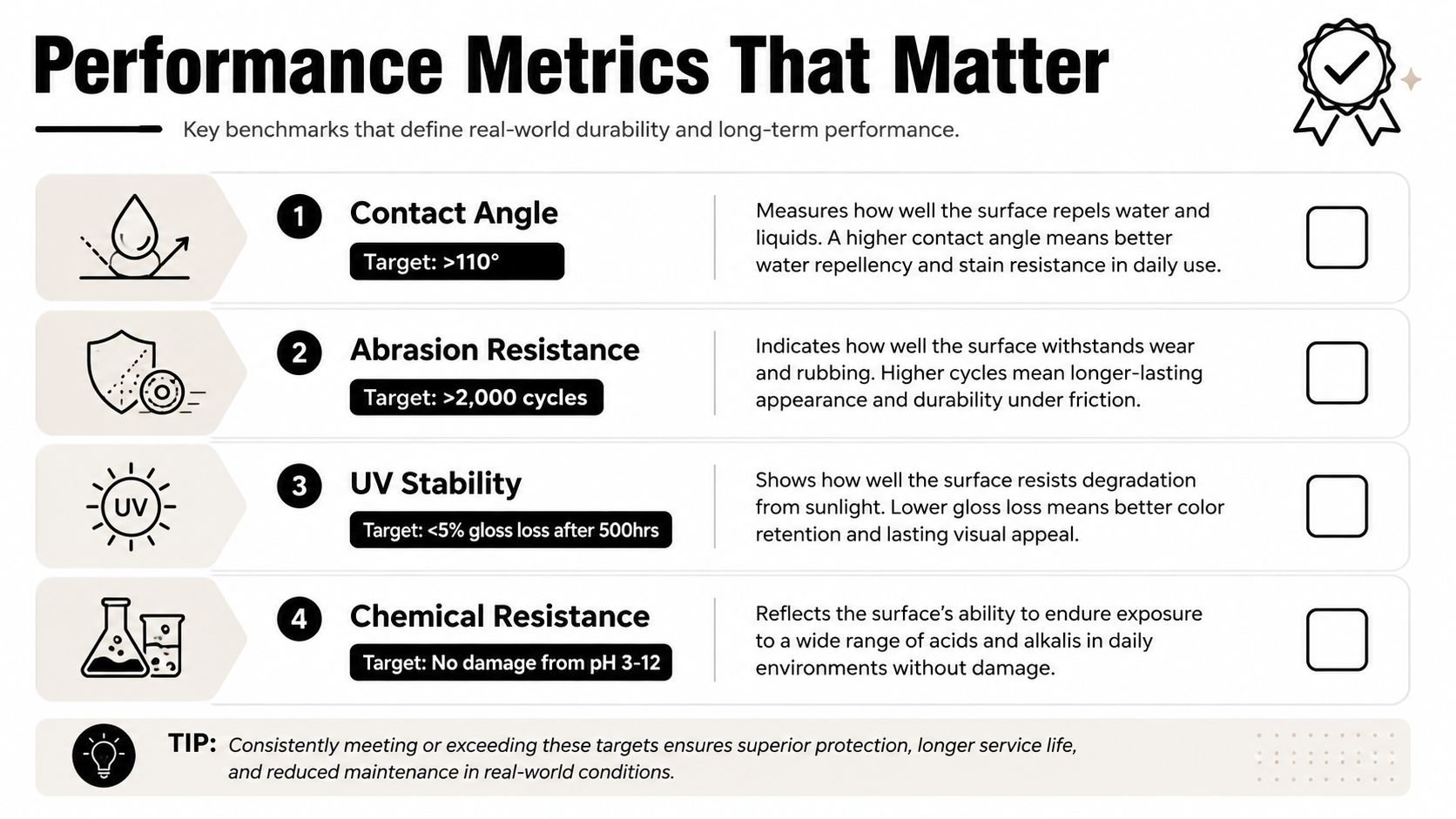
The first water-beading video is persuasive, but it tells you very little about service life. A serious evaluation looks at contact angle, abrasion resistance, UV stability, chemical resistance, and substrate compatibility.
A high contact angle shows that water is reluctant to spread at that moment. It doesn’t prove the surface will behave the same way after detergent, grit, wipers, ultraviolet exposure, or repeated drying. Abrasion testing is more useful when the test includes a defined abrasive, load, and number of cycles.
Contact angle needs context
A surface above 150 degrees can qualify as superhydrophobic, but that value should be tied to the test conditions and the surface’s age. A freshly prepared coupon in a controlled lab isn’t the same as a bonnet exposed to road grit.
One peer-reviewed study found that a hydrothermal micro and nano convex coating retained a water contact angle above 150 degrees after 300 sandpaper abrasion cycles. The test used 800-mesh sandpaper and a 100 g load, while a less protected comparable structure fell to 144.6 degrees after 350 cycles (abrasion study). The useful lesson is structural. Microtexture protection can determine whether water-shedding behavior survives mechanical abuse.
Look for exposure testing
UV and weathering matter because a coating’s chemistry can change even when the panel still looks glossy. A 2024 outdoor study reported that a TiO2-SiO2-PAA coating remained effective on glass for up to three years, but its relative self-cleaning efficiency changed from about 4% over three years to about 2% in the fourth year on glass (outdoor durability discussion).
That isn’t a universal lifespan promise. It demonstrates why a buyer should ask how the product was tested, on which substrate, and under which exposures. The same source also highlights abrasion and humidity as persistent challenges for self-cleaning materials.
Use this checklist before accepting a claim:
- Contact angle: Ask whether the measurement was taken before or after wear.
- Abrasion: Look for the abrasive type, load, and cycle count.
- UV exposure: Confirm whether the test measured appearance, repellency, or cleaning behavior.
- Chemicals: Check resistance against the cleaners and contaminants the vehicle sees.
- Substrate: A result on glass may not transfer directly to paint, PET, plastic, PPF, or trim.
For a deeper look at how testing should be interpreted, review coating testing practices. The best field decision is based on retained performance, not the most dramatic first demonstration.
Applying and Maintaining a Self Cleaning Coating on Cars
Preparation decides whether the coating bonds evenly. A product can have excellent chemistry and still fail when applied over embedded contamination, polishing oils, silicone residue, or moisture.
The full install with Alpha Quartz
Start with a thorough wash, chemical decontamination, and mechanical decontamination where the paint needs it. Correct defects before coating, then use a suitable panel wipe and inspect the surface under strong lighting.
Apply Alpha Quartz in a controlled cross-hatch pattern, working a manageable section at a time. Follow the product’s flash behavior, level the coating before it grabs, and buff with a clean towel using light, even pressure. Alpha Quartz is positioned for DIY users and mobile detailers because it is easy to install, has an extended 15-minute working window, and can be used indoors or outdoors.
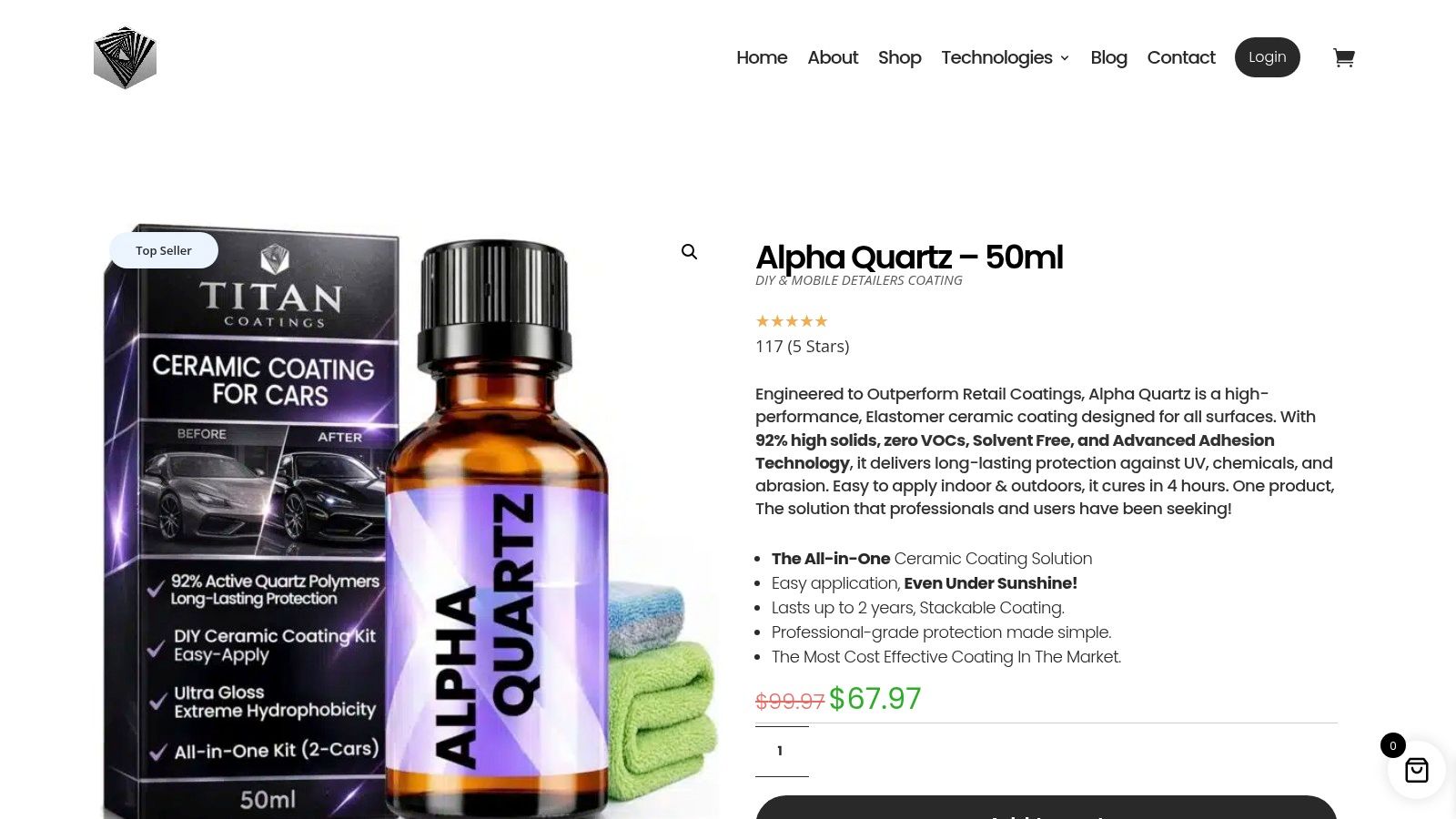
The elastomer formulation is the important distinction for operators working in variable conditions. It is hard like glass but flexible, which can help the film accommodate temperature movement and impact rather than cracking as readily as a rigid layer.
A faster maintenance route
For a maintenance appointment, Ultra Ceramic Spray is the more practical choice when the vehicle already has a sound base layer or the customer needs a quick refresh. It uses Dark Matter Technology to provide water-based, flexible membrane protection and is designed for paint, glass, PPF, wraps, and trim.
Work on a cool, clean surface. Mist the product onto the towel or panel according to the product directions, spread it evenly, and level it before residue dries. A second towel should remove remaining streaks, especially on dark paint and glass.
Use the application principles in this guide to applying ceramic coating to a car. Don’t apply over a dirty panel and expect the coating to hide the problem. The film will preserve whatever sits beneath it.
Treat glass as a separate surface
For windshields and exterior glass, APEX Glass Ceramic Coatings is the dedicated option. Its purpose is to improve water runoff and wet-weather visibility, making driving in rain less stressful when the glass has been thoroughly polished and degreased first.
Use a dedicated glass preparation process, remove mineral deposits, and keep the application thin and uniform. A glass coating can help rain move away more efficiently, but wiper blades, washer fluid, road film, and hard-water contamination still require sensible maintenance.
Why Flexibility Beats Pure Hardness in Real-World Use
A car doesn’t stay still while the coating does its job. Panels expand, contract, vibrate, flex, and absorb impacts. A coating that is hard like glass but also flexible has a better chance of maintaining continuity when the substrate moves.
That matters most in climates with sharp temperature changes. A bonnet can move from intense daytime heat to a freezing overnight condition, while the coating and the underlying panel respond at different rates. A rigid film may resist surface scratching, yet micro-cracking can become the more relevant failure path when stress repeats.
The membrane advantage
An elastomer membrane absorbs some of that movement instead of fighting every change. Titan Coatings introduced its elastomer coating approach using nano tubes technology and Dark Matter tech, with the aim of combining glass-like hardness with flexibility.
That combination also speaks to impact. Bugs hit the front of a car with concentrated force, especially on highway trips. A flexible coating won’t prevent every mark, but its ability to move with the surface is more relevant than a hardness number viewed in isolation.
Field observation: A coating that survives the first wash but develops micro-cracks through repeated thermal cycling hasn’t solved the durability problem.
The same logic applies to glass. A windshield sees wiper movement, washer fluid, vibration, and rapid weather changes. Glass itself is rigid, but the coating system still has to tolerate real use without turning into an uneven or streak-prone layer.
Choose for the climate, not the sales pitch
A hard traditional ceramic can be appropriate for a controlled installation where the owner maintains the car carefully. Wax and sealant remain sensible for customers who want simple, repeatable refreshes. Elastomer technology becomes more compelling when the vehicle lives outdoors, sees temperature swings, or needs a coating that can tolerate a mobile operator’s less controlled installation environment.
Research supports the broader principle that surface architecture and formulation affect retained performance. One study reported a silane-modified multi-walled carbon nanotube coating that remained superhydrophobic after wear up to 400 cm and resisted acidic and alkaline solutions (wear-resistant coating study). That finding doesn’t make every nanotube coating equivalent, but it reinforces the value of designing for wear rather than only initial appearance.
Choosing the Right Titan Coating for the Job
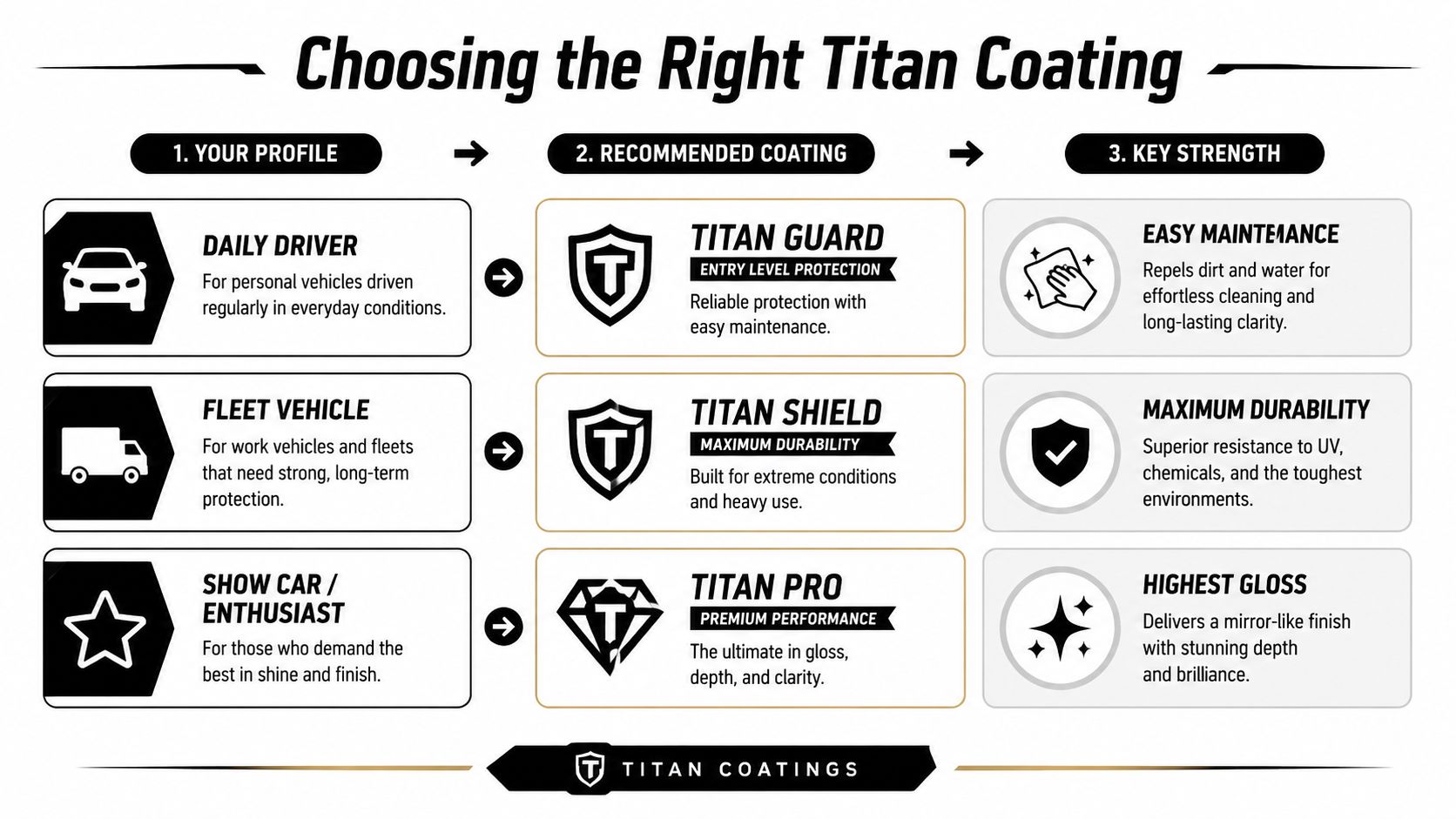
The right choice starts with the surface, not the word “nano.” Paint, PPF, vinyl, plastic, wheels, and glass each present different preparation and maintenance demands.
- Paint and exterior trim: Use Alpha Quartz when the customer wants a full elastomer coating that is accessible to DIY users and mobile detailers.
- Windshield and exterior glass: Use APEX Glass when rain visibility and water runoff are the priority.
- Paint, glass, PPF, wraps, or trim maintenance: Use Ultra Ceramic Spray when a quick, flexible membrane refresh makes more sense than a full coating install.
- Fleet or repeat service: Standardize preparation and application, then use the spray format between more substantial coating appointments.
- Enthusiast vehicles: Choose the full coating when the owner will support it with careful washing and realistic expectations.
A European Commission CORDIS project also reported mass production of permanent self-cleaning 3D plastic automotive components by combining nanostructured tools with functional thermoplastic nanocompounds (CORDIS automotive project). That matters because self-cleaning behavior isn’t limited to flat painted panels. It can be engineered into complex parts when the manufacturing process supports it.
Titan Coatings operates in over 30 countries and describes testing across harsh climates and extreme conditions. For product selection, the practical takeaway is simple. Buy for the substrate, install for the environment, and explain self-cleaning as reduced effort rather than no maintenance.
APEX NANO – Titan Coatings offers practical options for self-cleaning vehicle protection, from the flexible Alpha Quartz elastomer coating to APEX Glass for rain-exposed windshields and Ultra Ceramic Spray for fast maintenance work. Visit APEX NANO – Titan Coatings to choose the system that fits your surface, workflow, and climate, then put the science to work on your next vehicle.
0 Comments