
It's the second week of March and the roads have finally dried out. Your rocker panels wear a white crust of salt, the leading edge of the hood has collected a spray of tiny chips from winter grit, and the windshield beads water unevenly where the wipers have scrubbed the glass. Nothing is broken. Everything looks tired.
That gap between tired and broken is where a protective coating earns its keep. Industry spends heavily on corrosion and wear because the same slow chemistry that fades a hood also pits bridges, pipelines and factory steel, and the right layer can reduce a meaningful share of that loss. On a car, the layer is easier to picture: a thin, replaceable barrier takes the contact, blocks some of the water, salt, grit and ultraviolet light, and gives you time to clean gently before small damage becomes repair.
A coating still has limits. It asks for surface prep, sensible washing, and inspection when gloss or water behavior changes. Treat it as a maintenance system rather than a permanent shield, and it pushes the expensive event back by years.
Why a Thin Layer Can Protect Something Expensive
A protective coating is a deliberately engineered layer, and "engineered" is the word carrying the weight. A raincoat keeps you dry because someone chose a polymer that water beads off and cut it long enough to cover the seams at your shoulders, and it protects for exactly as long as the material stays intact. Sunscreen follows the same logic: a thin film that absorbs or scatters ultraviolet light before it reaches skin. Both buy time. Time is the whole product.
Multiply that logic across the world's steel and the stakes turn enormous. The NACE IMPACT study estimated the worldwide cost of corrosion at approximately US$2.505 trillion in 2013, equal to 3.4% of global gross domestic product, and concluded that currently available corrosion-management practices, organic and metallic coatings among them, could potentially reduce those losses by 15% to 35%. The same NACE IMPACT study put the potential savings at US$375 billion to US$875 billion. That is structural money, the kind that decides whether a ship hull or a pipeline serves its full design life or gets replaced early.
Coatings earn that money by isolating a metal substrate from the electrochemical conditions rust needs. Take the electrolyte away from steel and the reaction stalls.
Your car runs the same experiment every day at smaller scale. Paint meets rain, road salt, bird droppings, tree sap, industrial fallout and sunlight, and the clearcoat takes that hit first so the colour layer and primer underneath don't have to. How long the thin film keeps paying off depends on what it is exposed to and how it is treated, because a coating works as a barrier with a maintenance schedule attached, and its real service life is set by exposure and inspection as much as by hardness.
The principle is easier to see when you draw it.
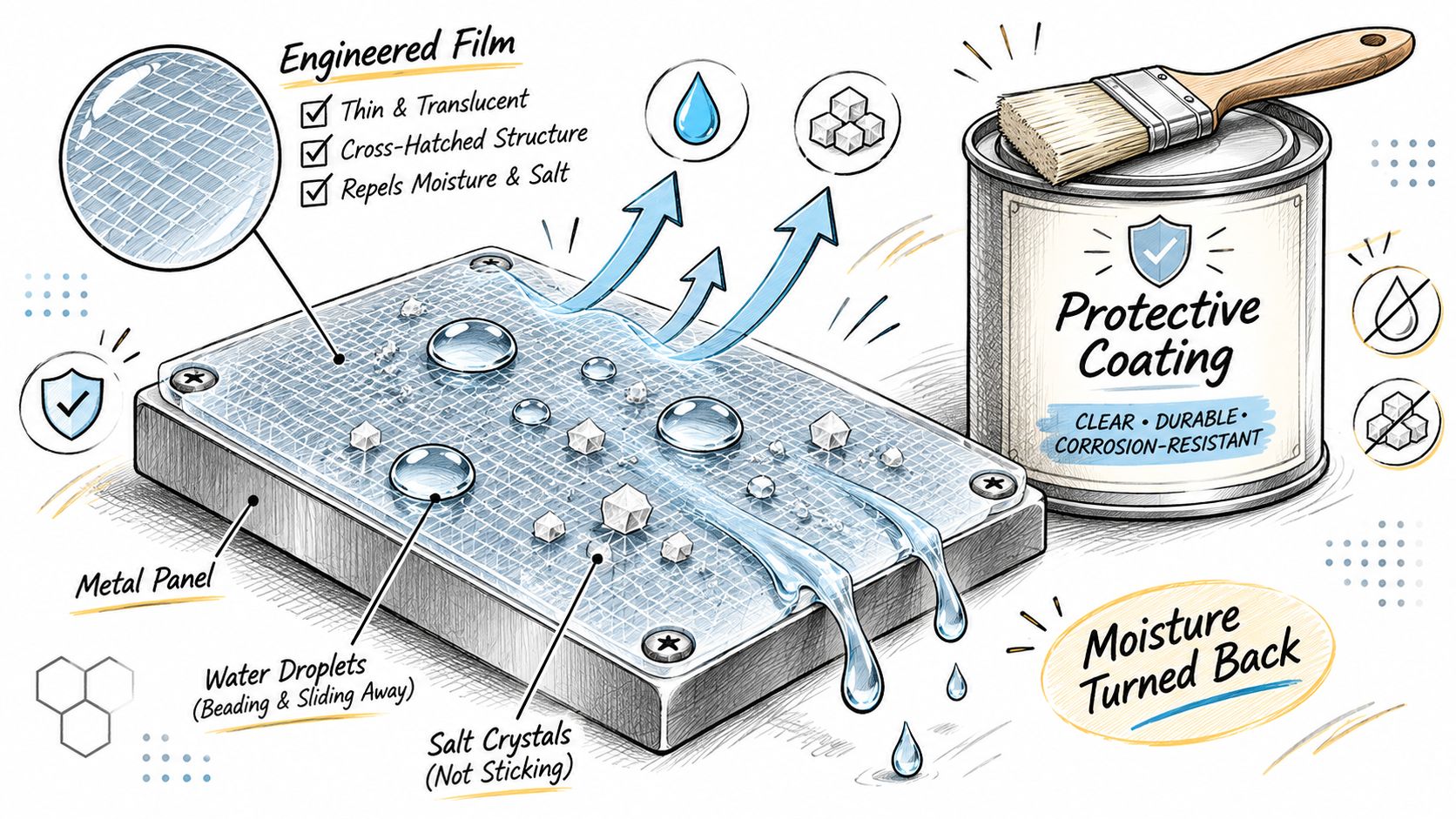
Everything that follows rests on one reframe. A coating is a risk-control technology: it extends service life, holds maintenance costs down and delays the day you pay for a repaint, a replacement panel or new glass. Four questions decide whether a particular product does that for you. Which mechanism does it use? Does it suit your surface, your climate and your parking situation? How long will it realistically last? And what will you do to keep it working?
How Protective Coatings Block Damage in Three Ways
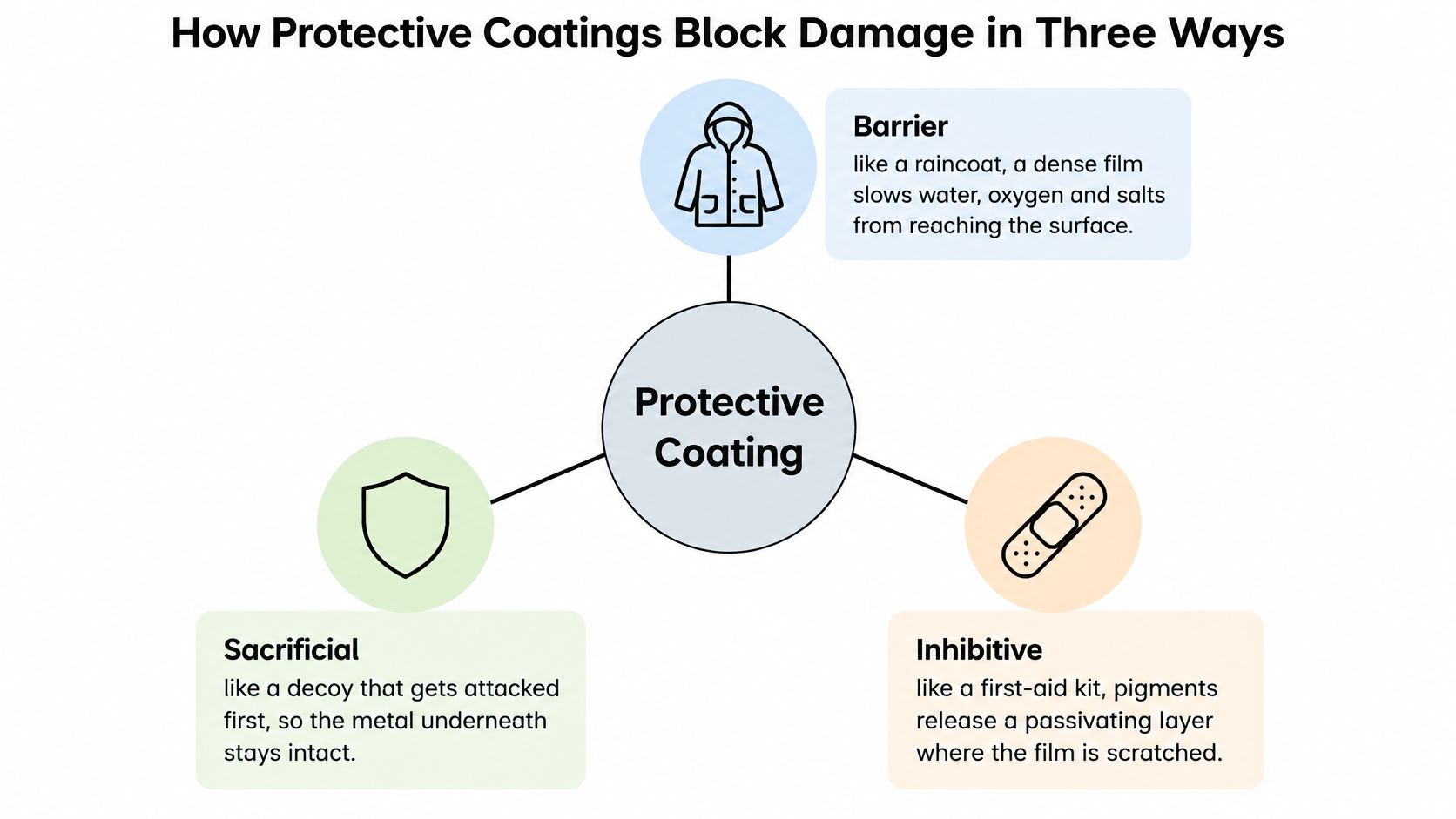
Say a work van spends its winters on salted roads and its summers parked in open sun. What is protective coating doing on its panels while all that exposure lands? The answer splits into three mechanisms, and the U.S. Bureau of Reclamation identifies them as barrier protection, sacrificial protection and corrosion inhibition.
Barrier protection sits between the weather and the metal. The clearcoat on a hood is the everyday version: a dense film of binder and pigment that slows water, oxygen, salts and other electrolytes moving toward the substrate. On steel, cutting off electrolyte access stalls the corrosion reaction entirely. On paint or glass, the same film beads water, so contamination gets less chance to bond.
Sacrificial protection works like a decoy. A more active metal is deliberately built into the system so it corrodes first, while the steel it guards stays intact. That's the logic behind a zinc-rich primer on a chassis or a structural member.
Inhibition is chemistry at the interface. Inhibitive pigments interfere with the corrosion reaction itself or push the metal surface toward passivation, a stable oxide state that resists further attack. An inhibitor earns its keep at the breach: when a scratch cuts through the film, it slows what starts at the exposed edge.
| Mechanism | How it works | Typical example | Where it matters |
|---|---|---|---|
| Barrier | Slows water, oxygen and salts reaching the substrate | Dense polymer or ceramic topcoat | Paint, glass and bodywork |
| Sacrificial | A more active metal corrodes first and protects the base metal | Zinc-rich primer | Bare or exposed steel |
| Inhibitive | Pigments interfere with corrosion reactions or promote passivation | Inhibitive primer | Steel in corrosive service |
| Layered system | Primer and topcoat stack different mechanisms | Epoxy primer with polyurethane topcoat | Heavy-duty steel and marine structures |
Here's the same split in one picture.
Where a good coating still fails
A coating doesn't fail evenly. It fails at its defects: pores in the film, scratches cut through to the substrate, edges where the film runs thinnest, and any patch where adhesion never formed properly. Water finds those paths and travels sideways beneath the film, so the surface underneath corrodes while the top still looks glossy.
That gap between a glossy surface and the damage creeping under it is why a coating reads better as a barrier plus a maintenance system than as a permanent shield. Inspection catches the defects early, while the film is still doing most of its job.
Adhesion is where surface preparation enters the story. Residues and weak oxide layers cut interfacial adhesion, which lets moisture migrate beneath the coating instead of sitting on top of it. Wiping a panel down properly before application does more for coating life than the name on the bottle.
Barrier films that live in sunlight carry a second job, and the UV protection ingredients in the formulation decide whether the film keeps doing it for years or photo-oxidizes into a chalky shell.
The rule that governs everything after this is simple: match the mechanism to the threat. A transparent topcoat on paint is judged on water repellency, chemical resistance and gloss retention. It isn't a corrosion-control system for exposed steel, and nobody should sell it as one.
That distinction keeps expectations honest. A ceramic layer on a hood does real work, repelling water and holding gloss. A bare chassis rail still needs its zinc primer.
Common Coating Types and Where Each One Fits
Say a café owner walks into a detailing shop to protect the paint on a new delivery van and leaves holding a bottle marked "glass coating" because the word sounded tough. The label told her nothing about the surface it was made for. Each coating family is built around a different surface and a different kind of abuse, so the surface and the exposure pick the product.
Start with the two that look alike. Ceramic clearcoats add a hydrophobic, chemical-resistant and UV-resistant layer over paint; on wheels they resist brake dust and iron fallout, and on bodywork they slow the bonding of contamination. Elastomer ceramic coatings chase a different balance, pairing glass-like hardness with enough give to move with the panel. That flexibility is the spec most labels skip, and it decides whether a film survives years of thermal cycling or cracks at the first hard winter.
At the heavy end sit epoxy and polyurethane systems, built for chemical exposure and abrasion on steel, marine assets and plant equipment, where an acid-resistant epoxy coating handles tanks, bunds and floors that meet aggressive chemicals. Zinc-rich primers protect bare steel sacrificially and need a topcoat to survive UV and weather, so they usually sit under something else. Glass coatings live on windshields, where the payoff is visibility rather than gloss.
| Coating family | Main protection | Best-fit surface | Watch for |
|---|---|---|---|
| Ceramic clearcoat | Hydrophobic, UV and chemical barrier | Paint, glass, wheels | Very hard films need flexibility to avoid cracking |
| Elastomer ceramic | Hard but flexible membrane that absorbs movement | Paint, wraps, PPF | Check elongation and recovery in the product data |
| Epoxy or polyurethane | Chemical and abrasion resistance | Steel, marine, industrial | Surface prep and cure time decide results |
| Zinc-rich primer | Sacrificial corrosion protection | Bare steel | Needs a topcoat for appearance and UV |
| Glass coating | Water repellency and clearer visibility | Windshields and glass | Keep glass clean and follow the product's reapplication guidance |
One product worth naming is Apex Glass Coating- 50ml, a hydrophobic glass and windshield coating that bonds into the pores of the glass, enhances visibility in rain and reduces wiper use. Even a well-bonded film works as a barrier with a care routine attached: wash it with a pH-neutral shampoo, skip harsh chemicals and abrasive cleaners, and it keeps doing its job.
What a hardness number actually tells you
Automotive clearcoats are multifunctional polymer films whose durability comes from a trade-off between hardness, toughness, elasticity, crosslink density and resistance to photo-oxidation. Instrumented scratch testing on automotive clearcoats found visible whitening and damage at approximately 20 to 30 N under specific test conditions, according to published clearcoat research. That figure means nothing without the test method, the load, the tip geometry, the speed and the substrate stack behind it.
The same body of work shows ultraviolet exposure breaking polymer chains, which lowers Shore hardness and drops the load needed to start a scratch. A sun-aged panel mars more easily than a new one, and surface damage creates routes for moisture and corrosive agents to enter the system.
The same questions show up far from the garage. Anyone weighing coating options for commercial flat roofs is still balancing surface type, sun exposure and movement. Across every family in the table, the pattern holds: a coating behaves more like a good raincoat than a suit of armour. It sheds what hits it, flexes with what moves beneath it, and lasts longest when someone keeps it clean and checks it now and then.
Why Flexible Coatings Survive Hot and Cold Swings
Say a car sits parked overnight at minus eight degrees. By two in the afternoon the same hood is hot enough to sting your palm. Paint, primer, clearcoat and whatever sits on top of them expand and then contract, and each layer moves at its own rate because they are different polymers with different rates of expansion.
A rigid film has nowhere to put that strain. It cracks at the first stress point, usually a panel edge, a stone chip or a seam, and once a crack opens, water has a road in. An elastic film stretches instead and then pulls itself back, the way a rubber band returns to shape after you let go.
Two numbers describe that behaviour, and they only mean something together. Elongation measures how far the film stretches before it fails. Elastic recovery measures how completely it returns to its original shape. Technical guidance on crack bridging warns that elongation below 300% may not withstand thermally driven cracking, and names elongation, recovery, coating thickness and ambient temperature as the factors that decide whether a film can accommodate movement at all. A film that stretches far but stays stretched has failed as surely as one that never moved. That threshold belongs to a particular application, so check a product against its own data rather than borrowing someone else's number.
The difference shows up most clearly across a full year of weather.
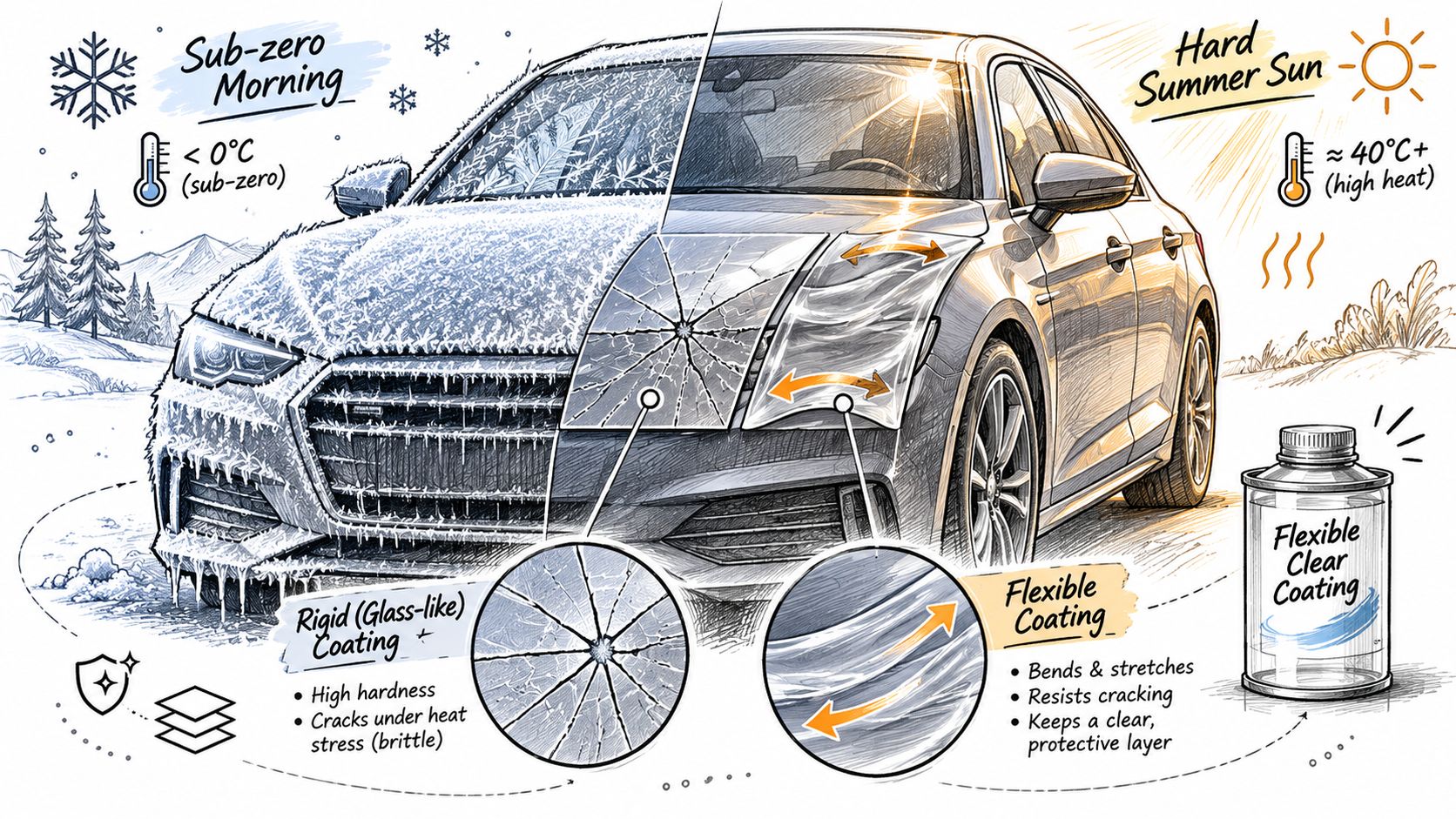
Elastomer ceramic technology exists to answer exactly this stress. Titan Coatings, a manufacturer of elastomer-based ceramic coatings for automotive surfaces, built its approach on Dark Matter Technology, and the claim is deliberately unglamorous: a film that is hard like glass yet flexible, so it moves with the panel instead of fighting it. Frozen mornings and hot afternoons stop being a cracking risk, and bug strikes on a summer highway stop being a chipping event. The flexibility shows up in the data sheet as elongation and recovery figures, and coating flexibility is worth checking in the product data before you commit.
For DIY owners and mobile detailers, Alpha Quartz 50ml Ceramic Coating is an elastomer ceramic designed for all surfaces and made for easy application indoors or outdoors.
On the coldest morning of the year, ask what the film on your hood does when the metal shrinks. If the honest answer is that it moves with the panel, the coating is doing its job. A film that flexes still earns a look after a hard winter, because a barrier only protects for as long as someone confirms it is still whole.
How Long Protection Lasts and What Durability Means
Say a café owner coats the delivery van, and a neighbor coats a garage-kept coupe with the same product. A few hard winters later, the van's film looks tired while the coupe's still sheds water like day one. Same coating, different lifespan. Any product advertising one fixed number is quoting a marketing department, because engineering practice defines durability as an estimate of the period until the first major maintenance.
The ISO 12944 durability categories run from low, up to 7 years, through medium at 7 to 15 years, high at 15 to 25 years, and very high at more than 25 years. Actual performance depends on the coating system, the substrate, the preparation, the climate, chemical exposure, abrasion and how often somebody inspects the film.
| Durability category | Years to first major maintenance | Typical exposure |
|---|---|---|
| Low | Up to 7 years | Mild climate and light exposure |
| Medium | 7 to 15 years | Road use in moderate climates |
| High | 15 to 25 years | Intense UV, coastal air or winter salt |
| Very high | More than 25 years | Severe industrial or marine exposure |
Five different things decline at different rates on the same panel: service life, appearance retention, water beading, corrosion protection and warranty duration. A clearcoat can still bead water beautifully long after its gloss has flattened, and a warranty can expire while the film has years of work left in it. Treating all five as one number is how owners end up disappointed by a coating that's doing exactly what it should.
Exposure decides which band you land in. Intense UV, winter road salt, coastal air, frequent washing and industrial fallout all age a film faster than a mild inland climate does, which is why the same product can behave differently on two cars parked three streets apart. Accelerated aging in a lab can't be converted straight into a real-world lifespan either. Hours in a weathering chamber tell you how one product ranks against another; they don't tell you the date it will fail on your street. The realistic life of a ceramic layer depends on the same variables the standard lists, so the sensible move is to find your exposure, pick the band it implies and confirm the estimate with a yearly look at the film.
A certified professional installs Titan Coatings, and that installer issues the warranty. Its terms depend on the layering and products used, which means two cars carrying the same base coat can hold different coverage from different installers. If the coating degrades, a certified installer inspects the vehicle, provides feedback and works on restoring it as needed. That arrangement turns durability from a number on a box into something closer to sunscreen: the label sets expectations, the exposure does the aging, and a regular check tells you when it's time to reapply.
Limits, Maintenance and Knowing When to Reapply
Say a driver coats her car in spring, parks outside through a salty winter and skips most washes. By the next summer the film still beads water on the bonnet, yet the gloss has flattened and the edges around the wheel arches look tired. The coating held the line between the paint and everything thrown at it; the routine that keeps a barrier working never happened. A coating limits contact with scratches, chips, bonded fallout, bird droppings, road salt and accumulated grime, and coating inspection and maintenance guidance describes performance as a system built from substrate condition, preparation, application, inspection and ongoing care.
Products sold as "maintenance-free" are describing a smaller workload, and that is all they are describing. Dirt releases faster, water beads sooner and chemical etching takes longer. The wash routine shrinks, and it stays necessary.
- Rinse salt and bird droppings promptly. Winter brine clings to lower panels and arches, and bird waste is acidic enough to etch a film left sitting in the sun.
- Wash with a pH-neutral shampoo. That is the routine for any coated vehicle, and it keeps the film behaving the way it did on day one.
- Skip harsh chemicals and abrasive cleaners. They attack the layer you paid for.
- Dry with a soft cloth. A clean microfiber towel prevents the marring you would otherwise chase with a polisher later.
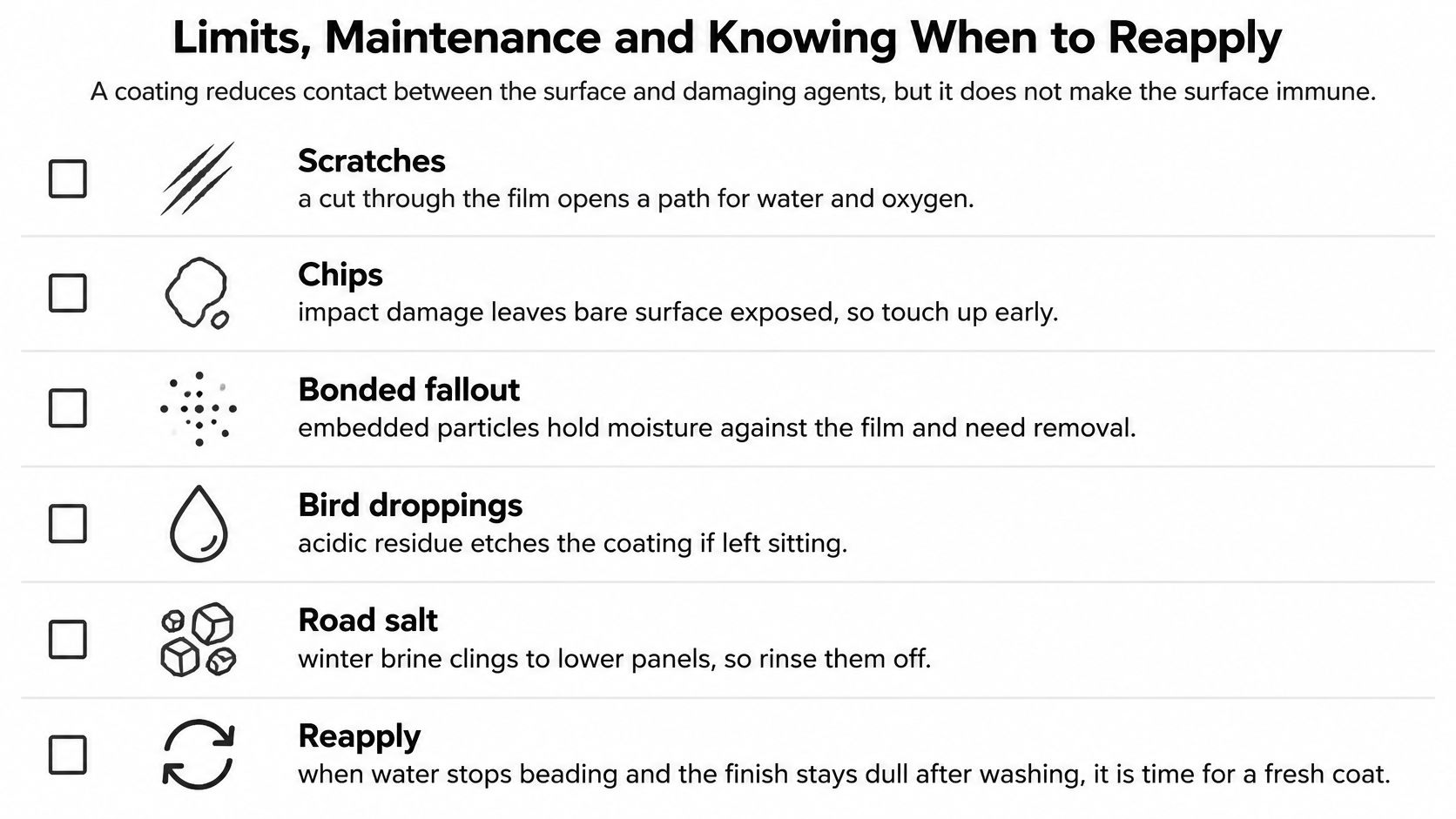
Inspection is the habit that saves money. Check gloss, water beading, staining, bonded contamination and edge damage every few weeks, because a film that stops beading in one patch is flagging a problem long before a full correction becomes unavoidable. Catching a weak spot early usually means attention to that area rather than a strip and redo of the whole car.
Two situations get confused at this point: contamination sitting on the film, and a film wearing through underneath it. If bonded fallout or swirl marks survive a wash, the surface needs correction before anything new goes on, because sealing fresh product over embedded grit traps the grit and wastes the product. When a coating degrades, a certified installer inspects the vehicle, gives you feedback and works on restoring the coating as needed.
For the stretches between those visits, Ultra and Omniguard are DIY products that help maintain and refresh a coating at home, and the Ultra ceramic spray is made for exactly that job.
Choose the Right Coating and Prepare the Surface
Say a driver buys a well-reviewed ceramic, applies it over a weekend, and watches it sheet water beautifully for a month before the beading fades and stains start sticking. The coating probably performed exactly as designed. The problem usually sits earlier in the story: a sound product chosen for the wrong surface, or a good layer laid over residue that should have come off first.
- Identify the surface. Paint, glass, wheels, gelcoat and bare steel each behave differently and each rewards a different family.
- Name the main threat. UV, road salt, temperature swings, abrasion or chemical contact, ranked by what your car meets.
- Match family and durability band. A daily driver parked on a coastal street faces a different job than a garaged weekend car.
- Match the format to the panel. HYPERGLASS 50ml is built for glass and TRITON 100ml is the marine coating, so a single product rarely suits every surface on every vehicle.
- Prepare the surface properly. Surface prep is required before installing a Titan Coating, and BioPrep with 99.99% pure alcohol gives the best bond, which is why prepping car paint properly matters more than the product choice.
Quality credentials deserve careful reading too. ISO 9001 sets requirements for establishing, maintaining and continually improving a quality-management system, and it does not certify that a particular coating achieves a universal level of gloss, hardness, flexibility or service life. Titan Coatings is an ISO 9001 certified company, which tells you the process is managed and monitored. Product data still has to prove how the coating performs on your surface.
Preparation outside the garage follows the same rule about clean, intact substrates. If you've just cleaned a paved apron, Water Works Power Washing driveway advice covers the same conversation about sealing a clean surface before contamination returns.
The product follows the job: a glass ceramic for windshields and rain, an elastomer ceramic that owners and mobile detailers can work with, a spray ceramic for upkeep between services. The whole range sits in the Titan Coatings shop.
APEX NANO – Titan Coatings builds elastomer ceramic systems for paint, glass, marine and aviation surfaces, and the difference shows up exactly where hardness alone fails: cold snaps, hot afternoons and the daily grind of road salt. If you're protecting a vehicle you plan to keep, start with the right family, prepare the surface properly and layer it the way your installer recommends. Visit APEX NANO – Titan Coatings to see the full range and find the coating that fits your surface and your climate.
0 Comments