
Say a café owner sees an acidic cleaner dull a painted surface, while a sump coating faces repeated drips. The right film depends on the test conditions: a hard, flexible vehicle coating can suit splashes and temperature cycling, while a novolac lining is built for sustained tank exposure. Neither resists every acid.
Acid Resistant Epoxy Beyond a Paint Label
Walk a detail bay on a Saturday and you’ll see the mix-up. An acidic wheel cleaner beads on a thin film, the tech walks away, and a ring stays after the rinse. Twenty feet over, a plant sump coated in a heavy system takes the same family of acids day after day and still looks intact. The label on both cans used the same words. The service did not.
That split has a long root. Epoxy resins became commercially available in the late 1940s, while nitrocellulose and alkyd resins still covered automotive primers and topcoats, and PCI Magazine’s history of EPON resins records that 1946–1947 evaluations by Devoe & Raynolds found an alkyd topcoat over an epoxy-ester primer far better than the same topcoat over an alkyd primer. Adhesion, a dense cross-linked network, and resistance to moisture and aggressive chemicals turned epoxy into the protective layer for steel, concrete, tanks, floors, wastewater gear, and equipment in acid and salt.
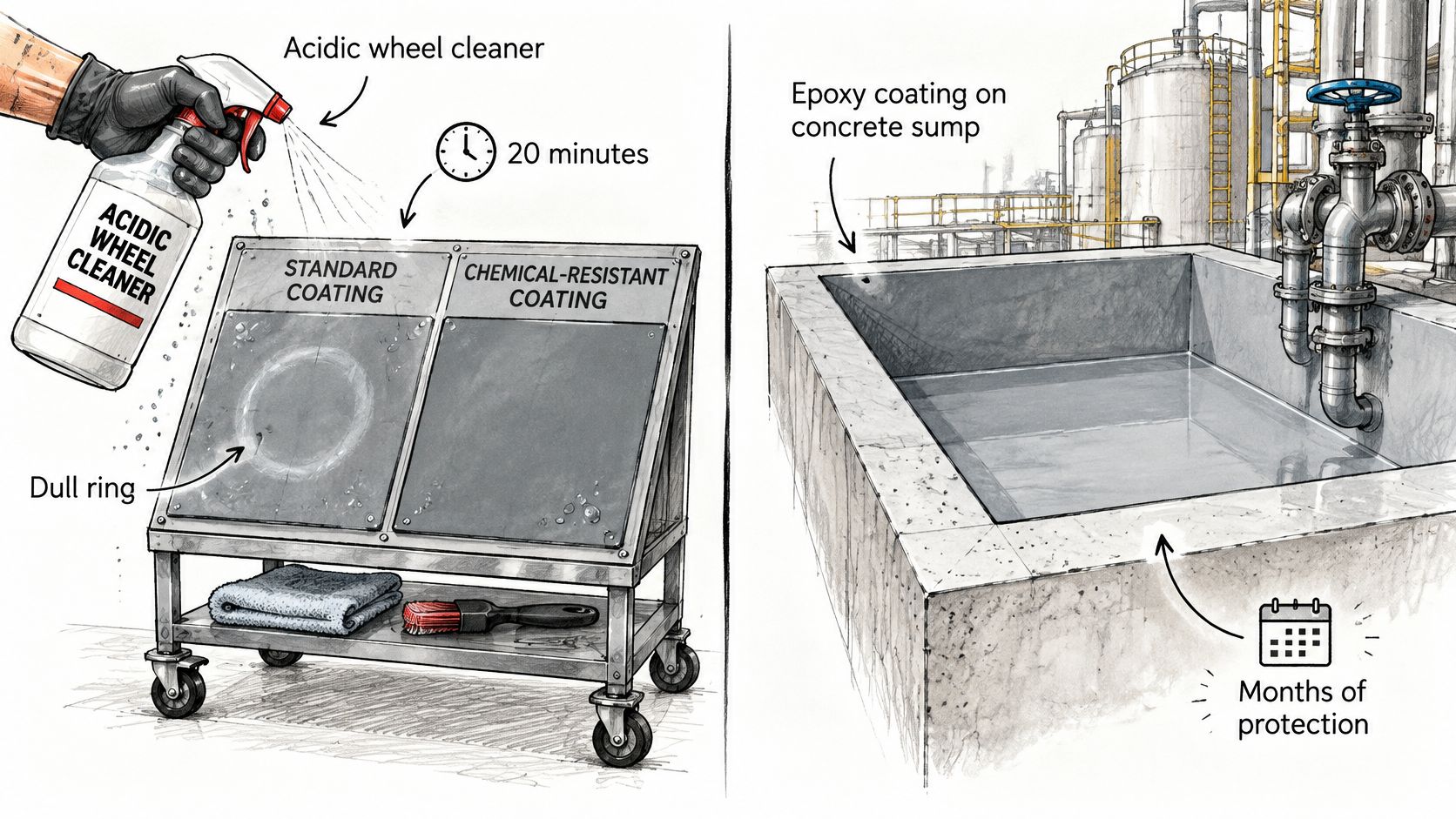
An acid resistant epoxy coating is not a color of paint, and it is not immunity to every acid. Resin chemistry, cure, thickness, holidays, and the exposure decide the result. A buyer who treats the phrase as a universal attribute will specify a tank lining for a door skin, or a consumer film for a sump, and then blame the resin when the wrong row of the job shows up.
The useful move is a short specification. Name the chemical. Say whether it splashes or soaks. Then match resin architecture, a test you can read, and a film that stays continuous on the surface you have, from a sump wall to a panel that flexes between a frozen morning and a hot afternoon.
Practical rule: If you can’t name the acid and the contact time, you don’t have a resistance claim yet. You have a slogan.
Match the Coating to the Real Exposure
Acid resistant means one named chemical, at a named strength and temperature, for a named time, on a named substrate, judged by a named failure sign. Circle one row before you talk resin.
| Exposure | Typical cases | Details to specify | Do not assume |
|---|---|---|---|
| Short splash or drip | Wheel cleaners, bird droppings, battery electrolyte mist, industrial fallout | Acid name, concentration, temperature, dwell, substrate, film age | A tank-lining claim covers a thin automotive film |
| Covered 24-hour spot | About 1 ml of 10% acetic acid, 50% sulfuric acid, 50% sodium hydroxide, 10% ammonium hydroxide, or xylene | Watch-glass contact and a 1-to-5 damage score | A score of 5 on one chemical is a score of 5 on all |
| Vapor or fume | Organic-acid vapors, battery charging areas, process fumes | Vapor versus liquid, temperature, ventilation, dwell | Liquid immersion data predicts hot vapor |
| Continuous immersion | Tanks, sumps, wastewater, secondary containment | Acid, percent, temperature, duration, holidays, abrasion | Any epoxy, or a consumer film, is qualified |
| Splash plus flex or impact | Vehicles, marine fittings, panels that expand and vibrate | Chemical spot rating plus a bend test such as ASTM D522 | Hardness alone keeps the film continuous |
| Abrasion plus chemistry | Floors, hangar traffic, ship decks | Film thickness, full cure, and whether grit and acid act together | A holiday-free lab panel matches the job site |
How to pick the row
Short splash is the detailer’s row. Wheel cleaner, bird droppings, a mist of battery electrolyte, and industrial fallout hit, then get rinsed. Dwell is minutes, not a season. A covered spot is stricter. A coatings report places about 1 milliliter under a watch glass for 24 hours, then scores the spot from 5 (no damage) to 1 (very strong damage) on chemicals such as 10% acetic acid, 50% sulfuric acid, 50% sodium hydroxide, 10% ammonium hydroxide, and xylene, as described in the Paint.org biobased epoxy report.
Vapor is its own row because hot organic-acid fumes are not a puddle. Continuous immersion covers tanks, sumps, and secondary containment, and it needs holiday and abrasion notes. Flexing panels and trafficked floors add movement or grit to the chemistry. A membrane chosen for a commercial flat roof has to survive ponding and sun on a broad deck. That exposure logic is the same idea here. Standing liquid, heat, and movement each change what “resistant” is allowed to mean.
Mineral acids and organic acids don’t behave as one family. In a 60-day immersion study, general epoxy resins in 10% acetic acid showed noticeable drops in Barcol hardness and bending strength, while organic-acid-resistant formulations deteriorated less, and one pass condition is no swelling, cracking, softening, or dissolution after 60 days in 5% acetic acid at 23 ± 2°C, per a Japan Sewage Works Agency technical report. A film that survives dilute hydrochloric acid can still fail in hot acetic vapor or on cracked concrete. A short spot test can’t predict a long soak. For steel in process service, start from a chemical resistant coating for steel written to the row you circled, not to a generic epoxy name.
How Crosslinks Slow an Acid Attack
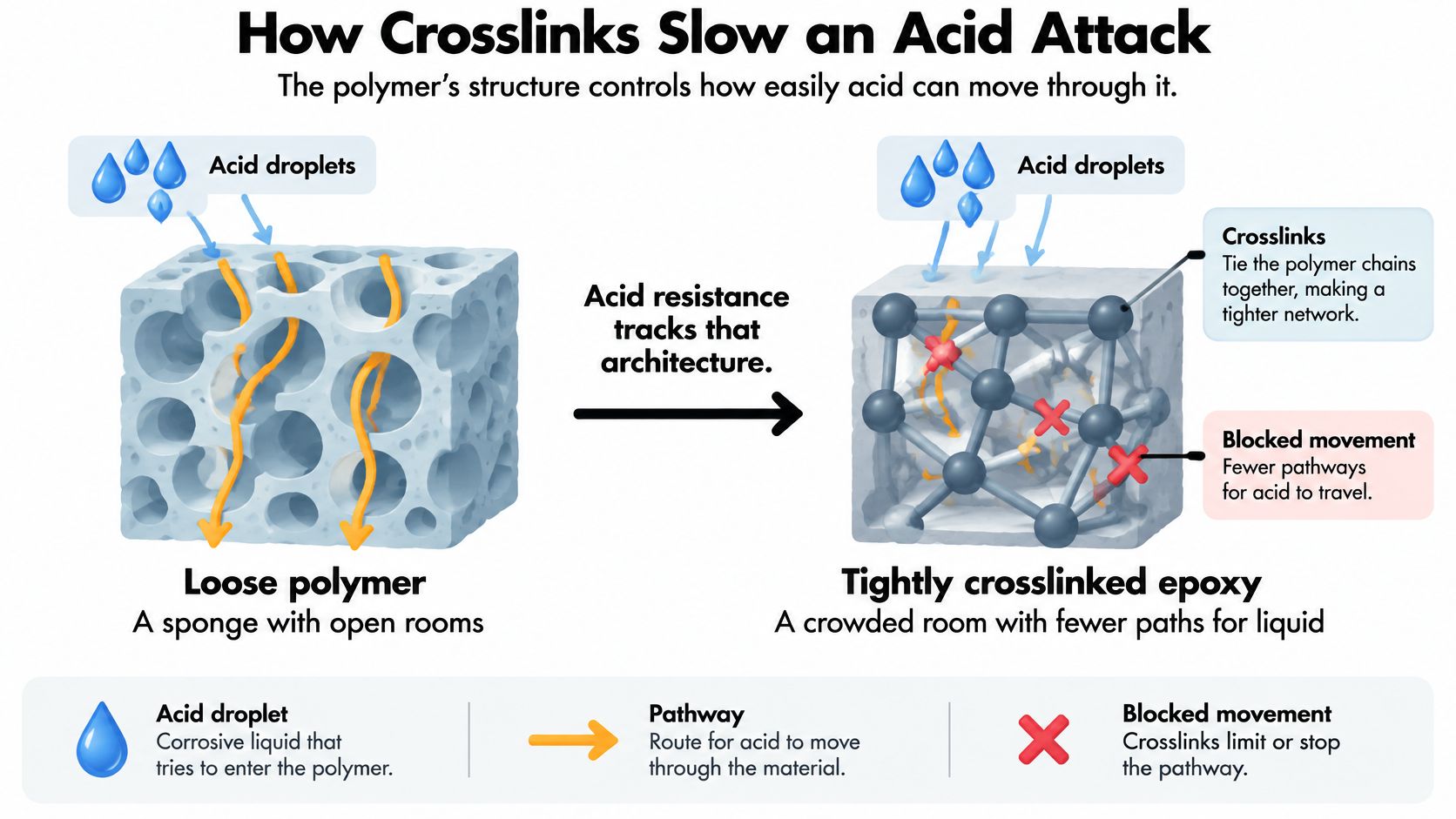
Say a café owner needs to protect a floor from occasional acidic splashes, not continuous tank immersion. The resin’s crosslink network helps set how quickly liquid can enter and move through the film. A more tightly crosslinked structure leaves less accessible free volume and slows permeation, though no coating resists every acid under every condition.
What a long soak ranked
A 600-day immersion compared seven epoxy systems in citric, nitric, and sulfuric acids, at concentrations up to 20% and about 26°C. Novolac epoxy had the lowest acid permeation, followed by a higher-performance conventional epoxy and then a standard epoxy, according to the Water360 epoxy coatings performance report.
Permeation followed two stages:
- Fast first uptake: Acid entered accessible free volume, and the film gained mass before a blister appeared.
- Slower second stage: Diffusion continued through a more saturated network. The curve flattened, but did not stop.
Sulfuric and nitric acids permeated faster than citric acid in that comparison. Acid type and how its molecules interact with the resin matter alongside concentration. The same percentage of two different acids does not describe the same exposure.
What to specify for a soak
For prolonged immersion or repeated chemical service, consider novolac or another highly crosslinked resin, then qualify the coating against the actual acid, concentration, temperature, duration, and failure limit. A brief spot test cannot predict performance across a 600-day soak.
A hard novolac tank lining may suit continuous immersion, while a hard-but-flexible vehicle film may better accommodate splashes and temperature cycling on moving panels. Choose for the exposure and substrate, then confirm with testing. Crosslinking only helps when the film cures properly and remains intact: incomplete cure or pinholes can give acid easier paths into the coating.
Tests Cure and Defects That Change the Result
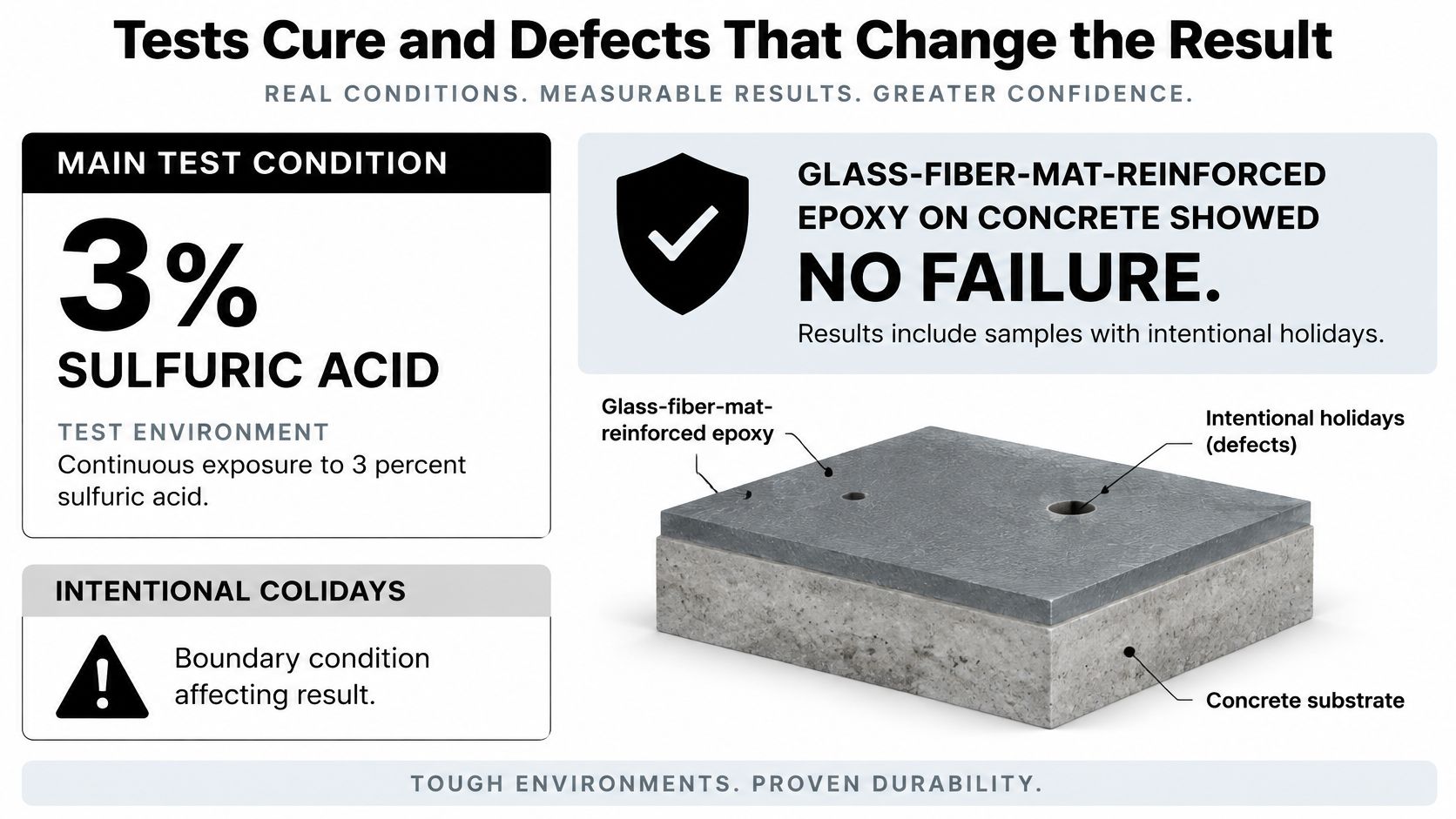
Say a café owner needs to protect a concrete floor from acid splashes. A reinforced epoxy system may suit that exposure, but its test result has boundaries: it belongs to a particular substrate, film build, acid, and test method. Glass-fiber-mat-reinforced epoxy on concrete showed no failure for up to 20 months under 3% sulfuric acid, including samples with intentional holidays. Using procedures adapted from ASTM G20-88, researchers calculated more than 70 times the time-to-failure of the unprotected condition in a peer-reviewed coatings durability study. That result applies to reinforced concrete, not thin vehicle film.
Numbers that fence the claim
A short soak can make a coating look stable. Modified epoxy immersed in 10% sulfuric acid for 100 hours lost only 3–4 MPa of compressive strength, within a stated range of −5% to +5%, according to a peer-reviewed coatings durability study. In a separate aging result, hydrochloric acid at 60°C for 40 days reduced tensile strength to 44.42 MPa, a 28.3% drop, in the same study. The acid and temperature changed, and so did the result.
A 2024 waterborne coating study aligned with ASTM D1308 and ASTM D870. Its reference coating remained effective in sulfuric acid for 32 days, while the graphene-silica nanocomposite lasted 55 days, a 71% extension. Results also rose from 65 to 106 days for sodium hydroxide and from 52 to 96 days for sodium chloride, as reported in the 2024 nanocomposite coating study. Those gains describe that formula, not every nano coating.
| System | Exposure studied | Measured result | Buyer takeaway |
|---|---|---|---|
| Glass-fiber epoxy on concrete | 3% sulfuric acid, including holidays, ASTM G20-88 adapted | No failure up to 20 months; more than 70 times the unprotected life | Result applies to reinforced concrete |
| Modified epoxy | 10% sulfuric acid for 100 hours | Compressive strength down only 3–4 MPa, within −5% to +5% (study) | Short immersion can look stable |
| Epoxy aging study | Hydrochloric acid at 60°C for 40 days | Tensile strength 44.42 MPa, a 28.3% drop (study) | Heat and acid can change the outcome |
| Waterborne graphene-silica epoxy | Sulfuric acid, methods aligned with ASTM D1308 and D870 | 32 days for the reference versus 55 days for the nanocomposite, a 71% gain | The result applies to this formula |
| Post-cured novolac | 30% nitric acid, 10% acetic acid, phenol, methylene chloride | Higher post-cure temperature, lower weight gain | Cure quality affects chemical resistance |
| CNT-modified epoxy | Acidic saline below pH 3 up to 60 days; one salt study at 3.5% NaCl | Loadings such as 0.25–0.5 wt% or 2 g/L; impedance about 10^8 ohm-cm² at 0.01 Hz after 36 days in salt water | Dispersion and dose shape the barrier |
For novolac, higher post-cure temperature reduced weight gain in 30% nitric acid, 10% acetic acid, phenol, and methylene chloride. More complete crosslinking leaves less free volume, as described by Coatings World on chemical resistance. Weight gain can signal blistering, softening, or adhesion loss before visible damage appears.
Carbon nanotube loadings of 0.25 and 0.5 weight percent were studied in acidic saline below pH 3 for up to 60 days. In another result, a formulation with 2 g/L of modified nanotubes maintained impedance near 10^8 ohm-cm² at 0.01 Hz after 36 days in 3.5% sodium chloride, in MDPI composite coatings research. Dispersion and dose determine whether those additives help form a barrier.
What the bay has to control
Mix ratio, working time, ambient temperature, humidity, and full cure all affect the film. A lab panel cannot reproduce every combination of concrete porosity, steel profile, thermal cycling, and abrasion. After exposure, inspect for haze, soft spots, edge creep, pinholes, and adhesion loss. For a plain-language overview of what third-party testing actually covers, look at the test scope alongside the coating result.
Selection Criteria and Test Standards
Say a café owner needs a coating for a concrete floor exposed to acid splashes. A short spot test may pass while a bend test reveals cracking in a flexible vehicle film. “Acid resistant” is therefore a bounded test result, not a promise that one coating resists every acid or exposure.
Use this checklist to turn the intended service into a specification:
- Name the acid and its strength.
- Specify the temperature and whether the film faces vapor or liquid.
- Set the exposure duration, from a drip to continuous immersion.
- Identify the substrate, including steel profile or concrete porosity.
- Set the film thickness and holiday limit.
- Require full cure before chemical service begins.
- Define failure, such as swelling, cracking, softening, or dissolution.
| Standard | Test type | Answers the question |
|---|---|---|
| ASTM D1308 | Household-chemical spot test | Does a short covered spot damage the film? |
| ASTM D870 | Water immersion | Does prolonged water exposure soften or blister the film? |
| ASTM G20 | Adapted chemical resistance for coated concrete | Does acid reach the substrate through a coated concrete system? |
| ASTM D522 | Mandrel bend | Does the film crack when it flexes? |
A supplier naming a test method should also state the pass limit for the tested exposure. A D1308 spot result, for example, does not establish how a film performs under immersion or flexing. For a tank lining, prioritize the chemical exposure test; for a vehicle panel facing splash and temperature cycling, a hard-but-flexible film may suit the movement better than a rigid novolac lining. Review the chemical resistance of engineering plastics when selecting fittings, and use a chemical resistance table only when it includes the relevant material and chemical.
Where Acid Resistant Epoxy Earns Its Keep
A service truck makes the split obvious. Battery acid mists the tray at 7 a.m. By night the same vehicle has crossed from desert heat into a freeze, with grit on the lower panels. The tray wants a qualified lining. The skin wants a film that can move.
Five workplaces, five acid stories
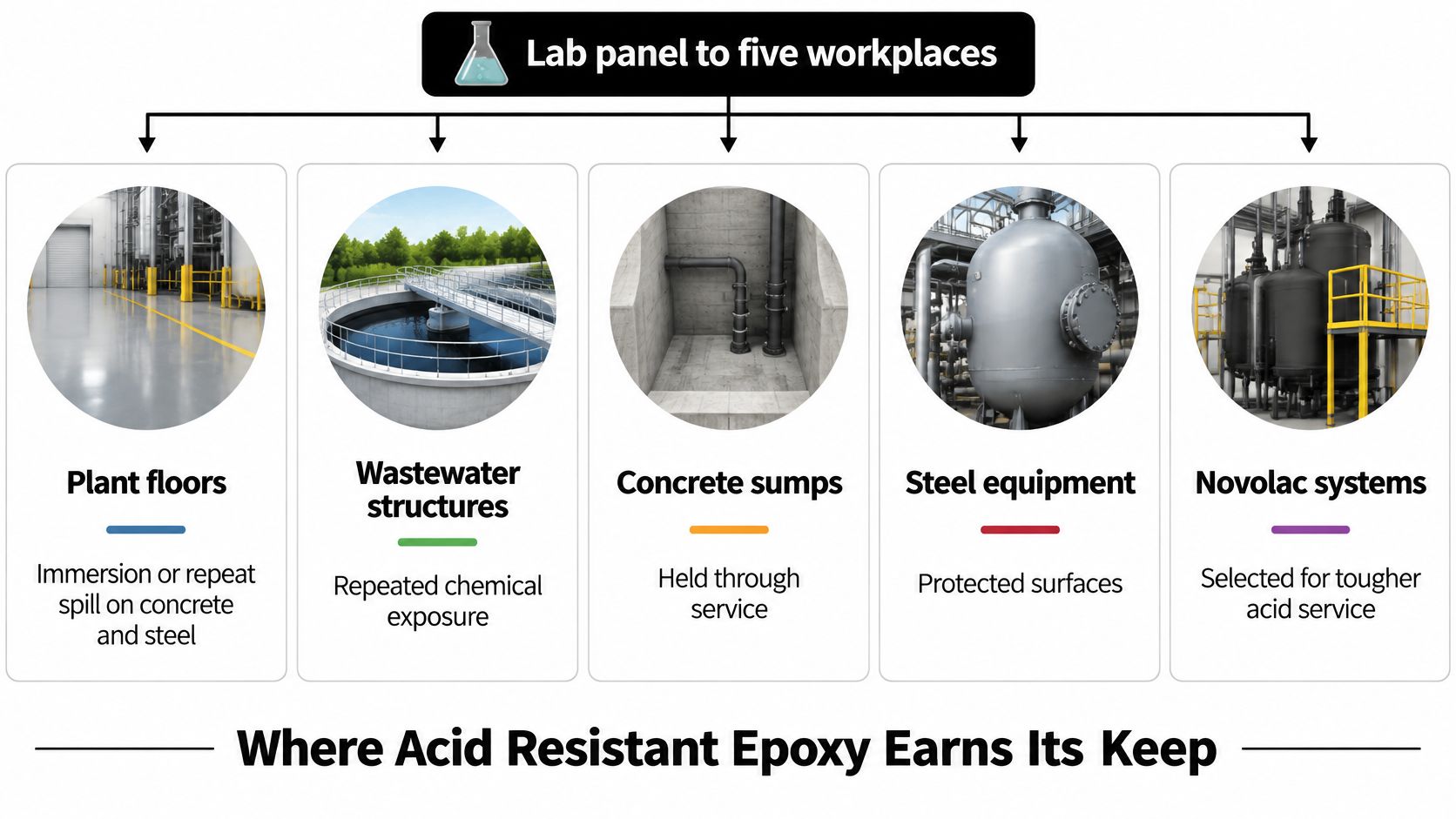
Plant floors and wastewater structures see immersion or repeat spill on concrete and steel. Novolac systems, holiday limits, and film thickness dominate, because a pinhole becomes the path.
Automotive work is usually brief. Wheel cleaner, bird droppings, electrolyte around terminals, industrial fallout, and fuel or cleaner splash in a shop are not a sump. Rinse time is part of the protection.
Aviation stacks deicing chemicals and hydraulic-fluid drips with ramp grit and wide temperature swings on skins and ground gear. A rigid high-build that suits a tank can crack on a panel that expands.
Marine fittings and decks add salt to acidic cleaners and fuel, plus constant flex. Continuity after movement matters as much as the chemical spot score.
Defense and expedition vehicles combine impact, storage in extreme climates, and films that must stay continuous after the body moves. A lab panel that never flexed isn’t that duty cycle.
Lab benches tell a related story in a smaller room. Labs USA’s epoxy resin table options exist because spills of acids and solvents land on a work surface that also gets wiped, scratched, and cleaned. The tabletop isn’t a vehicle door, and it isn’t a wastewater channel either.
Proof a fleet buyer should request
Ask for process control under ISO 9001 and for third-party exposure data tied to a named method. You want the acid, the duration, and the failure sign in the report, not a brochure adjective. Containment and floors get a qualified acid resistant epoxy with thickness and holidays written down. Splash, impact, and temperature cycling on an exterior point toward a flexible system instead. Broader plant uses sit under industrial coating applications, where the substrate and the traffic change the spec again.
Flexible Vehicle Coatings When Epoxy Is the Wrong Film
Say a café owner drives through a winter thaw, then parks in the sun. The vehicle panel warms and shifts; a bug strikes at speed. A rigid coating can crack under that movement, giving acid and salt a route beneath the film even while the surface still looks glossy.
Flexibility can be tested rather than assumed. A 2025 coatings study assessed bending resistance with ASTM D522, a method that checks whether a coating deforms without cracking, as reported in the 2025 coatings bending study. The result depends on conditions such as mandrel diameter, film thickness, cure schedule, and substrate, as well as whether cracks appear. An elastomer-modified coating aims to pair a hard surface with enough give to accommodate movement and temperature changes. That can help keep a barrier continuous, but no film resists every acid. Product-specific test data still matters. The role of give is explained in this guide to coating flexibility.
Films for splash, glass, and flex
A vehicle exposed to splashes, dirt, and temperature cycling calls for a different film behavior than a tank lining under continuous immersion. APEX Nano is a vehicle-side option for those changing conditions; a hard-but-flexible film can suit that duty better than a rigid novolac lining.
Alpha Quartz 50ml Ceramic coating is an elastomer ceramic coating for paint, including for DIY users and mobile detailers. Apply it in a cross-hatch, allow a short dwell, then wipe with short-pile and long-pile microfiber. Its flexibility is intended to help the film accommodate temperature swings and insect impacts. The practical measure is whether the coating stays continuous, since a crack can compromise the barrier.
For glass, Apex Glass is designed to shed rain and help wipers clear the windshield. Apply two coats and treat the wiper blades so water moves across the glass rather than smearing through the driver’s view.
Choose a film for the surface and exposure through the Titan Coatings shop. Vehicle splash and flex call for a coating suited to movement; continuous acid immersion calls for a specified lining system.
Specify the Acid Then Keep the Film Intact
Say a café owner finds cleaner splashed along a painted fleet vehicle, while a plant manager faces acid on a concrete floor. Those are different exposure problems. For immersion, vapor, or floors under chemical traffic, specify a novolac or other highly crosslinked acid resistant epoxy. Record the acid, concentration, temperature, exposure duration, film thickness, allowable holidays, and cure schedule. For vehicle splash, glass, or temperature cycling, choose a flexible Titan film suited to that surface. A vehicle coating is not a substitute for a tank lining.
Upkeep that keeps the path closed
- Identify the chemical and rinse it promptly. Wheel cleaner and bird droppings can mark a surface when left to dwell. Rinse them rather than waiting until the rest of the vehicle is finished.
- Allow full cure before chemical exposure. A soft, uncured film is more vulnerable to staining than a fully cured one.
- Inspect edges, chips, and pinholes under bright, diffused light after harsh cleaners. Look for haze or soft spots before peeling begins.
- Repair holidays before the next exposure. Even a small opening can let acid reach the concrete or travel beneath a panel-edge coating.
- On glass, reapply the hydrophobic coating when water no longer sheets away and the wipers begin working harder. Changes in visibility during rain offer a practical cue.
- On paint, refresh the sacrificial layer on its interval. Where temperature swings and bug strikes are routine, keep a stackable elastomer coat as the base. ULTRA Ceramic Spray is a water-based flexible membrane sealant for paint systems, wraps, PPF, glass, wheels, plastic trim, and some household items. Apply it to a short-pile towel, buff in one layer, and allow it to dry before exposure to weather.
Choose the paint sealant for painted surfaces and the hydrophobic coating for glass. For a hood, windshield, or fleet skin exposed to splashes, match the coating to the surface and the chemical contact, then maintain the film before a defect becomes an entry point.
APEX NANO – Titan Coatings develops elastomer and nano-structured films for vehicle surfaces exposed to splash, impact, and temperature cycling, rather than continuous acid immersion. For a hood, windshield, or fleet skin, select a flexible vehicle coating, not a tank lining. Visit APEX NANO – Titan Coatings to compare the vehicle coatings and choose one suited to the exposure.
0 Comments