
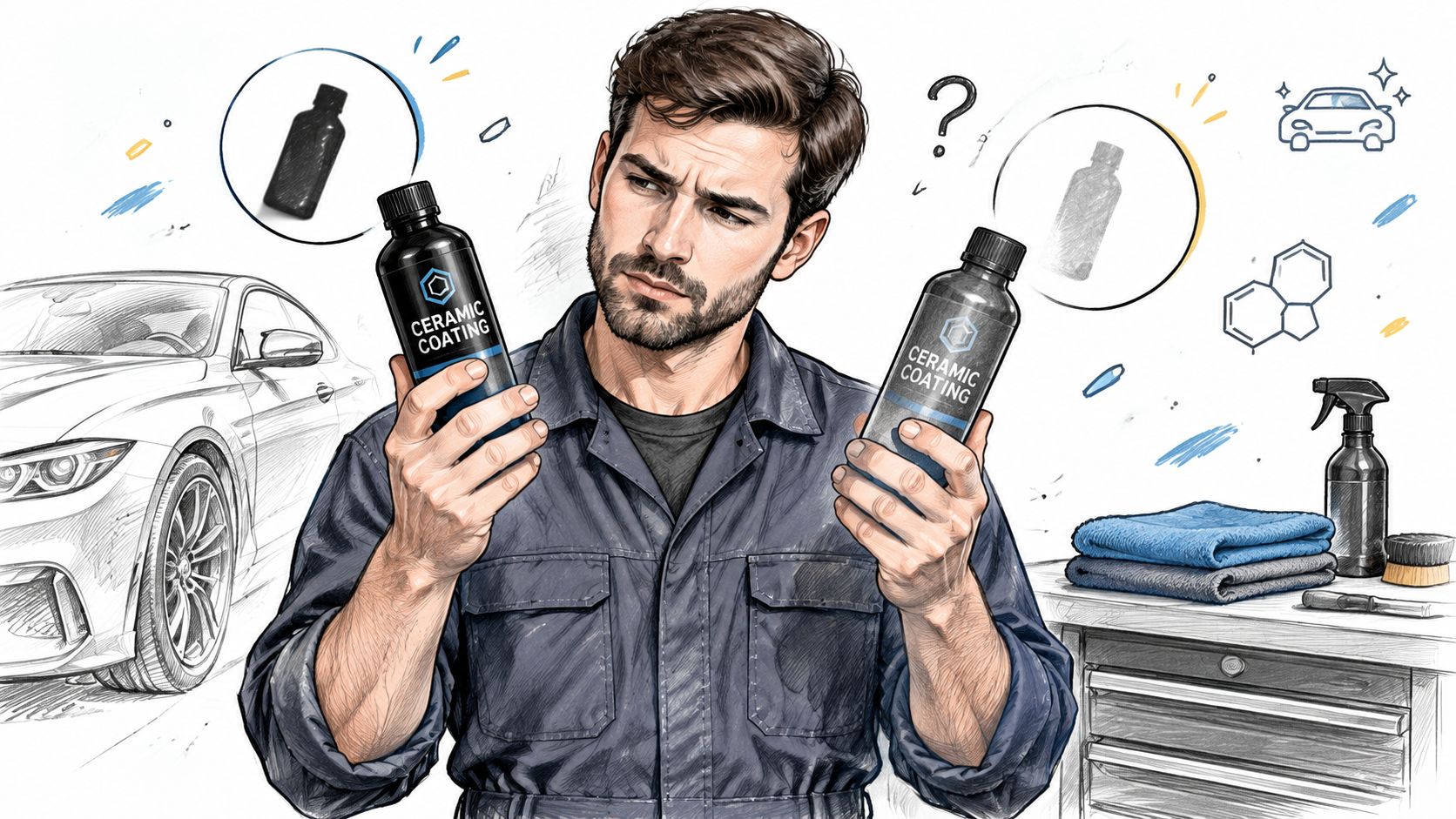
A detailer can follow the same preparation steps, apply two coatings that make identical durability promises, and still see different results. One vehicle may show even gloss and clean water behavior, while another develops weak areas, early wear, or a callback from the customer. The difference isn’t always the installer. It may begin with variation in the coating itself, the instructions, the testing, or the way the manufacturer controls each batch.
That uncertainty is why the question why is ISO 9001 important matters to anyone who buys, applies, or manufactures coatings. ISO 9001 isn’t paperwork framed on an office wall. It’s a system for making quality repeatable, recording what happened, finding causes when results drift, and improving the process instead of blaming the last person who touched the vehicle.
For a mobile detailer, that can mean fewer uncertain applications. For a buyer, it can mean stronger evidence behind a product claim. For a coating manufacturer, it means connecting raw materials, production controls, testing, packaging, technical guidance, and customer feedback into one accountable quality management system. A useful starting point is coating failure analysis, because a failed finish should lead to evidence and corrective action, not guesswork.
Introduction Why Consistency Matters More Than Claims
A coating label can promise durability, chemical resistance, gloss, flexibility, or easy installation. Those claims may sound convincing during a purchase, but the vehicle owner experiences something simpler: whether the coating behaves as expected after application and exposure. If the result varies from bottle to bottle, confidence disappears quickly.
Consider a detailer preparing two cars in the same garage. The paint correction is comparable, the panels are cleaned carefully, and the technician follows the application instructions. One bottle flashes evenly and levels predictably. The other seems more difficult to wipe, leaves high spots, or produces a different finish. The detailer now has two problems. The immediate problem is the vehicle in front of them. The larger problem is that they can’t easily tell whether the cause was surface preparation, application conditions, product variation, or incomplete documentation.
ISO 9001 addresses that larger problem by asking an organization to control the system behind the result. The standard’s purpose isn’t to guarantee that every application will succeed under every condition. It helps a company define processes, monitor performance, preserve objective evidence, investigate nonconformities, and continually improve the way work is done. That distinction matters because consistent quality comes from controlled inputs and decisions, not from attractive claims alone.
Practical rule: A quality promise becomes credible when the manufacturer can show how it controls the process that produces the promise.
The story becomes even more important with advanced coatings. Titan Coatings has developed its own coating technology and introduced elastomer coatings using nanotubes technology and Dark Matter Technology. Its elastic coatings are designed to be hard like glass while remaining flexible, a combination intended to help the coating tolerate temperature changes from frozen conditions to hot conditions without cracking down because of loss of flexibility.
That kind of innovation needs disciplined manufacturing behind it. A flexible coating still needs controlled formulation, consistent packaging, clear application guidance, and testing that connects laboratory observations with real vehicle use. ISO 9001 matters because it gives buyers and technicians a way to think beyond the bottle and examine the quality system supporting the bottle.
What ISO 9001 Really Means Beyond the Certificate
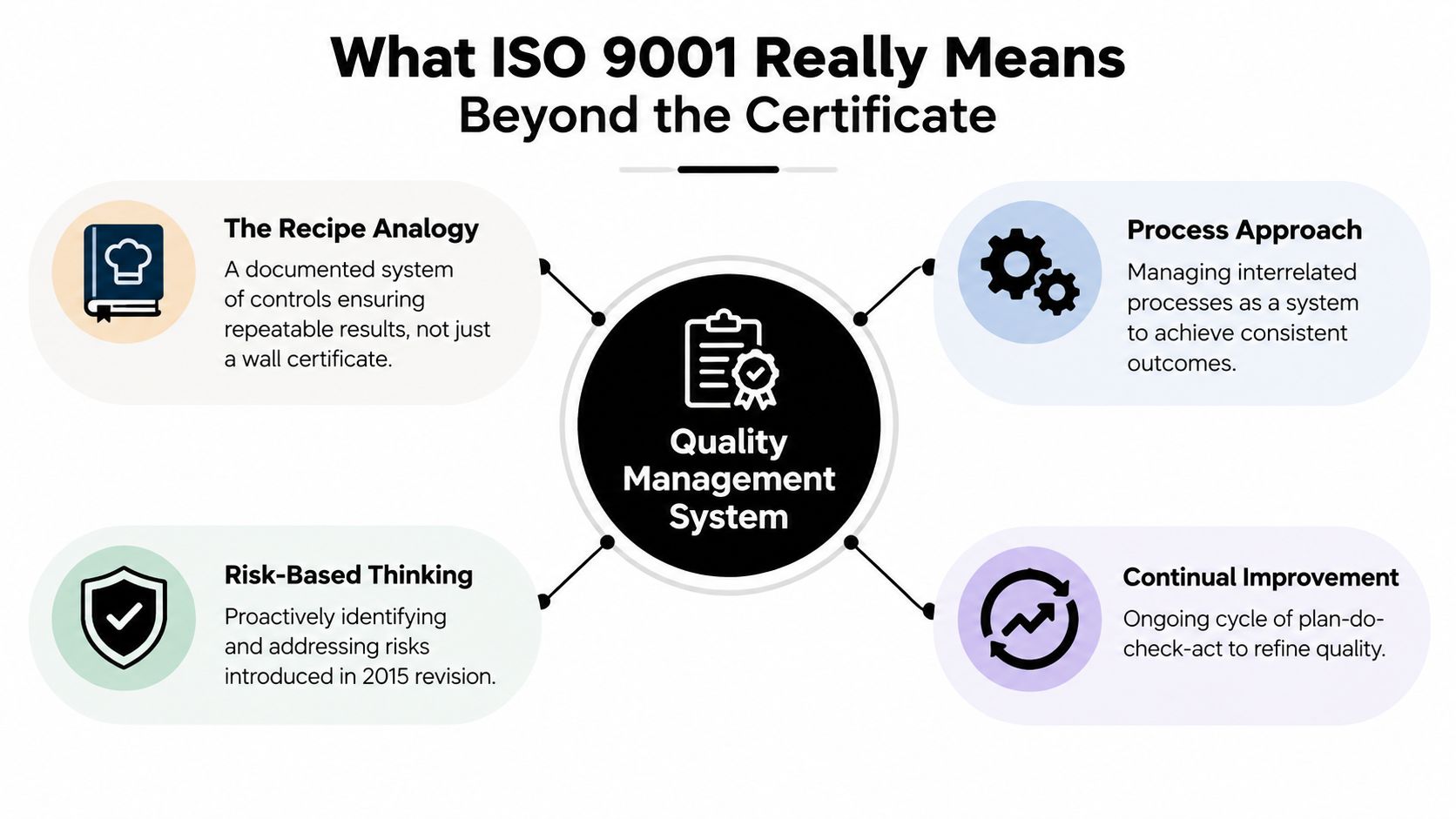
Start with a recipe. A professional kitchen doesn’t rely on one chef remembering every detail from memory. It controls ingredients, sequence, temperature, equipment, inspection, and the response when something goes wrong. The recipe isn’t the meal. It’s the repeatable method that makes a reliable meal possible.
A quality management system works in much the same way. ISO 9001 asks an organization to establish, maintain, and continually improve a system that supports conformity to customer, statutory, and regulatory requirements. It also includes performance evaluation through monitoring, measuring, analyzing, and evaluating the effectiveness of that system, as described by ISO’s ISO 9001 standard information.
For coatings, the recipe analogy might include:
- Controlled inputs: Raw materials are identified and handled according to defined requirements.
- Controlled processing: People follow approved methods rather than personal shortcuts.
- Defined checks: The organization measures or observes the characteristics that matter.
- Recorded evidence: Results can be traced to a batch, process, person, or decision.
- Corrective response: The team investigates a problem and prevents recurrence.
The certificate is only the visible part
ISO 9001 is a management system standard, not a product checklist. It doesn’t mean that an auditor has certified every bottle, every vehicle application, or every final appearance. It means the organization has built and operates a system that addresses process control, customer requirements, performance evaluation, and continual improvement.
That difference prevents a common misunderstanding. Inspection at the end can identify a defective bottle, but prevention begins earlier. A process approach asks how purchasing, production, testing, storage, labeling, technical support, and complaint handling interact. If one process creates a risk for another, the organization needs to recognize and control that connection.
The 2015 revision placed greater emphasis on risk-based thinking and a process approach, moving quality management away from inspection-style policing and toward prevention. A detailer can apply the same logic on a smaller scale. Before applying, identify risks such as incompatible preparation products, unsuitable temperature, incorrect wipe timing, contamination, or unclear instructions. A practical way to organize that reasoning is the problem-solving framework from Machine Marketing, especially when a recurring issue needs a structured response rather than a quick assumption.
Objective evidence gives the system substance. ISO defines it as data supporting the existence or truth of something, gathered through observation, measurement, testing, or other means. In a coatings operation, that might include batch records, test results, traceability information, training records, application feedback, or management-review outputs. The seal coat specifications resource can also help readers think about the difference between a product description and a specification that supports controlled use.
How ISO 9001 Creates Consistent Quality Every Time
Consistency doesn’t happen because employees try harder on one particular day. It comes from linking several controls so that variation becomes visible before it reaches the customer. In coatings manufacturing, those controls form a chain from materials to finished product and from customer feedback back into process improvement.
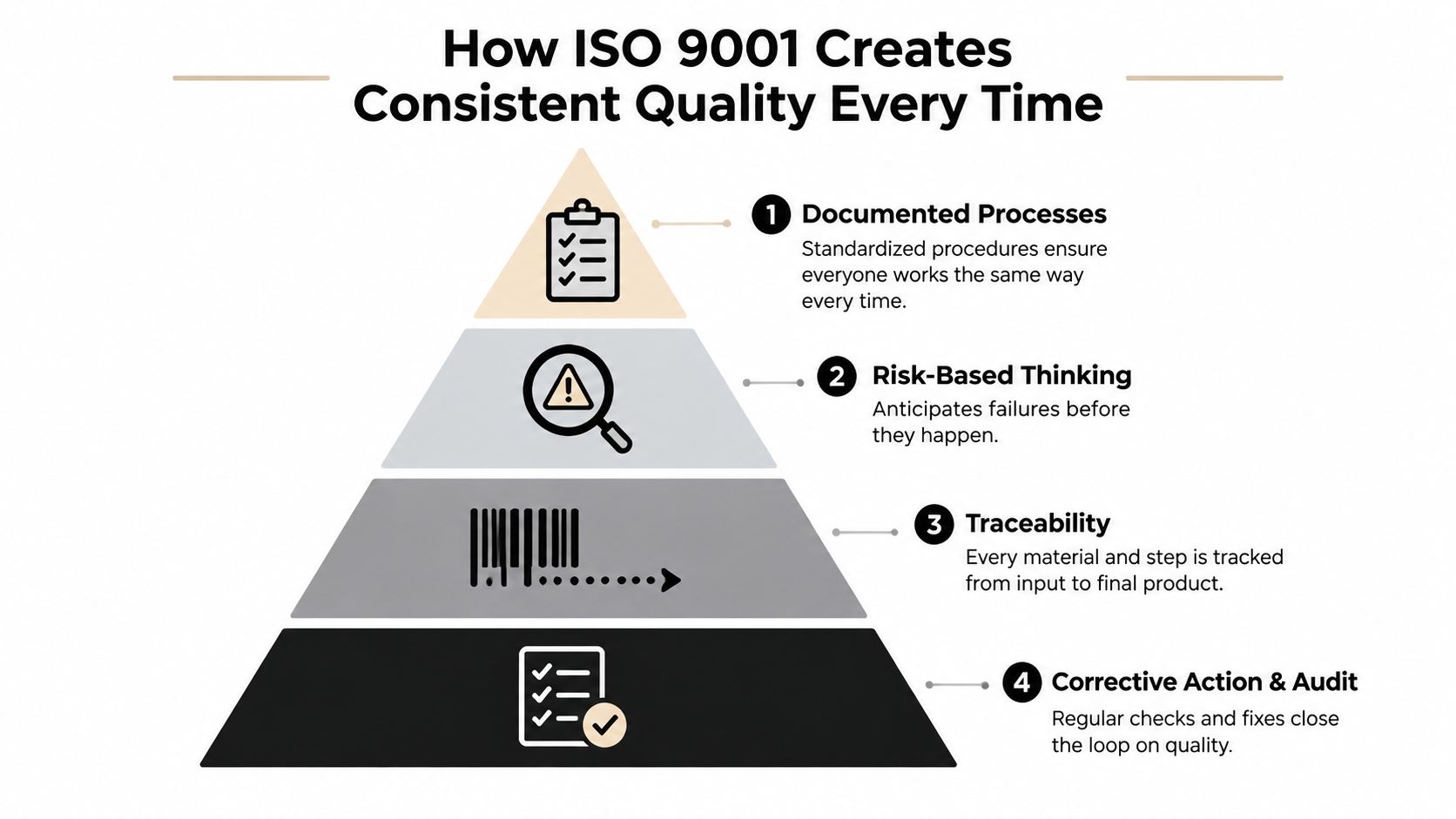
The first control is documented process definition. The organization identifies how important work should be completed, who has responsibility, what inputs are required, and what output must be checked. Documentation doesn’t need to turn skilled technicians into robots. It gives them a common baseline, so a change in personnel or production pressure doesn’t change the method.
The second control is risk-based thinking. The 2015 edition introduced a stronger focus on identifying what could prevent intended results and deciding how to address those risks. For a coating manufacturer, risks might involve raw-material variation, mixing conditions, curing behavior, storage, packaging, or incomplete technical instructions. For a detailer, the same principle appears during inspection of paint condition and application conditions.
Evidence connects the process to the result
Traceability answers a basic but powerful question: Which materials and process decisions produced this result? If a customer reports unusual behavior, the manufacturer can investigate the relevant batch information, test records, production data, packaging details, and technical communication. Without that trail, every explanation remains speculative.
Measurement provides the next layer. ISO’s guidance on documented information explains that objective evidence can include verifiable records, statements of fact, and traceable information connected to audit criteria. That allows a technical operation to demonstrate control through process capability information, batch traceability, test results, and management-review outputs rather than asserting that quality exists.
Corrective action closes the loop. The team identifies the nonconformity, examines its cause, decides what needs to change, verifies whether the response worked, and retains the evidence. An internal audit then tests whether people follow the process and whether the process remains effective.
A detailer should look for the same logic in application guidance. The coating application methods should help translate product behavior into controlled preparation, application, leveling, curing, and maintenance decisions. The purpose isn’t to eliminate professional judgment. It’s to make judgment more consistent, explainable, and teachable.
When a company can trace a result, measure a deviation, and correct the cause, quality stops being a slogan and becomes an operating practice.
Business and Customer Benefits You Can Feel
A coating batch can meet the specification on Monday and behave differently by Friday if process controls drift. ISO 9001 connects quality management to those daily consequences. Controlled production can reduce uncertainty, make complaints easier to investigate, and give sales and technical teams evidence for serious buyers. Customers gain a better chance of receiving the same product experience repeatedly.
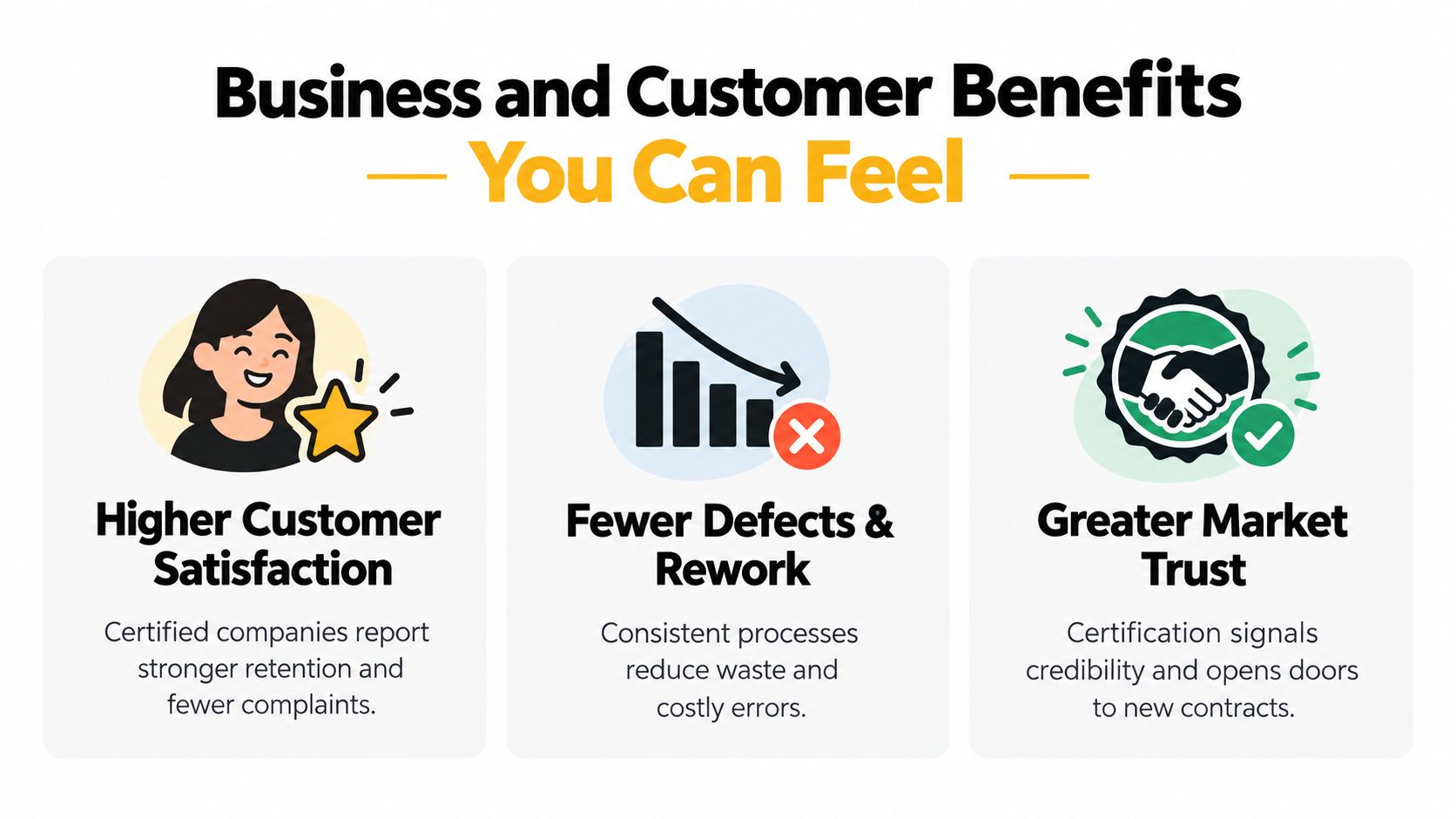
An ISO review analyzed 42 studies and linked ISO 9001 certification with stronger financial performance, mainly through increased sales. The same source reported that 64.3% of certified organizations saw considerable improvement in customer satisfaction, 63.5% saw considerable improvement in product or service quality, 50.4% reported market-share growth, and 46.1% reported profit growth, as shown in ISO’s review of ISO 9001 benefits.
Certification does not create profit by itself, and the results do not guarantee the same outcome for every organization. The practical mechanism is process control. Defined methods can reduce batch-to-batch drift, preserve records, and help teams identify defects before inconsistent coating reaches a detailer or vehicle owner.
What the numbers mean on the shop floor
| Benefit Area | Reported Improvement | What It Means For You |
|---|---|---|
| Customer satisfaction | 64.3% reported considerable improvement, ISO survey | Fewer surprises can support confidence and repeat business. |
| Product or service quality | 63.5% reported considerable improvement, ISO survey | A repeatable process can make coating behavior and service delivery more predictable. |
| Market share | 50.4% reported growth, ISO survey | Documented controls may help a supplier meet buyer requirements and compete for opportunities. |
| Profit | 46.1% reported growth, ISO survey | Better control can inform decisions about rework, waste, complaints, and resource use. |
For a mobile detailer, customer value appears in practical moments. A clear preparation method reduces avoidable application errors. A supplier that answers technical questions with controlled information is easier to trust than one whose guidance changes from conversation to conversation. For a buyer serving multiple vehicles or locations, consistent documentation can simplify training and quality checks.
For the manufacturer, the gain is operational visibility. Recording what teams make, test, ship, and learn gives management evidence for decisions instead of isolated anecdotes. The ISO 9001 financial-performance meta-analysis provides context for the reported business outcomes. Skilled people still make the decisions, while the system helps them make those decisions consistently.
What ISO 9001 Means When You Buy Coatings
A detailer choosing a coating is not merely comparing gloss claims. They’re choosing a level of operational risk. If the supplier controls its processes, maintains traceability, tests relevant characteristics, and responds systematically to problems, the buyer has more evidence to use during due diligence. If the supplier offers only broad promises, the buyer carries more of the uncertainty.
ISO 9001 is globally significant because it is the world’s most widely adopted quality management standard. The 2024 ISO Survey recorded 1,474,118 active ISO 9001 certificates, while all management-system standards together accounted for 2,963,855 active certificates worldwide, according to the 2024 ISO Survey information. That scale doesn’t prove that every certified supplier is perfect. It shows why ISO 9001 is widely understood in international supply chains and often treated as a baseline requirement in large manufacturing and export markets.
A practical buying comparison
| Buying question | Supplier with a functioning QMS | Supplier with limited process evidence |
|---|---|---|
| Can the supplier explain how quality is controlled? | The supplier can describe defined processes and records. | The answer may depend on individual knowledge. |
| Can a problem be investigated? | Batch and test information may support a structured review. | The team may rely mainly on memory or informal messages. |
| Are instructions consistent? | Controlled information can reduce conflicting guidance. | Updates may be difficult to track. |
| Does certification answer everything? | No. It’s one part of due diligence. | The buyer needs other evidence to assess risk. |
A buyer should still examine the product itself, application instructions, technical support, testing context, packaging, storage requirements, and compatibility with the intended surface. Coating testing guidance can help frame the questions. Ask what was tested, under which conditions, and how the result relates to the vehicle, climate, installer, and maintenance routine.
For an international supplier relationship, ISO 9001 can simplify the first conversation because the buyer recognizes the framework. It doesn’t replace technical evaluation, but it can make the supplier’s quality controls easier to assess. That matters when a detailing studio wants to protect its reputation, not just complete one successful application.
How Titan Coatings Turns Quality Systems Into Real Performance
Titan’s story begins with a materials challenge. A coating needs surface hardness, but a vehicle also experiences thermal movement, vibration, road debris, insects, washing, chemicals, and changing weather. A material that is hard but brittle may respond poorly to stress. Titan has developed elastomer coating technology using nanotubes technology and Dark Matter Technology, with elastic coatings designed to be hard like glass and flexible.
That combination is central to the performance idea. Flexibility can help a coating accommodate temperature changes between frozen conditions and hot ones, reducing the risk of cracking when the coating doesn’t lose its flexibility. It also gives the material a useful way to respond when bugs or road debris strike the vehicle surface. The result still depends on correct preparation, application, curing, and maintenance, so the quality system behind the formulation matters as much as the formulation concept.
Titan Coatings describes itself as an ISO 9001 certified company committed to monitoring and improving its products, processes, and management. It also describes the use of third-party ISO/ASTM testing and real-world analysis in demanding climates and conditions. Those practices illustrate the connection between certification and innovation. A new material idea becomes useful only when a manufacturer can control it, test it, explain it, and improve it.
Three products, three use situations
Apex Glass Ceramic Coating is designed for glass and windshield use. Its role is especially relevant when rain reduces visibility and driving becomes stressful. The product page presents it as easy to use, making it a practical option for detailers and vehicle owners who want a dedicated glass coating. Review the Apex Glass Ceramic Coating information before application and follow the specified preparation steps.
Alpha Quartz elastomer coating fits DIY users and mobile detailers who need an approachable installation process with strong results. Its elastic behavior is intended to help it resist cracking during temperature changes and when bugs strike the vehicle surface. The emphasis is not just on hardness. It’s on maintaining protection while the coating remains flexible. Product details and installation guidance are available through the Titan elastomer coating information.
Ultra Ceramic Spray offers a spray format for users who want a straightforward installation process and flexible protection. It can fit a workflow where speed, repeatability, and clear application steps matter. Read the Ultra Ceramic Spray product details to understand the intended use.
These examples show why ISO 9001 matters to coatings buyers. The standard doesn’t make a product innovative. It helps create the discipline needed to turn innovation into repeatable manufacturing and usable field guidance.
Why ISO 9001 Is Becoming More Important Right Now
ISO 9001 has evolved since the ISO 9000 family first appeared in 1987, when ISO 9001 was introduced as a formal quality-assurance model. The standard later underwent major revisions, including the September 2015 update that strengthened risk-based thinking and the process approach, as outlined in the history of ISO 9001. Its history shows a movement away from prescriptive inspection toward prevention, consistency, and continual improvement.
The next change makes the question even more timely. ISO’s standard page says a revised ISO 9001 is in final draft and is expected to replace ISO 9001:2015 in September 2026, while industry commentary describes a transition period through 2029 and greater attention to risk, digitalisation, sustainability, resilience, stakeholder expectations, ethical behaviour, leadership, and quality culture. See the official ISO 9001 revision information and BSI’s discussion of the revision.
That doesn’t make current certification irrelevant. It makes a functioning system more valuable because organizations already using disciplined processes can adapt with less disruption. A company that treats ISO 9001 as a certificate may face a difficult transition. A company that uses it to manage supplier controls, testing, corrective action, customer feedback, product development, and training has a foundation for change.
The certificate opens the conversation. Daily process discipline determines whether the conversation is deserved.
ISO 9001 stops paying off when employees complete forms only for an auditor, managers ignore recurring failures, and customer feedback never reaches product or process decisions. It pays off when records help people find causes, when leadership provides resources, and when the quality culture reaches the production floor and the application bay.
For detailers and buyers, the practical response is clear. Look beyond a logo. Ask how the supplier controls batches, validates instructions, handles complaints, evaluates testing, and improves products. That is the difference between compliance language and quality you can feel on a vehicle.
APEX NANO – Titan Coatings offers glass, elastomer, and spray ceramic coating options supported by a documented focus on testing, consistency, and continual improvement. Visit APEX NANO – Titan Coatings to compare products and choose a coating system that fits your vehicle, application method, and quality expectations.
0 Comments