
You park your freshly detailed vehicle outside, return later, and find a layer of fine dust bonded to the paint. The coating that was described as permanent still beads water, but the gloss looks flatter, the windshield is harder to see through after rain, and small marks appear wherever sand, insects, or washing have worked across the surface. In hot desert climates, protection rarely fails from one dramatic event. It wears down through repeated heat, ultraviolet exposure, abrasive particles, and sudden temperature changes.
That’s why desert vehicle care requires more than another layer of wax or a harder ceramic product. The surface needs protection that can resist abrasion while moving with the substrate beneath it. Titan Coatings’ elastomer approach, nano-tube technology, and Dark Matter Tech address that durability problem by combining a glass-like finish with flexibility, a useful combination for owners, mobile detailers, and studios working in arid markets.
The Reality of Vehicle Care in Extreme Heat
A customer in a desert city can follow every conventional instruction and still watch a coating lose its character. The car gets washed carefully, parked under a shade structure when possible, and treated with a premium ceramic coating. Months later, the finish may still feel slick, yet the surface shows dull patches, fine marring, and reduced visual clarity. The owner assumes the product was defective. Often, the bigger issue is that the protection was selected for hardness rather than for repeated movement under heat.
Hot desert climates are defined by very low moisture availability. Major climate references describe hot deserts as receiving less than 250 millimeters of precipitation annually, while many regions fall within the 0 to 200 millimeter range. The Köppen BWh subtype also uses a mean annual temperature of at least 18°C and annual precipitation no greater than 200 millimeters, separating true hot deserts from semi-arid areas (hot desert climate classification). Dry air leaves dust loose and mobile, while intense sunlight and heat repeatedly stress paint, plastics, rubber, glass, and the coating itself.
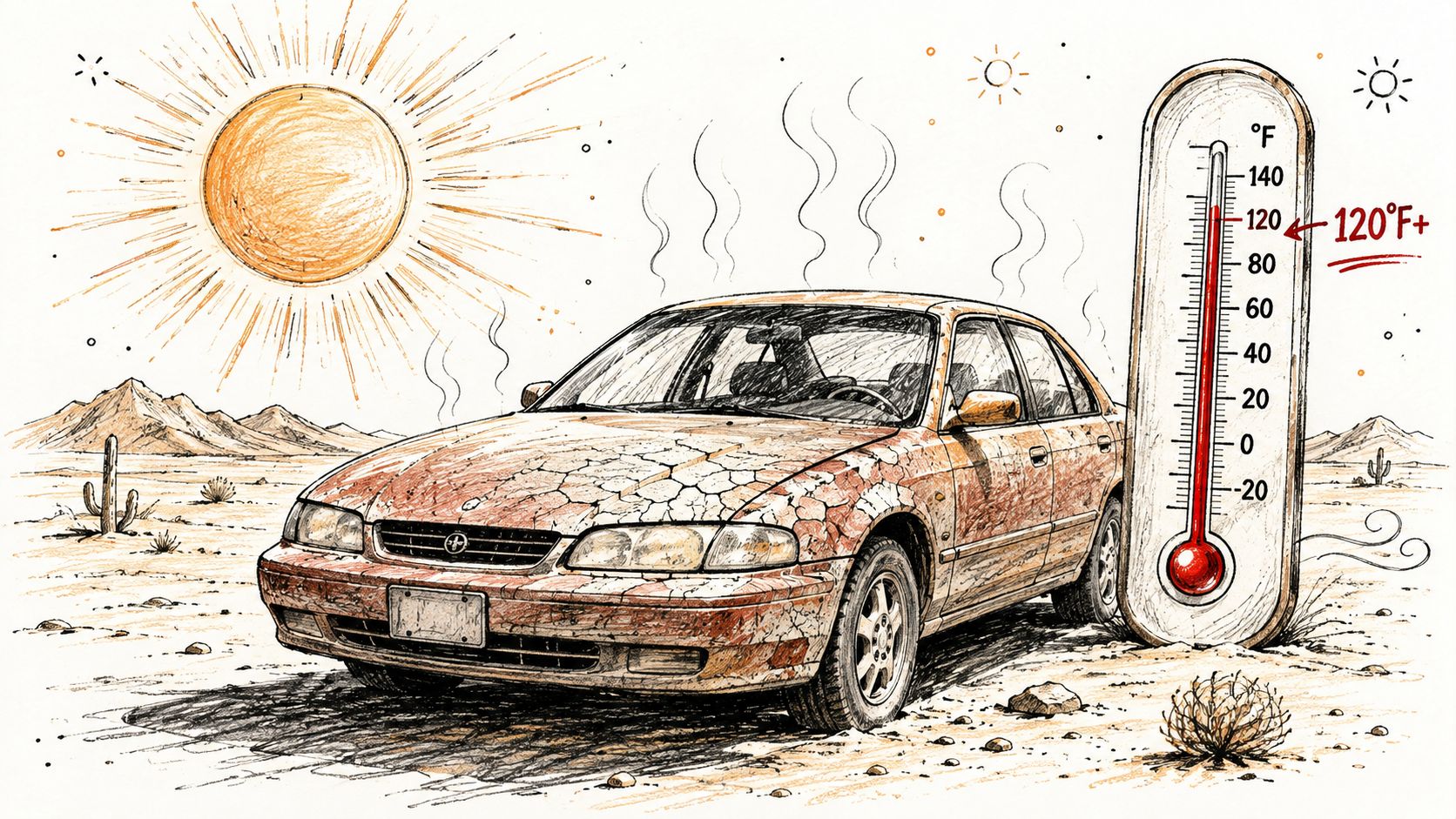
Why ordinary success elsewhere doesn’t translate
A wax or sealant that performs well in a mild, humid environment may struggle when the vehicle receives intense solar input every day. A rigid coating can retain gloss for a time, but repeated expansion and contraction place stress on the film. Dust also changes the washing process. Every wipe across a dry, gritty panel creates an opportunity for abrasion, especially when the owner delays washing because the car appears only lightly dirty.
The same considerations apply to utility vehicles and resort fleets. Operators maintaining rugged off-road golf cars for resorts face similar exposure from sun, dust, passenger contact, and frequent outdoor parking. A protection system must fit the operating environment, not just the vehicle’s appearance on installation day.
Titan’s guidance on coatings for harsh weather conditions reflects that broader need. Desert protection is a system, not a single bottle. Preparation, product flexibility, application timing, parking habits, and washing technique all determine how long the finish remains serviceable.
Understanding the Compound Stress Environment
Hot desert climates create a compound stress environment, where several damaging conditions act at once. The Köppen BWh classification combines a mean annual temperature above 18°C, annual rainfall typically below 250 millimeters, and precipitation below 50% of potential evapotranspiration (Köppen climate classification details). That moisture deficit suppresses vegetation and leaves exposed surfaces surrounded by dry, mobile particles.
Heat adds the second layer. A historical temperature milestone of 56.7°C, measured at Furnace Creek Ranch in Death Valley, California, on 10 July 1913, remains a widely cited benchmark (hot desert temperature conditions). Hot-month averages commonly sit around 29 to 35°C, while midday readings of 43 to 46°C are frequent in hot desert regions (BWh climate characteristics). These figures describe the surrounding air and climate, while a dark vehicle panel, roof, hood, or dashboard can experience a much harsher localized load under direct sun.
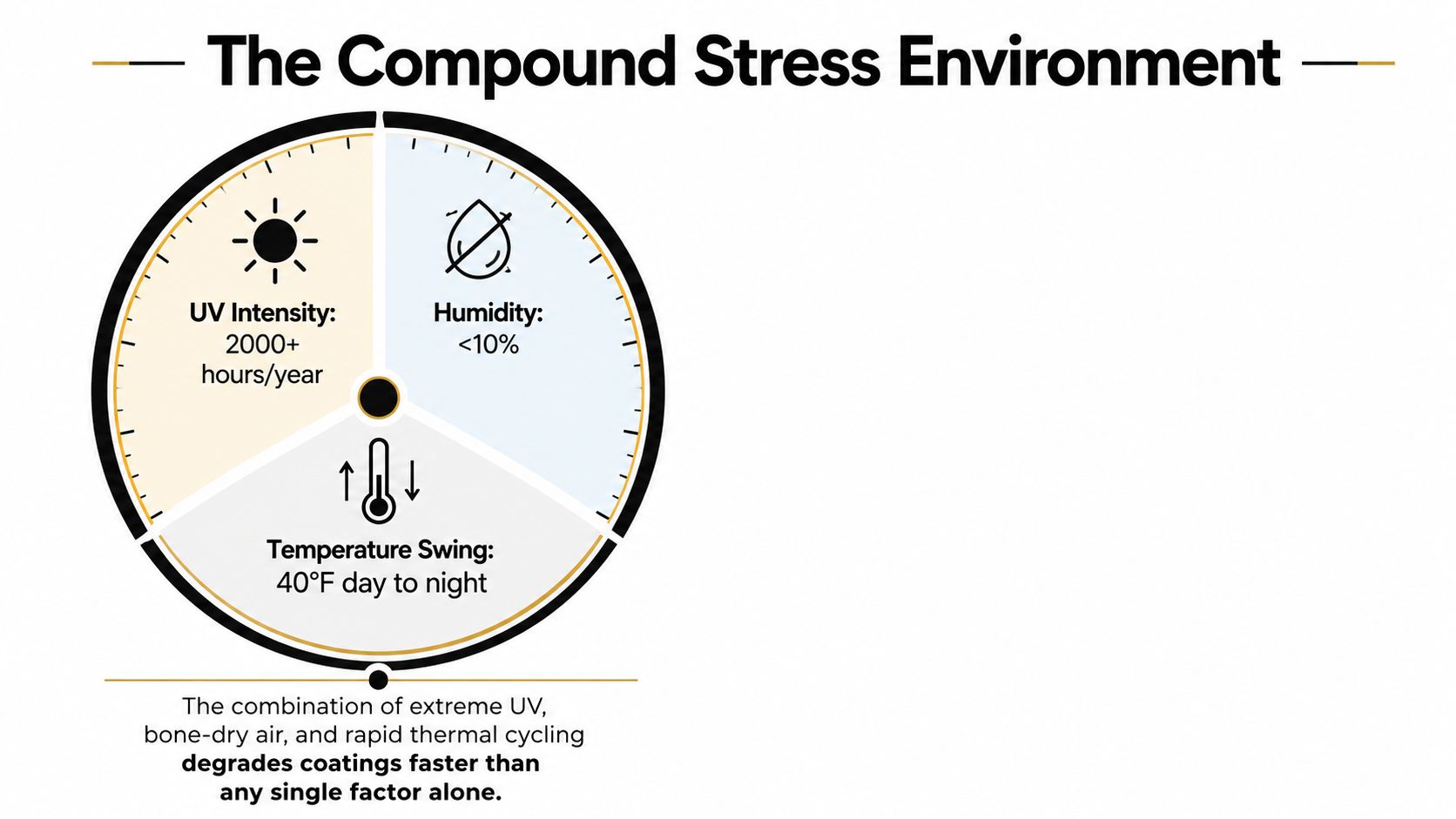
Three stresses, one failure pattern
Ultraviolet radiation breaks down susceptible materials over time. Scientific research on outdoor materials identifies solar UV exposure, together with ambient temperature, as a factor that limits service life because UV degrades materials including plastics (UV and temperature effects on outdoor materials). On a vehicle, that concern extends beyond clear coat. Trim, wiper components, rubber seals, interior plastics, and exposed coating chemistry all face sunlight.
Low humidity keeps the environment dry, but it doesn’t make dust harmless. Fine mineral particles settle on the paint and remain ready to move under a towel, wash mitt, or automatic brush. A coating may repel water and contaminants, yet it still needs a safe cleaning method because hydrophobic behavior doesn’t eliminate mechanical contact.
Thermal cycling creates the third stress. Hot desert temperatures can approach 50°C during the day and fall to around -2°C at night in some educational climate examples (day and night temperature variation). A vehicle doesn’t need to experience that exact range for the principle to matter. Repeated heating and cooling make the panel and protective film expand and contract, and a rigid film has less freedom to accommodate that movement.
That combination explains why generic advice such as “wash more” or “add wax” often disappoints. Washing removes contamination, but it can’t restore a coating that has developed stress damage. Wax can add temporary slickness, but it doesn’t solve the structural conflict between a moving substrate and a brittle protective layer. A better UV resistance rating guide starts with the complete exposure profile, not a single hardness label.
Why Traditional Ceramic Coatings Fail in Deserts
Hardness sounds like durability, but hardness alone isn’t a durability strategy. Traditional ceramic coatings are valued for gloss, chemical resistance, water behavior, and a glass-like surface. The trade-off appears when a rigid film must follow a panel that repeatedly heats in the sun and cools after sunset.
Paint, metal, plastic, and the coating above them don’t respond to temperature in exactly the same way. As the vehicle warms, the substrate expands. As it cools, it contracts. A stiff film has limited ability to absorb that movement, so stress concentrates in microscopic areas. At first, the damage may be invisible. Over time, it can present as reduced gloss, fine cracking, weakened water behavior, or a surface that looks tired even though the coating still exists.
The flaw in the hardness-first approach
A detailer may polish a panel, install a rigid ceramic coating, and achieve a striking finish. The result can be excellent in a controlled environment. Desert exposure changes the test because the vehicle experiences repeated thermal cycling alongside UV and abrasive dust. Each contaminant removal session then adds mechanical contact to a surface already coping with heat-related stress.
This doesn’t mean every traditional ceramic coating fails immediately or has no value. Ceramics can provide useful protection when the product, preparation, installation, and maintenance match the vehicle’s conditions. The problem is presenting a hard film as a universal answer. Buyers comparing options can also review this practical resource on the best ceramic coating for cars, then ask a more important question: how does the coating handle movement, not just how hard does it cure?
Practical rule: In a desert, choose a coating for the way the panel moves, not only for the hardness number on the label.
Titan’s position is that flexibility supports longer service life. Its elastomer coatings are designed to be hard like glass while remaining flexible enough to move with the surface beneath them. That matters during temperature changes from freezing conditions to intense heat, because the coating is intended to flex rather than crack down as the substrate changes shape. The principle is simple, but it changes the purchase decision from maximum hardness to balanced resistance.
The distinction is especially important for hoods, roofs, trunk lids, and vertical panels exposed to direct sunlight and windblown grit. A coating that preserves its continuity under movement can continue serving as a sacrificial barrier. A coating that fractures may still look present, but its protection becomes less consistent across the panel. Learn more about the role of coating flexibility before treating hardness as the only meaningful specification.
The Elastomer Advantage and Dark Matter Technology
Titan Coatings introduced its own elastomer coating technology to the market using nano-tube technology and Dark Matter Tech. The practical idea is easier to understand than the branding. Instead of relying only on a rigid glass-like film, an elastomer coating forms a protective membrane that can absorb movement and return to position as the vehicle heats and cools.
That flexibility matters because desert damage isn’t isolated to one cause. UV weakens susceptible materials, temperature changes create movement, and sand or dust can abrade the surface during cleaning. A protective layer must therefore balance surface hardness with the ability to accommodate stress. Titan describes its elastomer coatings as hard like glass and flexible, a combination intended to improve longevity under changing conditions.
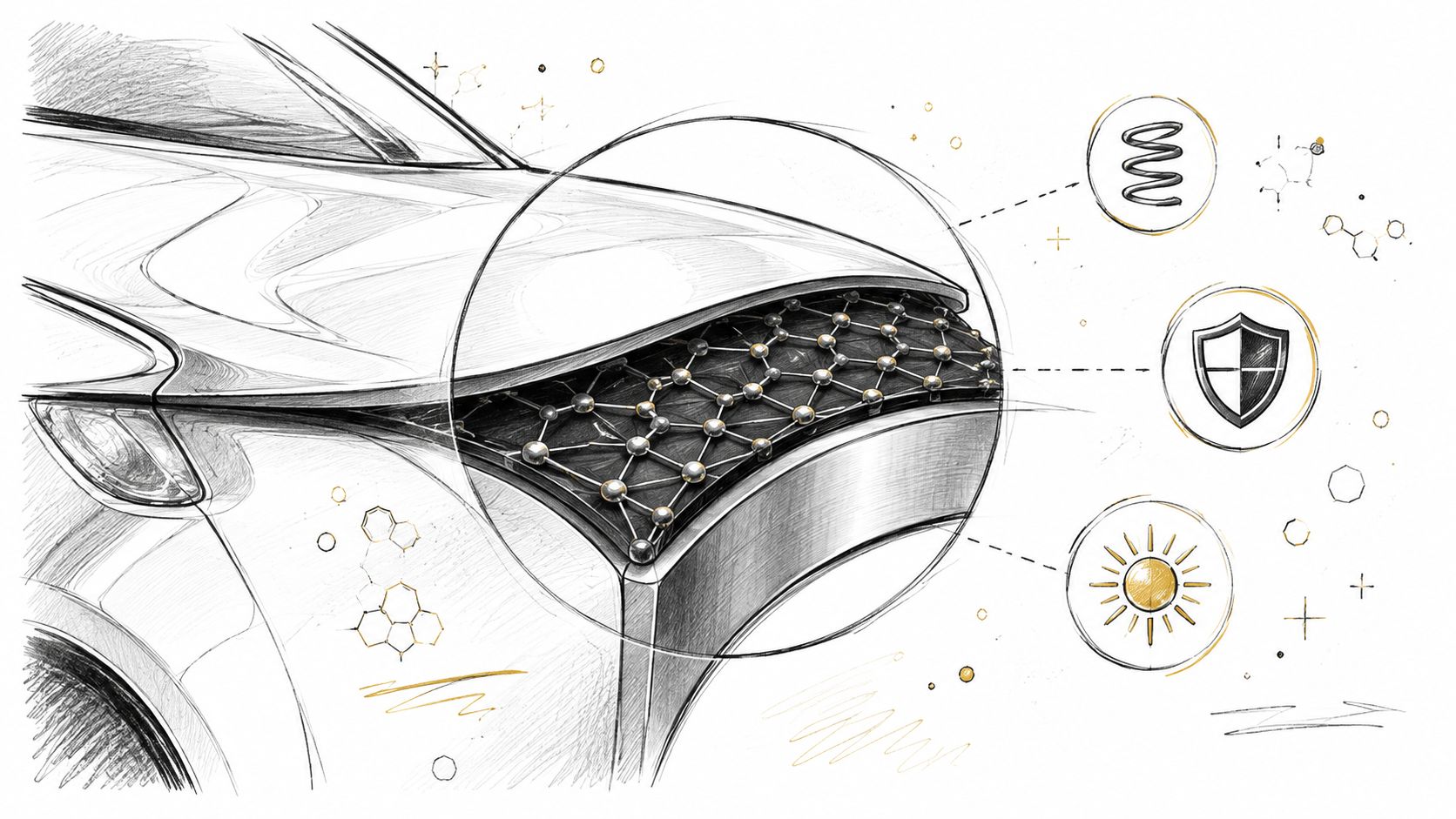
How the flexible membrane helps
Think of the coating as a sacrificial layer between the environment and the paint. The nano-tube structure is presented as helping create a network that supports surface resistance without forcing the entire film to behave like a brittle shell. When the panel expands or contracts, the elastomer can move with it. When insects strike the front end or grit contacts the surface, the coating provides a protective barrier that takes the first exposure.
This doesn’t make the vehicle immune to scratches, impact, contamination, or poor washing. No coating replaces safe technique. It does, however, address a weakness that conventional rigid systems can leave exposed. Flexibility reduces the chance that thermal movement turns into cracking, while hardness helps preserve a smooth, cleanable surface.
A practical installation mindset
The technology works best when the installer respects the process:
- Prepare the surface completely. Remove bonded contamination, correct defects where appropriate, and ensure the panel is clean before application.
- Control the working environment. Shade, temperature, dust control, and curing conditions matter more in arid locations because airborne grit can settle quickly.
- Use the coating as a system. Pair the primary film with safe washing, careful drying, and sensible parking rather than expecting chemistry alone to carry the entire burden.
- Match the product to the operator. A studio may prefer a more structured installation, while a DIY owner or mobile detailer may prioritize ease of use and predictable handling.
Titan’s explanation of what UV coating does helps place the technology in context. UV protection is important, but the desert challenge is broader. The strongest solution combines UV resistance, abrasion management, and elastic movement, so one stress doesn’t expose the weakness of another.
Choosing the Right Protection for Your Vehicle
The right product depends on the vehicle’s exposure, the installer’s experience, and the level of correction completed before application. A daily driver parked outdoors in a desert city needs a different routine from a weekend car kept inside. A mobile detailer also needs a product that fits changing job-site conditions, while a DIY enthusiast may prefer a simpler application with manageable maintenance.
Alpha Quartz is the more relevant choice when the goal is an elastomer coating with a flexible film. Titan presents it as easy to install and suitable for DIY users and mobile detailers. Its flexibility is designed to help the coating move through temperature changes from frozen conditions to hot ones without cracking down, and the same elasticity is intended to help when bugs strike the vehicle’s surface.
Ultra Ceramic Spray serves a different role. It focuses on straightforward installation and practical upkeep, making it useful for owners who want an accessible spray format or detailers who need a convenient maintenance option. It shouldn’t be treated as a substitute for every professional coating installation. Its value is speed, simplicity, and the ability to support a consistent maintenance routine.
| Feature | Alpha Quartz (Elastomer) | Ultra Ceramic Spray |
|---|---|---|
| Primary role | Flexible protective coating for demanding exposure | Easy-to-install spray protection and maintenance |
| Best fit | DIY owners, mobile detailers, and vehicles facing strong thermal cycling | Routine upkeep, quick applications, and convenient refreshes |
| Desert advantage | Elastic film designed to move with the surface as temperatures change | Simple application helps owners maintain protection regularly |
| Impact consideration | Flexibility is intended to help with bug strikes and surface movement | Use as directed, with careful preparation and washing |
| Installation style | Coating application with deliberate preparation and cure management | Spray application designed for accessible use |
| Selection priority | Choose when flexibility and long-term exposure are central concerns | Choose when ease and maintenance convenience lead the decision |
For windshield and glass, Apex Glass Ceramic Coatings addresses a different surface problem. The product is designed to be easy to use and to improve water behavior on glass, helping enhance visibility during rain. Desert regions may be dry most of the time, but sudden rain can combine with dust and road film to create stressful driving conditions. A clean, water-repelling windshield can make those conditions easier to manage. Review the Apex Glass Ceramic Coatings product before choosing a glass-specific solution.
You can also compare the available options through the Titan Coatings shop. Choose the chemistry according to the vehicle’s exposure and your installation discipline, not according to the most aggressive marketing promise.
Maintenance Strategies for Arid Environments
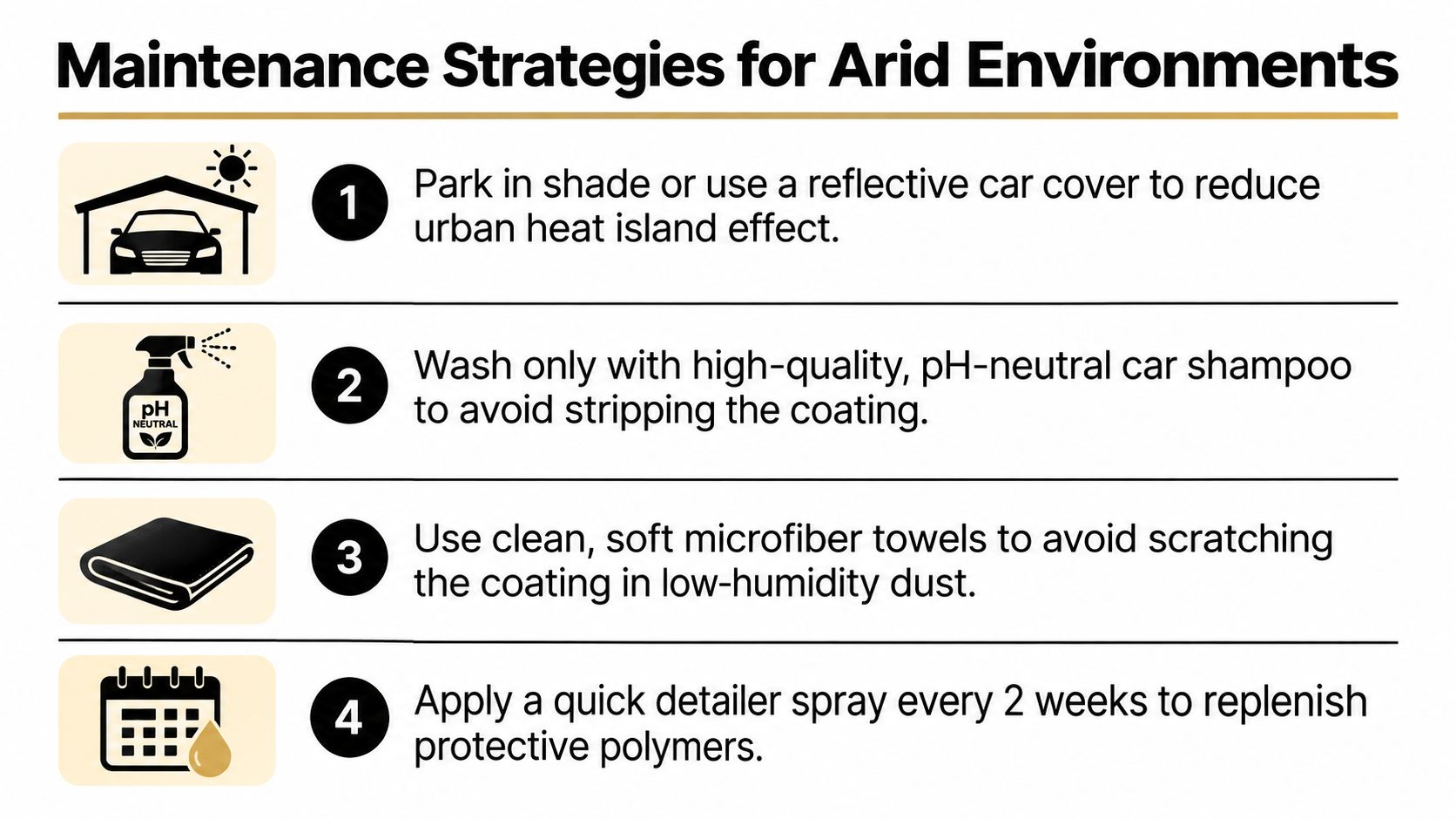
A flexible coating still needs careful maintenance. Desert dust is abrasive, and wiping a dusty vehicle without lubrication can create marring regardless of the coating type. The safest routine starts with removing loose contamination before contact washing, then using a high-quality, pH-neutral car shampoo and clean, soft microfiber towels.
Parking location deserves more attention than it usually receives. Urban desert heat isn’t identical from one street to the next. Heat-mapping work in Reno-Sparks released detailed urban heat island data from summer 2024, while Climate Central reported a Las Vegas average urban heat island index of 5.8°F (Reno-Sparks urban heat data). Pavement, tree cover, shade access, and neighborhood design can change the exposure of a parked car. MIT also explains that urban heat island effects are removed from global climate records because they represent a localized effect rather than the main driver of long-term warming (MIT explanation of urban heat islands).
A workable desert routine
- Choose shade first. Use covered parking or a reflective cover when practical, but make sure the vehicle is clean before placing a cover over it.
- Rinse before touching. Break the bond between loose dust and the panel before a mitt or towel crosses the surface.
- Wash with controlled contact. Use pH-neutral shampoo, separate clean tools from dirty ones, and replace towels when they become loaded with grit.
- Dry without dragging contamination. A clean microfiber towel or suitable air-drying method reduces unnecessary friction.
- Refresh consistently. A compatible quick detailer can support the maintenance layer, but it shouldn’t be used to conceal failing preparation or cracking.
If water access is limited, a carefully controlled dry car wash method can be useful, but only when the vehicle has light contamination and the chosen product provides enough lubrication. Don’t perform a dry wipe over heavy sand or visibly gritty panels. The coating’s flexibility helps it cope with thermal movement, but good technique remains the first defense against abrasion.
For rain visibility, maintain the glass separately from painted panels. A dedicated glass coating such as Apex Glass Ceramic Coatings can support water sheeting and clearer vision, while Ultra Ceramic Spray can offer a convenient way to maintain exterior protection. For owners who want a more specialized elastomer solution, Alpha Quartz is the stronger fit when temperature cycling and impact from insects are central concerns.
APEX NANO – Titan Coatings offers coating solutions for vehicles exposed to heat, UV, dust, and repeated temperature changes, including elastomer-focused protection and glass-specific products. Visit APEX NANO – Titan Coatings to review the available systems, then choose the product that matches your vehicle, installation method, and desert maintenance routine.
0 Comments