
Say your new black SUV lives outdoors, and one commute through a sprinkler zone leaves white spots baked across the hood by lunchtime. By the end of its first summer, the wash mitt has added faint swirls you can only see at the gas station, under hard white light.
Quartz Coating Compared With Wax, Sealant and Film
A detailer follows one daily driver from a spring wash through the first hard freeze. In April a fresh carnauba coat throws a warm gloss and water beads tight. By midsummer, heat, detergent and rain have flattened that bead, and white spots sit where the car dried in the sun. The owner stops asking for the familiar tub and starts asking what still looks cared for in December. The honest split is how each product sits on the clear coat, or bonds to it, and how that holds up in that climate.
Protection options compared by lifespan, water behavior and cost
| Protection | Typical lifespan | Water behavior | Cost range |
|---|---|---|---|
| Carnauba wax | Weeks to a few months before heat and detergents strip it | Strong beading that fades quickly | Low-cost tub or liquid, bought repeatedly |
| Synthetic sealant | Often a season of washes, then the slick feel drops | Good beading, slickness fades | Low-cost bottle, bought repeatedly |
| DIY ceramic kit | Multi-wash hydrophobic behavior when the film is cured and maintained | Very strong, long-lasting beading | Kit price, separate from paint correction |
| Professional ceramic coating | Hydrophobic behavior that outlasts seasonal wax under normal washing | Very strong, long-lasting beading | Installer package built around prep and labor |
| Quartz elastomer coating | Hydrophobic behavior and chemical resistance that hold through repeated washes | Very strong, hydrophobic | Quoted by vehicle size, condition and package |
| Paint protection film | Years of impact cover on the panels that take stone hits | Film surface beads water | Priced per panel or full front package |
The 2025 Automoblog industry analysis reports that professional ceramic-coating services generally cost $1,000-$2,000, while DIY ceramic-coating kits cost $20-$100. That gap is mostly preparation, paint correction, controlled curing and labor, not just liquid in a bottle. For a quartz elastomer, an authorized installer prices the job from the vehicle's size, its condition and the package, rather than from a single shelf tag.
Why One Product Outlasts Another
Wax sits on top of the clear coat. Summer heat, wash detergents and winter road film strip it, so the gloss has to be put back on. A cured quartz coating is chosen because hydrophobic behavior and chemical resistance are what you check after months of real weather, not a hardness slogan on the bottle. Wash it with care and the bead should still tell you the layer is working when the first freeze arrives.
A thick, clear film takes stone impacts on the nose of the car. One owner films the bumper, the hood edge and the mirrors, then coats the doors, roof and rear quarters for gloss and easier washing. If a small add-on is part of that plan, our guide to car paint protection stickers and where they help shows where targeted coverage makes sense.
The same logic shows up off the car. Homeowners get it from J.R. Hardwood Floor Refinishing & Cleaning tips on protecting a finished surface before daily wear sets in, rather than trying to restore it later.
Practical rule: Buy wax for a weekend glow, film for impact, and quartz when you want durable gloss with less upkeep between washes.
What Quartz Coating Is and How It Bonds to Paint
A coating that looks finished at sunset can still fail before midnight if the film has not cured. That window after the last wipe decides whether the bond is even or spotted.
A technical review of silica-based automotive coatings describes quartz and ceramic coatings drawing their protection from silica-based chemistry, where silicon-containing precursors form a three-dimensional cross-linked network that bonds to the clear coat, with typical cure development over approximately 24-48 hours and hardness ratings exceeding 9H on the pencil-hardness test. That network is what produces the optical gloss, the chemical resistance, and the lower surface energy that lets water bead and dirt release.
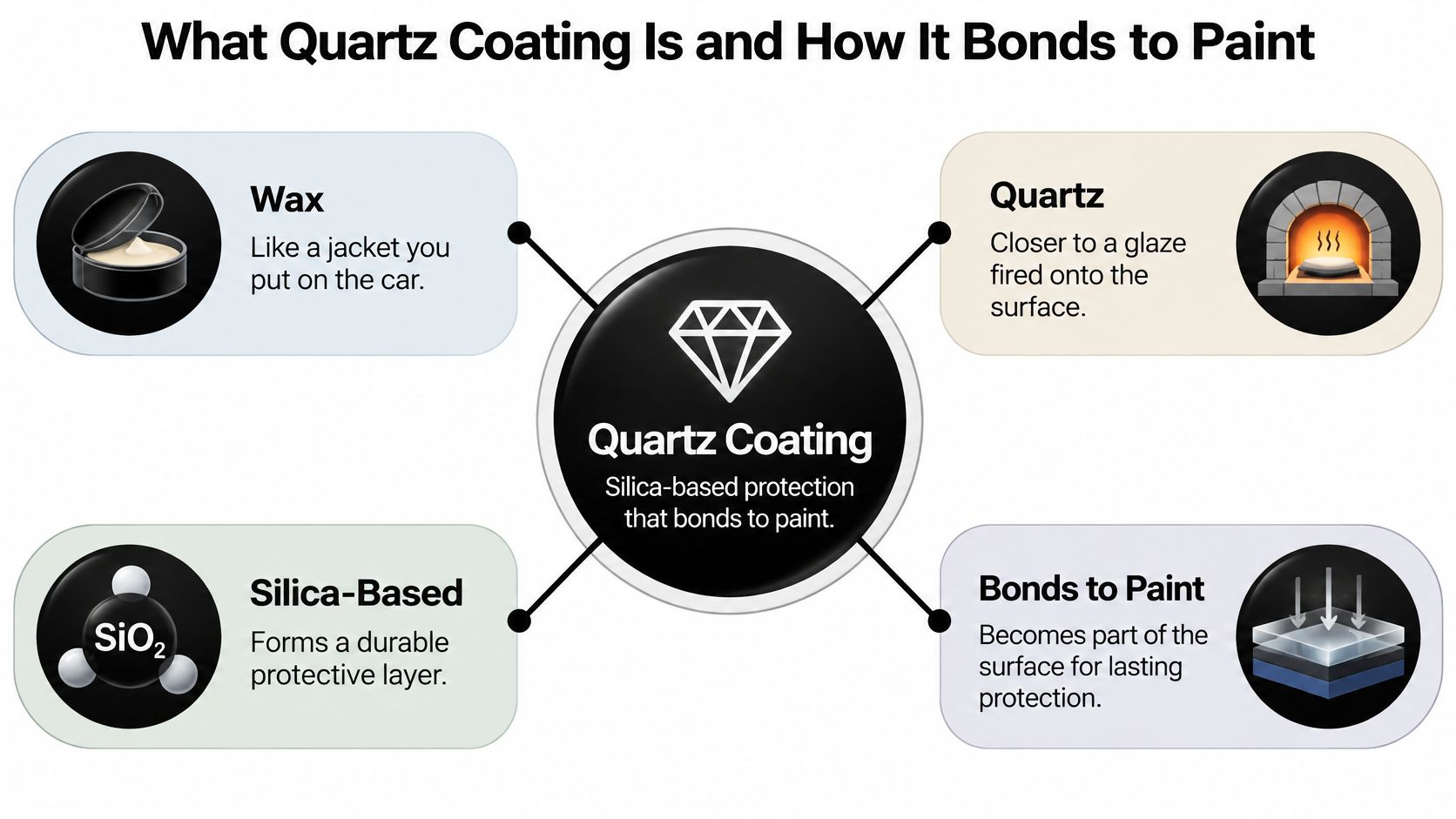
The Cure Sets the Bond
During those 24-48 hours, the car stays dry and free of condensation. Water on a fresh film can leave spots or break up an even bond. Polishing residue, residual oils, and other contamination can leave high spots and patchy hydrophobicity. Decontamination, correction where the paint needs it, and a proper panel wipe give the network a surface it can grip.
The 9H figure is one controlled scratch result on a pencil test. It does not describe stone chips or the fine marks a dirty wash mitt leaves. The same review lists titanium dioxide as an additive used to raise hardness and ultraviolet resistance.
A mobile detailer finishes a daily driver in a driveway at 4 p.m. Dew at 9 p.m., while the film is still developing, can leave uneven beading by morning even when the wipe-down looked clean. Shelter and the clock sit beside technique.
Where Titan Fits in This Chemistry
Titan Coatings is a manufacturer of elastomer-based ceramic coatings for automotive surfaces. Dark Matter Technology®, DiamondTech and HyperQuartz® formulas offer protection against harsh UV rays, scratches and chemicals, along with regenerative properties. Judge those claims against a defined test and the climate the car lives in: a pencil-hardness number for scratch resistance, a UV exposure result for sun load, and a chemical spot test for wash products, read against a hot summer or a salted winter rather than against a hardness slogan alone. Check chemistry versus compatibility with your paint system before layering products from different families.
Quartz and ceramic labels both sit in silica-based families. Cure instructions, solids content, and published test data are the comparison that matters.
A quartz coating is only as uniform as the clean, oil-free surface it bonds to.
Why Elastic Quartz Survives Heat and Cold Swings
Follow one sedan through its first year. In January it starts on a frozen morning, frost on the roof, washer fluid barely clearing the windshield. The panels are contracted and stiff, and road salt sits in every seam.
By July the same car bakes in afternoon traffic, then gets driven hard on the highway. Dark paint gets hot enough that you can't rest your palm on the hood. In August, a dusk drive through farmland covers the bumper and mirrors with insect strikes that dry hard overnight.
Movement Is the Hidden Stress
Paint, clear coat and coating expand and contract at different rates as temperatures swing. A rigid film has nowhere to go under that stress, so it can crack or lift at the edges over repeated cycles. Flexibility lets a film absorb small movement instead of fracturing.
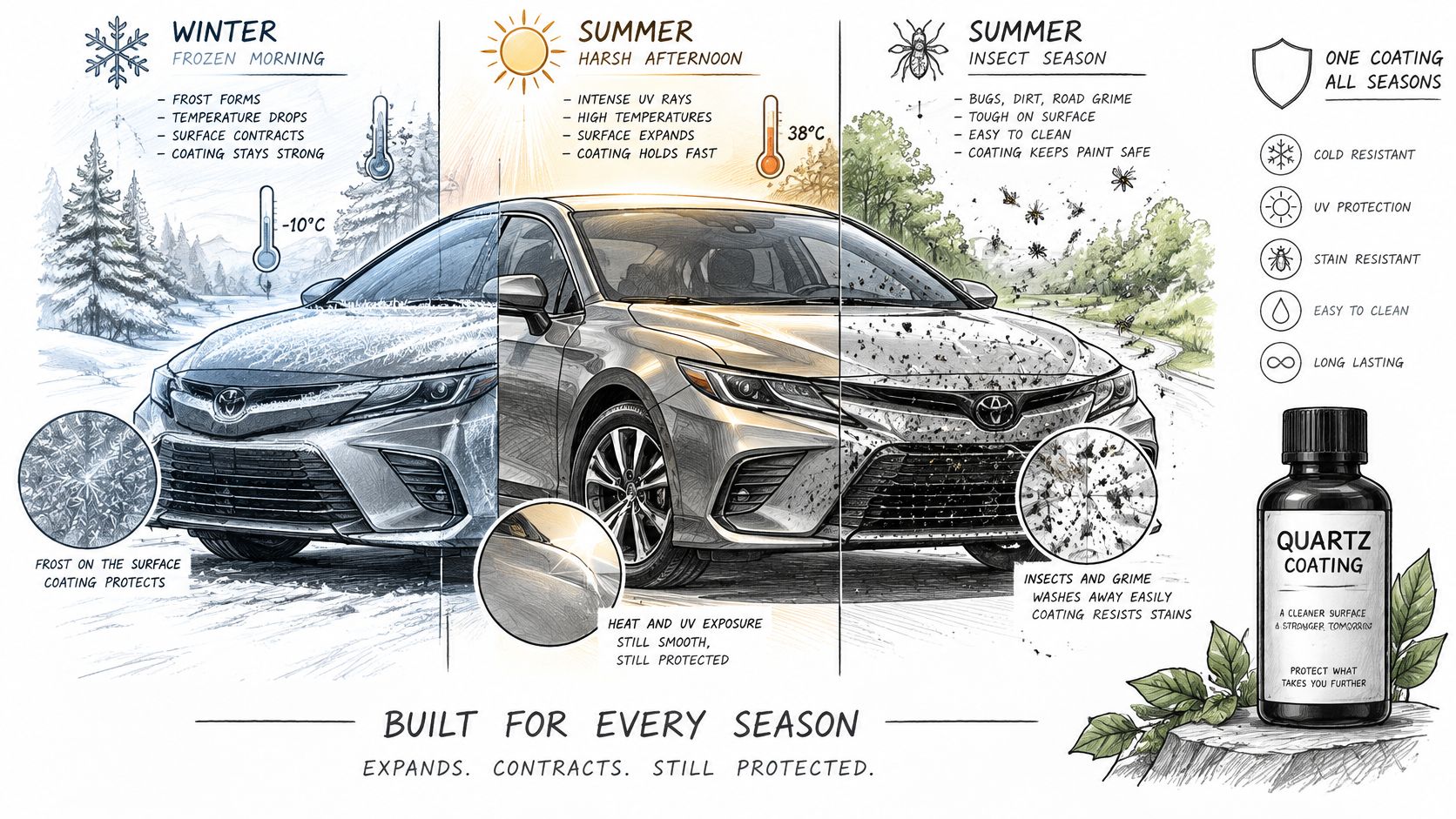
Titan Coatings makes elastomer-based ceramic coatings for automotive surfaces. Elasticity is the design idea: the film is meant to move with the panel rather than stay brittle. That is not proof it holds up on your frozen morning and your July hood. Ask for thermal-cycling or flexibility test data, plus adhesion and cracking results after exposure, and set those results against the climate the car lives in. A hardness number alone does not describe a freeze-to-heat swing. The design goal is laid out in the overview of coating flexibility under temperature change.
Dark Matter Technology, already covered with the other Titan formulas in the chemistry section, is one elastomer option in that lineup. It does not turn a thin film into armor. A deep stone strike will still beat the coating.
Color choice changes how visible that yearly wear looks. If you're repainting or wrapping before coating, you can preview car colors before committing so you know how a shade shows dust, spots and swirls in your light.
Climate check: Cars facing hard winters, hot summers or both give a flexible formula more work to do. The film still has to face the impact-prone front end, and only a named test shows how far that flexibility goes.
What Quartz Stops and What It Cannot
A high pencil rating doesn't mean a coating prevents scratches. Separate three outcomes that marketing often blends together. Scratch resistance means surviving a set test load, scratch prevention means never marking, and scratch concealment means gloss hides very light marks. Only the first is on offer.
Clear coat behavior explains why. As severity rises, the surface deforms elastically, then plastically, then fractures or delaminates, so the type of event matters more than a single hardness label. The MDPI review of automotive clearcoat scratch damage shows damage depends on event type, load, deformation, fracture and delamination, not hardness alone.
Tests That Separate Failure Modes
Defined methods keep claims honest. Pencil hardness runs under ISO 15184 or ASTM D3363, instrumented scratch and mar under ASTM D7027 or ISO 19252, and chemical-spot resistance under ASTM D1308 or ISO 2812, as summarized in the Mitsubishi Chemical surface protection glossary. Taber abrasion under ASTM D4060 and stone-chip testing under ISO 20567 or SAE J400 measure still different failures.
Damage types, what quartz coating does and does not stop
| Damage type | Quartz coating helps with | Quartz coating does not stop | Practical response |
|---|---|---|---|
| Automatic car wash swirls | Reduces light marring and eases cleaning | Heavy abrasion from dirty brushes | Use touch-free or hand washing |
| Stone chips | Resists light abrasion around the surface | Impacts that fracture through the clear coat | Paint protection film on high-impact front areas |
| Bird droppings and insect residue | Easier release and faster removal | Etching if left to bake in sun | Remove within hours with pH-neutral cleaner |
| Water spots | Hydrophobic surface reduces spotting | Mineral deposits once water dries | Quick detail spray and dry promptly |
| Keying or vandalism | Little protection against deep cuts | Deep cuts through clear coat | Paint repair; check coverage |
| Light wash marring | Reduces visible marring and maintains gloss | Repeated harsh abrasion | Maintain with gentle wash technique |
A quartz coating for cars is not paint protection film. It reduces light wash marring and makes contamination easier to remove, but it won't stop a stone chip or a key dragged down a door. Judge yours over time by gloss and water behavior after a proper wash, not by whether it survived abuse it was never built for.
Real Lifespan, Climate and Upkeep That Keep It Working
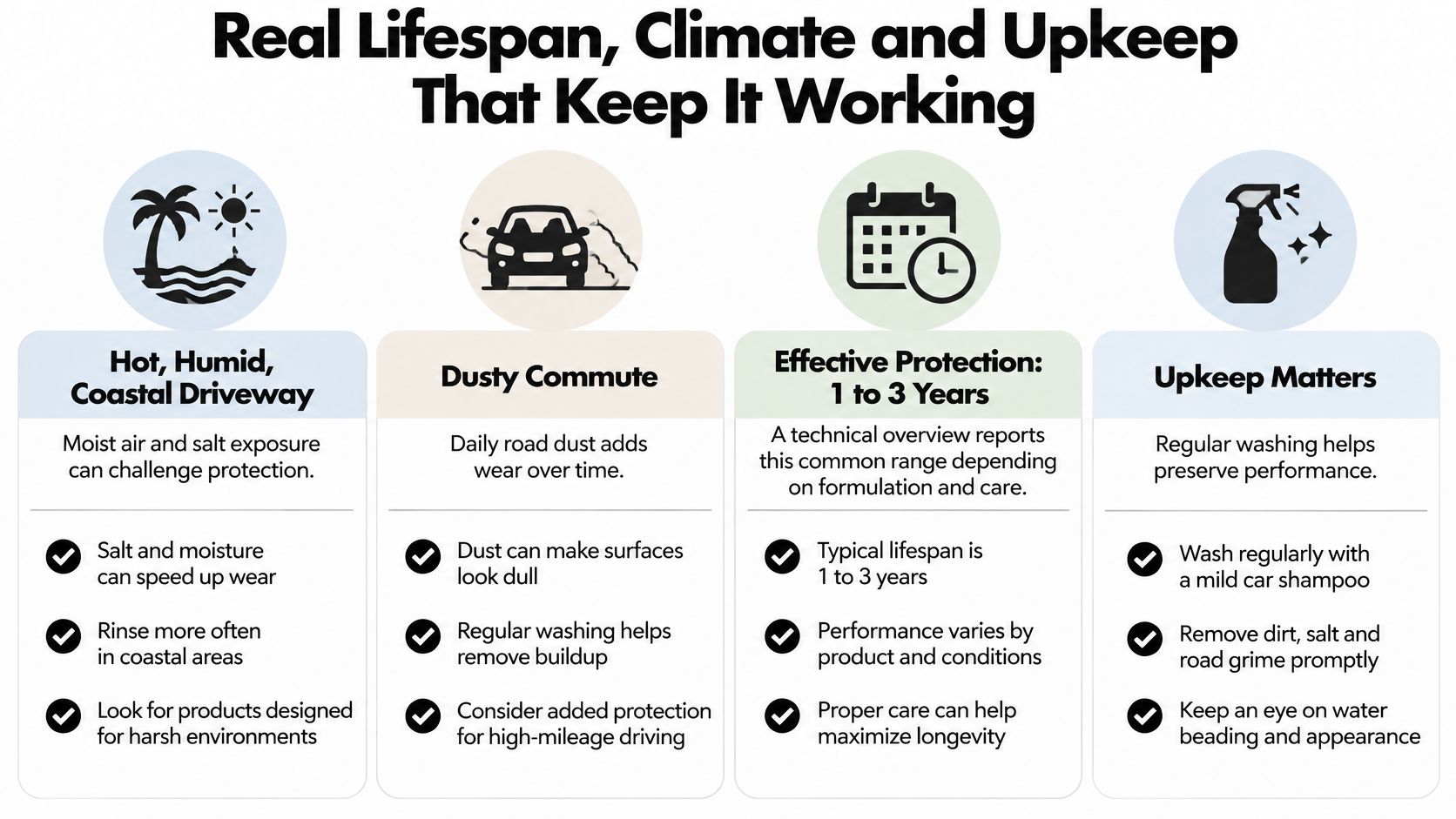
A car that sleeps on a hot, humid coastal driveway and commutes dusty roads takes a harder year than a garaged car in mild weather. Salt film settles overnight. Afternoon storms leave minerals on the hood. By Friday, grit coats the lower doors. Summer UV bakes that film, and the first winter adds road salt. That sequence ages a quartz coating faster than a mild, covered climate.
A technical overview of quartz and ceramic coating durability reports that effective protection commonly ranges from one to three years depending on formulation and environmental exposure, with periodic maintenance washing recommended. A warranty year that ignores climate will not match this car, so compare packages against the vehicle ceramic coating cost and lifespan factors.
What a Year of Weather Actually Tests
The stressors are UV intensity, heat, humidity, road salt, acidic rain, tree sap and alkaline detergents. Beading after a proper wash, covered earlier, is the water-behavior check. Read that same check against climate: a coastal summer can dull water behavior months before a garaged car shows the same change, even while the bonded film is still in place.
Panel checks still matter once the car is clean. Look at gloss, chemical staining and slickness from hood to rocker. If a coating degrades, a certified installer must inspect the vehicle, provide feedback and work on restoring the coating as needed.
The Upkeep That Protects Your Spend
- Wash gently: Use a pH-neutral shampoo and avoid harsh chemicals and abrasive cleaning products.
- Refresh rinse water often: Clean microfiber and fresh buckets stop grit from being dragged back across panels.
- Clear the surface before heat builds: Sap and road film that sit through a hot afternoon are harder on the coating than the same residue washed off the same day.
Stretching a coating's useful life is also a budgeting decision, much like the car budgeting tips for tight budgets that favor small preventive spend over larger repairs later.
How to Apply Quartz Coating Step by Step
A black sedan sits in a Houston driveway with polish dust still in the panel gaps, and a late storm is already on the radar. The same Alpha Quartz 50ml, a DIY and mobile detailers coating, on a dry Denver morning gives the film more time before it starts to grab. Climate changes the wipe. The order of the work stays put.
That order is the job. Read the full guide on how to prep car paint before coating before the bottle comes out.
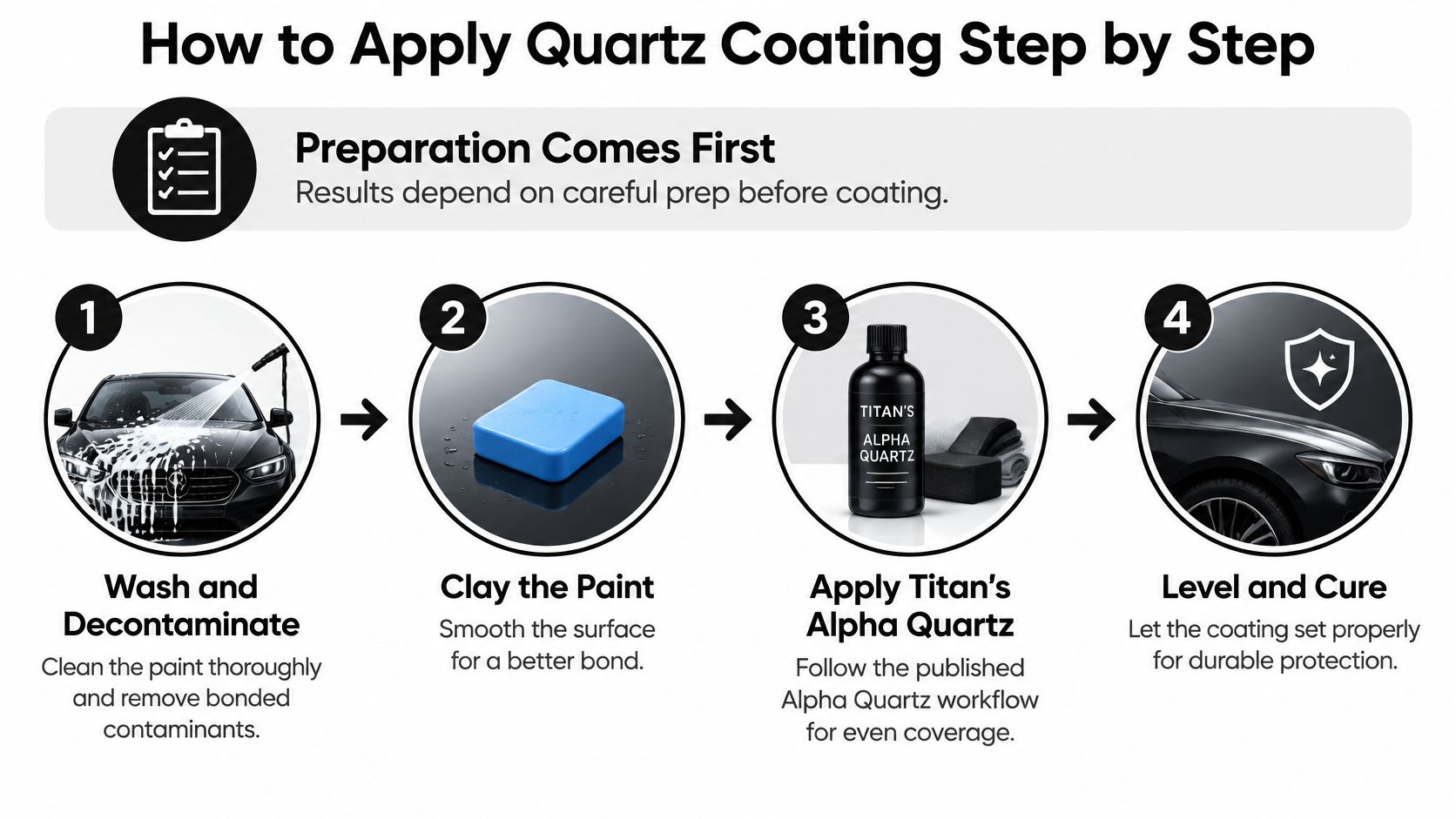
Alpha Quartz is an elastomer ceramic coating made for all surfaces, indoors or outdoors. Drop count, dwell, and cure window sit on the product label. Follow those instructions for the bottle in your hand. Formulas are not interchangeable, and a hardness claim on a box does not tell you when this panel is ready to level.
- Wash and decontaminate: Wash thoroughly, use iron and tar removers where needed, then clay bonded contamination. Grit left under the film shows up later as high spots.
- Correct the paint: Polish out swirls and light defects you do not want sealed in. Fresh gloss makes whatever you skipped easier to see.
- Remove polish residue: Use BIOPREP, which removes polish residues and silicones without damaging paint or clear coat. Oils left behind are why a fresh coating beads in patches.
- Panel wipe until dry: Wipe each panel dry and free of oils, working just ahead of the section you will coat. Do not wipe the whole car, then wait while dust settles.
- Load the applicator: Use the drop count on the Alpha Quartz label and spread in overlapping cross-hatch passes on one small section. Thin stripes hide until sun hits them the next day.
- Wait, then level: Dwell only as long as the label allows for the temperature you are in. A humid Gulf afternoon flashes faster than a cold, dry morning. Wiping too early pulls product off. Waiting past the label window makes the towel grab and the finish look hazy.
- Level with short pile microfiber: Turn a short pile towel often and keep the pressure light. Heavy pressure drags the film instead of leveling it.
- Buff with long pile microfiber: Follow at once with a long pile towel for the clear finish. A rushed buff leaves the faint haze owners later blame on the coating.
- Inspect, then leave it alone: Check every panel under a work light for high spots. Keep the car dry through the cure window printed on the bottle. In Houston that means the car is inside before the storm, not "almost cured" in the driveway.
Glass Uses a Lighter Load
Apex Glass Coating 50ml, a DIY and mobile detailers coating for windshields, takes a lighter load than paint. Its label sets the drops and the short dwell. Level and buff the same way. Clean the glass thoroughly first. Wiper chatter and a smeared film usually trace back to old sealant or silicone still on the surface.
On that Houston hood, the leveling passes looked even. The oil wipe was skipped because the paint already looked glossy, then rain landed before the labeled cure was finished. Monday showed patchy water behavior and a milky streak where residue sat under the film.
After the cure, rinse the car where it lives. Even sheeting, no grabby haze, and no missed high spots are the checks that matter. A hardness line on the packaging is not one of them.
Pick the Right Titan Product and Book Your Coating
The bottle follows the surface. A full-body paint job on a client's driveway, a windshield that stays wet on night drives, and a coating that is already six months old are three different jobs.
Through the year the choice changes with the car. Spring bodywork points to the main quartz coating. Rainy-season glass is a separate product. A mid-year wash that only needs slickness back is a spray, not a recoat day.
For glass, Apex Glass ceramic coating for windshields is a DIY and mobile detailers coating for windshields, where water beading keeps the view clearer in rain. For upkeep between services, ULTRA Ceramic Spray is a ceramic sealant used at home to maintain and refresh a coating that is still sound.
Titan products matched to the job
| Product | Best for | Surface focus | Price |
|---|---|---|---|
| Alpha Quartz 50ml | DIY and mobile detailers, full-body paint | Body paint | $67.97 |
| Apex Glass 50ml | Windshields and glass, clearer wet-weather view | Glass and windshield | $39.97 |
| ULTRA Ceramic Spray 100ml | Home maintenance and refresh between services | An existing coating | $39.97 |
Match the Product to the Surface
Choose Alpha Quartz when the job is the main elastomer quartz coating across the body and you will do the full preparation. It is the Titan product built for DIY and mobile detailers. Some Titan coatings are meant to be layered, and the installer sets that layering for the vehicle rather than guessing it on the driveway.
Choose Apex Glass when the windshield is the problem. Beading and clearing at speed make night driving calmer. Keep the paint product on paint and the glass product on glass so the result stays predictable.
Choose ULTRA Ceramic Spray when the base coating is sound and you want a fast refresh at home. Spray application fits a maintenance wash: it tops up slickness without committing the day to a full recoat.
Go professional when the paint needs significant correction, you have no shelter for curing, or you want a certified installer's inspection and restoration if the coating later degrades. Application pricing then depends on vehicle size, condition, and the package chosen. An authorized installer gives the accurate quote.
Match the product to the surface, follow preparation and cure without shortcuts, and check current options in the Titan Coatings shop before you book time in the garage or with an installer.
Alpha Quartz, Apex Glass, and ULTRA Ceramic Spray from APEX NANO – Titan Coatings cover different surfaces. Order the match, or ask an authorized installer near you for a quote.
0 Comments