
A marketing lead is ready to publish a new website banner. The ISO 9001 badge sits beside a photograph of a freshly coated steel beam, the product team approves the layout, and the campaign is nearly live. Stop before publication. That visual pairing can make buyers believe the beam itself is ISO certified, even when the certificate covers only the company’s quality management system.
The ISO 9001 certification logo is valuable because it communicates disciplined processes, not because it acts as a universal quality seal. Use the wrong artwork, place it beside the wrong product, or describe it carelessly, and a trust signal becomes a compliance problem. This guide gives marketing, sales, and quality teams a practical way to use the mark accurately.
What the ISO 9001 Mark Actually Certifies
ISO 9001 certifies a quality management system, not the physical product leaving a factory. An auditor assesses whether the organization operates controlled processes for areas such as documented procedures, internal audits, corrective action, and management review. The mark doesn’t certify a coating’s chemistry, flexibility, adhesion, appearance, or performance.
That distinction matters for any manufacturer that markets technical products. A certificate scope such as “design, manufacture, and supply of industrial coatings” defines the organizational activities and process boundaries audited by the certification body. It doesn’t turn every coating formula, batch, or finished item into an ISO-certified product.
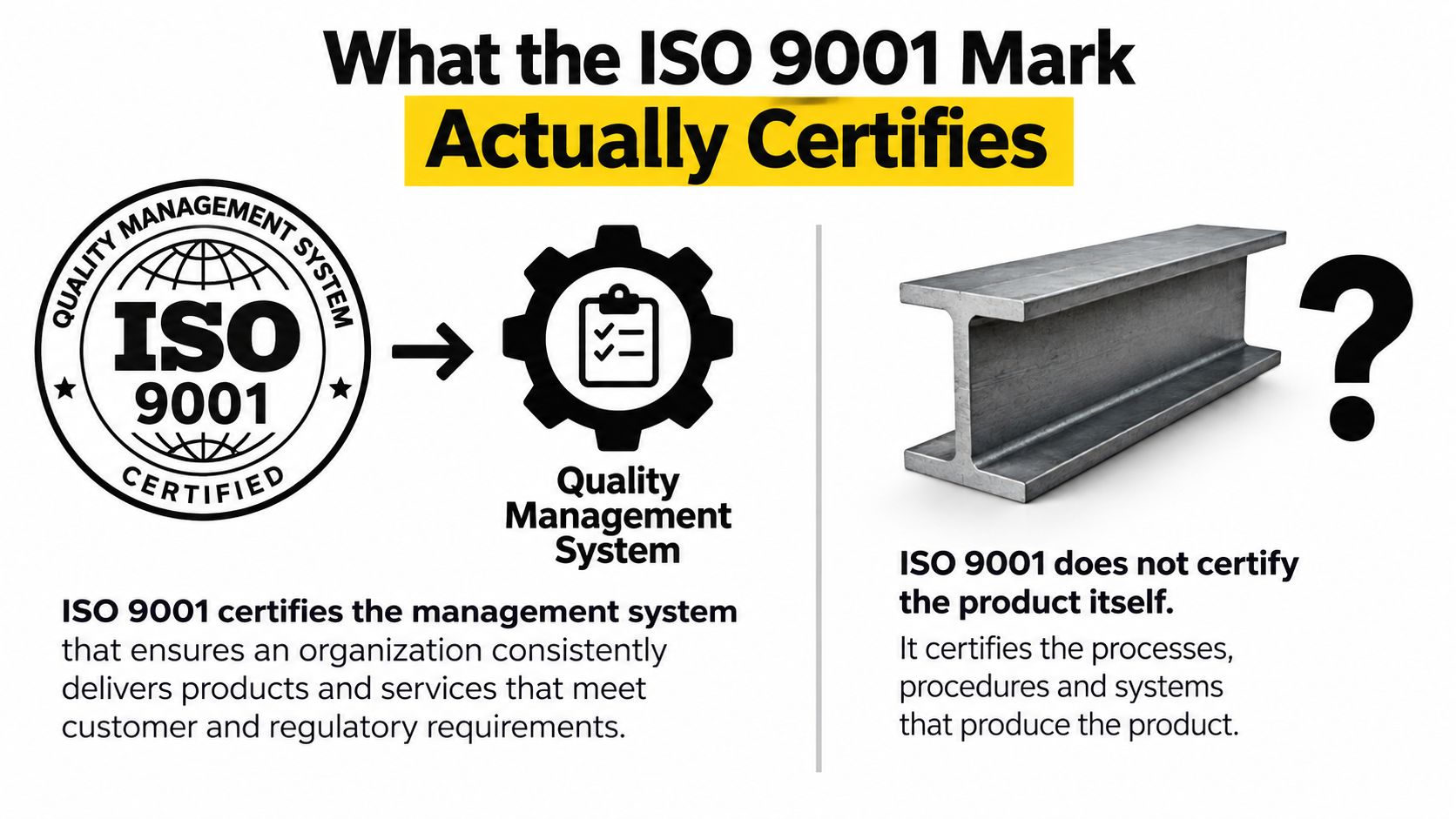
Read the scope before writing the claim
Start with the certificate itself. Confirm the legal entity, the certified locations, the activities covered, the certification body, the certificate number, and the current validity status. Then make sure the marketing claim describes the organization’s management system rather than promising that a particular product has been approved by ISO.
A safe statement is:
Manufactured under an ISO 9001:2015 certified quality management system.
You can add the certification body and certificate number when the body’s rules require them. Avoid statements such as “ISO-certified coating,” “ISO-approved product,” or “ISO quality guaranteed.” Those phrases shift the meaning from an audited management system to an unsupported product endorsement.
Titan has developed its own coating technology and presents itself as the first company to introduce elastomer coatings to the market using nano tubes technology and Dark Matter technology. Those product and technology claims remain separate from the ISO claim. Titan’s elastic coatings are described as hard like glass while remaining flexible, a combination intended to help the coating accommodate movement and temperature changes rather than crack as a rigid film might. The ISO mark doesn’t independently validate those product characteristics.
For background on why organizations value the standard, see Titan’s explanation of why ISO 9001 is important. The right interpretation protects both the buyer and the certified company. Buyers know what was audited, while the company preserves credibility around its actual product testing and performance evidence.
Who Owns the Logo and Which Version You Can Use
The first mistake usually happens before a designer opens the layout file. Someone searches for “ISO 9001 certification logo,” downloads a convenient vector image, and assumes that a familiar badge is free to use. It isn’t safe to work that way.
The current ISO 9001 standard was first published in 1987, and its current fifth edition was published in September 2015, as documented by ASQ’s ISO 9001 history and overview. The standard grew from earlier military procurement requirements and the BS 5750 framework before becoming ISO 9001. That history, combined with global adoption, gives the mark substantial recognition.
The ISO Survey 2024 data reported 1,474,118 ISO 9001 certificates worldwide, a 31.7× increase since 1993. The same survey recorded 2,081,672 active management-system certificates in Asia, representing 70.2% of the world total, while Europe held 671,774, or 22.7%. China accounted for about 652,000 ISO 9001 certificates, compared with 101,426 in Italy and 95,007 in India. The mark carries real equity, so certification bodies control its use carefully.
Identify the artwork before approval
There are usually three different assets in circulation:
| Mark Type | Owner | Who Provides It | Where It Is Allowed |
|---|---|---|---|
| ISO 9001 system mark | ISO | Generally not a freely downloadable client asset | Don’t use it as your company’s certification badge without authorization |
| Certification-body mark | Certification body or accreditor | The body that issued the certificate | Approved corporate communications, subject to its rules |
| Combined certification mark | Certification body, sometimes including accreditation identity | Issued with the client’s certificate package | Approved materials where scope and context remain clear |
ISO states that organizations seeking to demonstrate certification should contact the certification body that issued the certificate, as explained on the ISO 9001 standard page. The certificate is the proof of status. The logo is only a controlled communication asset that helps represent that status.
Keep the exact approved artwork, color rules, spacing requirements, and reproduction guidance together. Don’t reuse a vector file from a former employer, an old certificate package, or an anonymous logo-download page. If a certification body changes its mark or issues a replacement file, retire the old version across websites, brochures, tender documents, and templates.
For product-specific evidence, keep the certification claim separate from testing information. Titan’s approach combines third-party ISO and ASTM testing with real-world analysis, while ULTRA Ceramic Spray is described as a highly concentrated, water-based flexible membrane sealant for surfaces including paint systems, wraps, PPF, glass, wheels, plastic trim, household items, and personal items. Those are different types of evidence and shouldn’t be blended into one badge claim. Teams comparing certification and testing responsibilities can also review Titan’s guide to what third-party testing means.
Where You Can Place the Mark Without Misleading Buyers
Placement determines what buyers think the mark certifies. The same approved artwork can support a corporate quality page, yet imply product certification when placed over a product image. Review the complete layout, including headlines, photography, captions, and nearby claims.
On a website, use the mark in an About, Quality, Certifications, or footer area. Keep it beside the company name, certification body, certified scope, and required certificate details. Do not place it in a hero banner beside a product photograph. A buyer scanning the page may connect the badge to that item, regardless of the disclaimer below it.
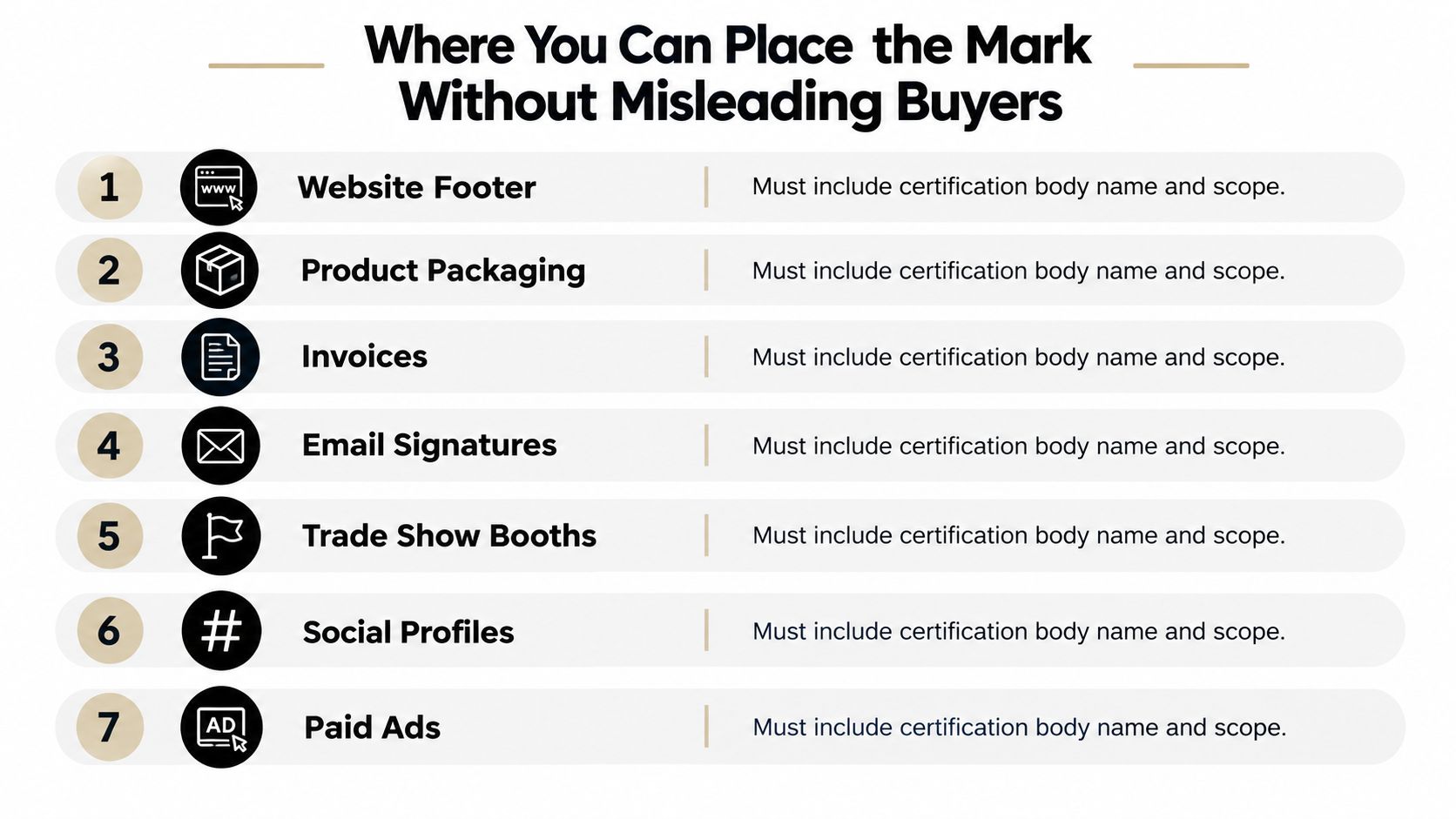
Apply the same test to every touchpoint
Use this checklist before publishing:
- Website footer: Identify the company, certification body, and relevant scope nearby.
- Quality page: Pair the mark with the certificate or a plain explanation of the audited activities.
- Invoices and letterhead: Keep it near company details, not beside an individual product line.
- Email signatures: Use approved artwork and include the required corporate context.
- Trade show booths: Position it with the company identity, away from product displays.
- Social profiles: Review cover images and profile graphics, since product photography can change the mark’s meaning.
- Paid ads: Keep the wording factual. Never use the badge as a visual promise about a specific item.
Packaging requires a separate approval decision. Management-system marks generally should not appear on products, product packaging, or materials that could be read as product conformity claims. If a certification mark appears alongside a product image, review the layout through a coating failure analysis framework to catch misleading visual pairings before buyers see them. Obtain written approval from the certification body before placing any mark on a label, and confirm that the certified scope and wording support the proposed use.
A placement example makes the distinction clear. Apex Glass Coating 50ml can be presented with its own product description and performance information, while the ISO 9001 mark belongs in the company or quality context around that presentation. Keep product attributes, application guidance, and testing evidence separate from management-system certification.
Use wording such as “Manufactured under an ISO 9001:2015 certified quality management system.” Place the explanation near the mark. Do not write “ISO 9001 certified product” unless a separate, applicable product certification exists and the relevant authority has approved that claim.
Common Misuse Pitfalls That Trigger Corrective Action
A campaign can pass a design review and still create an audit problem. Place the ISO 9001 badge beside a product photograph, and buyers may read it as a product-quality seal. The disclaimer below rarely corrects that first impression.
Follow the certification mark guidance: keep the mark legible, undistorted, and in the approved color scheme, and avoid wording or layouts that imply product or service certification. Corporate stationery, company brochures, and general promotional materials are usually safer locations. Products, packaging, labels, and ambiguous conformity claims require separate review.
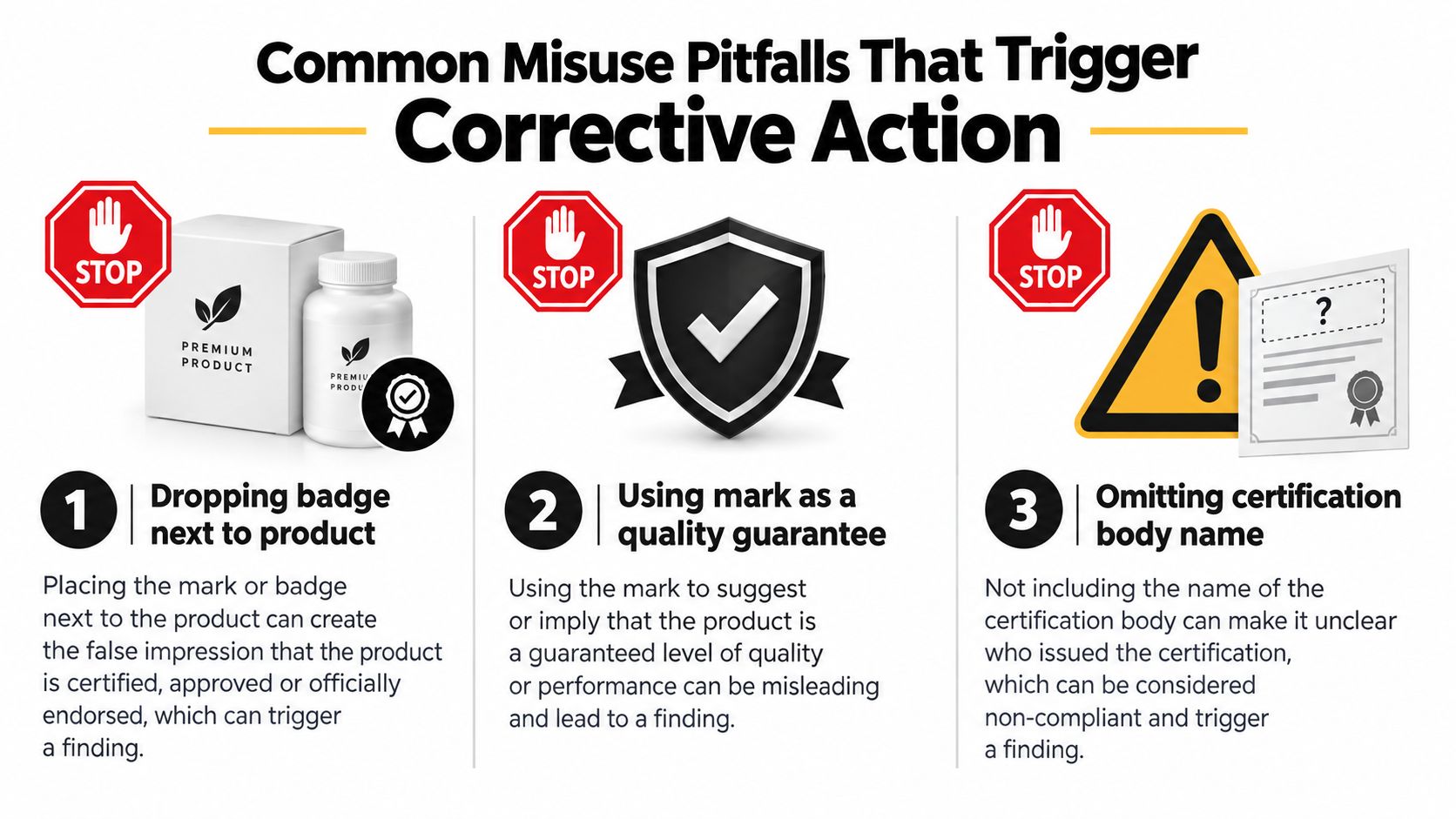
The errors auditors and buyers notice
- Product association: The badge appears on a product image, label, carton, or SKU panel.
- Overstated language: Copy calls the product “ISO certified,” “ISO approved,” or “ISO registered.”
- Scope drift: The mark sits beside goods, locations, or services outside the certified scope.
- Expired status: Old artwork remains after certificate expiry, suspension, withdrawal, or a scope change.
- Wrong identity: The accreditation mark is paired with the wrong certification body or certificate number.
- Artwork changes: A designer recolors, stretches, redraws, crops, or decorates the approved mark.
- Missing context: The company name, certified scope, or certification body is absent.
Use a precise claim:
Manufactured under an ISO 9001:2015 quality management system certified by [certification body], certificate [number].
Keep ISO 9001 separate from product evidence. A coating’s formulation, elasticity, temperature behavior, abrasion resistance, and windshield visibility performance need their own technical basis. Refer buyers to coating testing resources for that evidence, while keeping those results outside the management-system claim.
According to the ISO publication on conformity assessment, audit datasets covering ISO 9001:2015 recorded 22.6% of findings as minor nonconformities and 4.4% as major nonconformities. The publication identifies the source for this distribution. Logo misuse usually concerns communication or documentation control rather than product quality, but it can still trigger corrective action and reduce buyer confidence. Before publication, have the QMS owner verify the mark, wording, scope, and surrounding visuals.
Building a Simple Internal Workflow for Mark Compliance
Mark compliance shouldn’t depend on one experienced designer remembering an old certification-body email. Assign one Mark Steward, usually the QMS manager, quality lead, or brand-compliance owner. That person controls the current artwork, valid certificate PDF, scope statement, certificate number, and certification-body reproduction rules.
Keep those files in one shared, access-controlled folder with clear version names. Remove obsolete artwork from team libraries so nobody can select an expired or modified badge by accident.
Use a four-question publication gate
Every website page, brochure, trade-show panel, invoice template, tender response, and social graphic should pass these checks:
- Does the certificate cover the activity shown? Compare the asset’s product, location, and business description with the scope statement.
- Is the certificate current? Verify the certificate number, expiry status, and certification-body identity.
- Is the mark positioned with the company identity? Move it away from product images, labels, and individual product claims.
- Does the wording stay factual? Use “certified quality management system,” not “ISO-certified product” or “ISO-approved coating.”
Archive the approved layout after publication. Repeat the review when the certificate renews, the scope expands, a site changes, or the certification body issues new artwork. A quarterly sweep should include the public certification register, the corporate website, sales PDFs, email signatures, social profiles, and paid-media libraries.
Teams that want a broader readiness framework can use Evright Industrial readiness strategies to strengthen document ownership and audit preparation. The same discipline supports coating documentation. Application claims, technical sheets, and visual assets should follow controlled review, as shown in Titan’s coating application methods guidance.
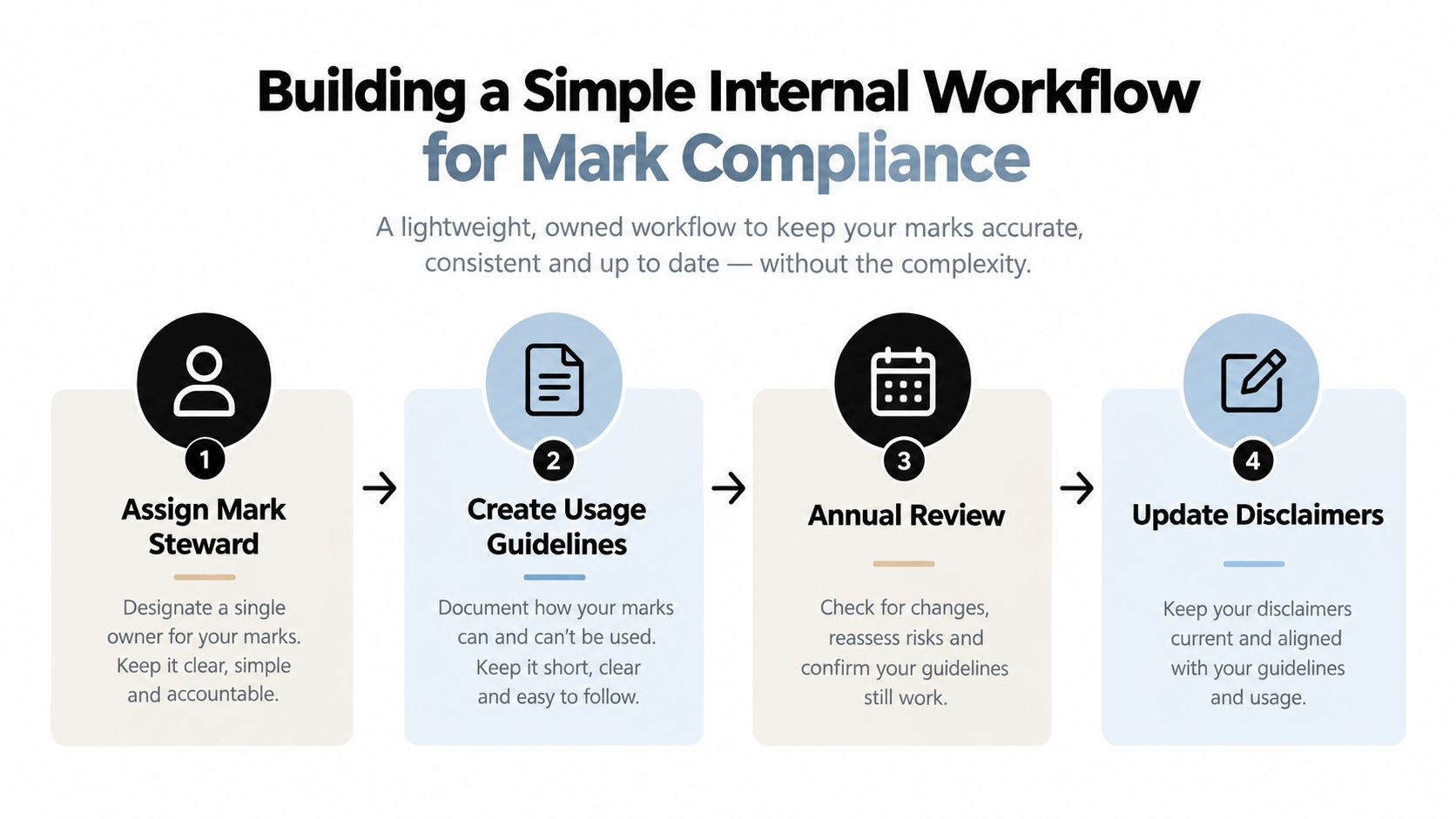
A lightweight workflow catches mistakes before a customer, competitor, or auditor does. It also creates an approval record that makes renewal and surveillance reviews easier to manage.
A One-Page Decision Guide for Your Marketing Team
Pin this guide beside the design queue. Before anyone publishes an ISO 9001 claim, ask four questions.
Which mark are you licensed to use
Use only the artwork supplied or approved by the certification body. Don’t download the ISO logo from a random website, redraw it, or reuse a file from an old employer. If the team can’t identify the owner and approval source, stop the publication and contact the issuing certification body.
Where will the mark appear
Corporate locations are safer: the quality page, website footer, company brochure, letterhead, invoice, tender pack, and trade-show stand. Product labels, packaging, product hero images, and individual product ads create a higher risk because viewers may interpret the mark as product certification.
What does the surrounding copy claim
Use “certified to ISO 9001:2015” when the wording clearly refers to the organization’s quality management system. Add the certification body, scope, and certificate number where required.
Never write that the product itself is ISO certified unless a separate product certification supports that exact statement. ISO 9001 does not certify a coating formula, a glass treatment, or a finished vehicle surface.
Is the certificate valid for the scope shown
Confirm the legal entity, location, activity, certificate number, and validity status. A company may hold certification for one defined operation while a campaign promotes another. Scope is not a decorative footnote. It determines whether the claim is accurate.
This discipline applies across the website footer, technical datasheet, tender response, social graphic, and trade-show display. It also keeps product communication honest. Titan describes elastic coatings as hard like glass and flexible, designed to accommodate temperature movement and reduce cracking risk, while its windshield coating content focuses on water repellency and visibility. Those product messages should remain supported by their own documentation.
For a manufacturer such as Titan Coatings, the ISO 9001 certification logo can reinforce buyer confidence when it identifies a controlled management system and stays within the approved scope. Used casually, it creates confusion. Used consistently, it gives procurement teams and auditors a clear signal that the company understands the difference between process certification and product performance.
APEX NANO – Titan Coatings develops coatings for automotive, aviation, marine, and defense applications, including elastic and ceramic coating technologies designed for different surfaces and use cases. Visit APEX NANO – Titan Coatings to review its coating solutions, technical information, and product resources, then align any ISO 9001 claim with the exact scope and mark rules issued by your certification body.
0 Comments