
You're halfway through a Saturday-morning detail when a solvent wipe changes the whole job. Brake dust lifts from the wheel, but the bargain coating beneath it turns cloudy and leaves a stain. The product label promised chemical protection, yet the finish has failed before the vehicle even leaves the bay.
That moment creates a fair question: why can PTFE resistance to chemicals remain dependable around aggressive fluids when an ordinary coating can haze, soften, or expose the substrate? The answer starts with the polymer itself, then moves into film structure, temperature, concentration, and application quality. It also explains why chemical inertness alone isn't enough for long-term vehicle protection.
PTFE, or polytetrafluoroethylene, has long been recognized as one of the most chemically inert polymers used in industry. Its history includes a 1941 patent and early wartime deployment, followed by broad adoption in chemical processing because it resists strong acids, bases, oxidizers, fuels, and many solvents. Technical compatibility data from Ready Plastics describe the material as a benchmark for corrosive environments, while also identifying a narrow group of exceptions.
The practical question for a detailer isn't just whether PTFE survives a chemical in a laboratory container. It's whether the complete coating can survive pressure, abrasion, substrate movement, thermal cycling, and repeated cleaning. To answer that, we need to start at the molecular level.
The Spilled Solvent That Started This Question
The detailer in our opening scene has two problems, not one. The solvent may have attacked the coating, but the coating may also have contained defects, poor adhesion, or a film too thin to protect the surface. Blaming the chemical alone would miss the more useful lesson.
A PTFE-based system would be evaluated differently because PTFE's carbon-fluorine structure gives it an unusually nonreactive surface. Strong mineral acids, bases, fuels, and common solvents generally struggle to alter the polymer itself within its operating limits. That doesn't mean every PTFE-containing coating automatically shrugs off every spill. The polymer's chemistry and the coating's construction are separate questions.
The promise and the qualification
This guide follows the path a senior materials engineer would use with a detailing client:
- Mechanism: why the carbon-fluorine backbone resists chemical attack.
- Compatibility: which acids, bases, oxidizers, fuels, and solvents are broadly compatible.
- Boundaries: how temperature, concentration, exposure duration, and unusual reagents change the answer.
- Coating integrity: why pinholes, cracking, delamination, and substrate movement can defeat an inert polymer.
- Maintenance: how preparation, curing, washing, and inspection preserve the protective layer.
That distinction matters on a vehicle. A wheel coating may face brake dust, road salt, fuel residue, cleaning chemicals, and repeated water exposure. A windshield coating faces wiper friction, bug residue, washer fluid, and rapid temperature changes. A paint coating faces ultraviolet exposure, contamination, washing, and flexing of the underlying panel.
Practical rule: Chemical compatibility describes what a material can resist. It doesn't, by itself, describe how long a complete coating will remain continuous and attached.
Titan's coating technology takes that distinction seriously. The company says it introduced elastomer coatings using nanotube technology and Dark Matter technology, with coatings designed to be hard like glass while remaining flexible. That combination matters because a flexible protective film can move with a vehicle surface instead of behaving like a brittle shell.
Before discussing Titan's products, however, it helps to understand why PTFE itself is so reluctant to react. The explanation is hidden in the bonds and the shape of its molecular chain.
Why PTFE Refuses to React With Most Things
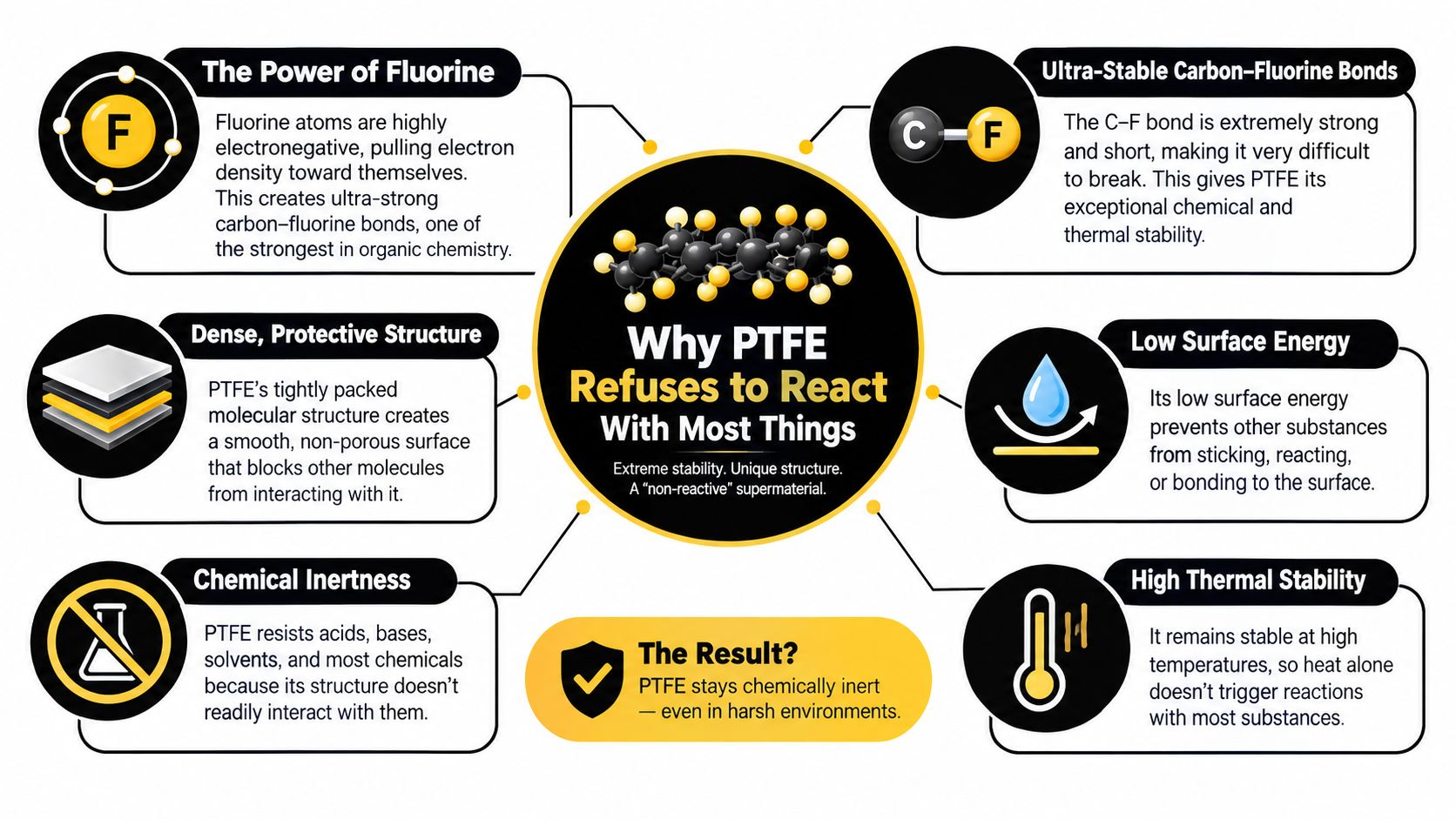
Think of PTFE as a carbon spine wrapped in a dense fluorine shield. The carbon atoms form the backbone, while fluorine atoms surround that backbone so thoroughly that incoming molecules have few accessible points to attack.
Three molecular advantages
Bond energy describes how much energy is required to break a chemical bond. The carbon-fluorine bond is exceptionally strong, so ordinary acids, bases, and solvents don't easily split the PTFE chain.
Polarity describes how unevenly electrical charge is distributed within a molecule. PTFE has a very low-polarity surface, which means it doesn't readily form the attractive interactions that allow many chemicals to wet, bond with, or dissolve a material.
Steric hindrance means that the physical shape of surrounding atoms blocks access to a reactive site. PTFE's fluorine sheath works like a tightly packed outer shell. Even if a reagent reaches the surface, it has difficulty reaching the carbon backbone underneath.
A useful analogy is vinegar on a glass bottle coated with a tough, non-wetting shield. The vinegar can touch the outside, but it can't find an easy chemical handle. PTFE behaves similarly with a wide range of aggressive media. By contrast, polymers containing more exposed carbon-hydrogen or carbon-oxygen bonds can offer easier targets for chemical attack, swelling, or oxidation.
Why the surface stays non-stick
The same structure that limits chemical reaction also limits adhesion. PTFE's surface energy is low, so many liquids spread poorly and many contaminants bond weakly. That helps explain its use in seals, liners, tubing, gaskets, chemical equipment, pharmaceutical systems, and semiconductor manufacturing.
For a vehicle coating, this molecular behavior is valuable but incomplete. A nonreactive top layer can resist a contaminant, yet the layer still has to remain attached to paint, glass, plastic, or metal. Alpha Quartz 50ml Ceramic coatig is described by Titan as a high-performance elastomer ceramic coating for all surfaces, with 92% high solids, zero VOCs, solvent-free formulation, advanced adhesion technology, and stated resistance to UV, chemicals, and abrasion.
The molecular shield explains the starting point. Compatibility charts show how that shield behaves around specific chemical groups.
What PTFE Actually Resists With Common Chemicals
Compatibility should always be read as a condition, not a slogan. The chemical name, concentration, temperature, pressure, contact time, and physical form of the coating all matter. A material that performs well in a room-temperature immersion test may require separate evaluation in a hot, pressurized process.
The table below summarizes the broad coverage described in the provided technical references. Where the source gives a concentration, it appears in the table. Where it doesn't provide a universal maximum, the safest entry is a qualitative rating rather than an invented limit.
| Chemical Class | Examples | Max Concentration | Max Service Temp (°C) | Resistance Rating |
|---|---|---|---|---|
| Mineral acids | Sulfuric, hydrochloric, hydrofluoric, nitric, phosphoric | Sulfuric up to 98%, hydrochloric up to 37%, hydrofluoric up to 100%, nitric up to 70%, phosphoric up to 85% | Within stated temperature limits | Excellent |
| Strong bases | Sodium hydroxide, potassium hydroxide | Not stated as a universal maximum | Within stated temperature limits | Excellent |
| Oxidizers | Hydrogen peroxide, bleach, ozone, chlorine gas | Not stated as a universal maximum | Within stated temperature limits | Excellent, with edge-case exceptions |
| Ketone solvents | Acetone, MEK | Not stated as a universal maximum | Room-temperature compatibility is broad | Excellent |
| Other solvents | THF, DMSO, DMF, chlorinated solvents, aromatic hydrocarbons | Not stated as a universal maximum | Application-specific | Excellent in referenced conditions |
| Fuels and fluids | Gasoline, diesel, hydraulic fluids, silicone oils | Not stated as a universal maximum | Application-specific | Excellent in referenced conditions |
PTFE chemical resistance data and material compatibility references report testing against 1,650+ chemicals at 20°C and 50°C conditions. The same reference states that no known solvents dissolve PTFE at room temperature and that chlorinated solvents produced less than 0.01% volume change after one year of immersion at 25°C.
Those findings explain why PTFE is selected for aggressive industrial exposure. They also explain why a solvent spill that destroys a conventional coating may have little effect on a sound PTFE surface. For a more detailed lookup, use Titan's chemical resistance table alongside the coating manufacturer's instructions.
What the table doesn't tell you
A resistance rating doesn't guarantee that a film will remain flawless. Discoloration can be a visual change without polymer attack, while a pinhole can expose the substrate without changing the surrounding PTFE. Likewise, a chemical may be compatible with the polymer but still attack an adhesive, primer, pigment, filler, or underlying metal.
PTFE's reported permeation rates for common solvents and corrosive gases are typically below 10^-12 cm²/s at 23°C, according to the provided material data. That low permeability helps explain its use as a barrier, but a real vehicle coating is thinner, more mechanically exposed, and more dependent on application quality than a molded industrial component.
The next question is therefore structural. What happens when the chemistry remains stable but the film itself develops a path through it?
When Chemical Resistance Is Not Enough With Coating Integrity
A solvent can leave a chemically inert PTFE surface unchanged while still reaching the material underneath. A windshield wiper illustrates the difference: rubber may tolerate washer fluid, but a crack in the blade still creates a route for water and debris. Coating protection depends on both polymer resistance and an unbroken film.
Four ways a coating can lose continuity
Microscopic pinholes may form during solvent flash-off or incomplete wetting. The surface can appear smooth while tiny openings give chemicals direct access to the substrate.
Sub-film corrosion starts when water and dissolved salts travel beneath a layer that looks continuous. The PTFE may remain stable, while the coating-substrate interface becomes the route for attack.
Flex-fatigue cracking occurs when a relatively rigid film moves less than the panel below it. A vehicle may cycle between -20°C and 60°C, repeatedly expanding and contracting the substrate. Treat these as typical application conditions rather than universal test limits. Repeated movement can turn a small weakness into a connected path through the coating.
UV-driven chain scission breaks polymer chains under prolonged ultraviolet exposure. If the formulation or stabilizer package does not control that exposure, the film can become more brittle and open pathways over time.
Thickness isn't the same as protection
Consumer spray coatings typically run 8 to 25 µm thick, and a 5 µm pinhole can expose the substrate. These are illustrative figures rather than universal PTFE coating specifications. The engineering principle remains: a defect extending through the film may matter more than the chemical stability of the PTFE around it.
A coating's weakest point is often where the substrate becomes exposed, not where the polymer reacts.
Adhesion, wetting, cure, film uniformity, and inspection therefore belong beside chemical resistance. Titan's guidance on third-party testing for coatings is relevant because independent testing can help separate a stable polymer from a complete coating system that withstands service conditions.
For a detailing client, the practical question is broader than whether a coating resists brake dust or solvent. Ask whether the film stays continuous after washing, impact, temperature changes, and substrate movement. PTFE supplies the chemical resistance at the polymer level. Coating integrity determines whether that resistance remains available across the vehicle surface.
Temperature Limits and Edge-Case Chemicals to Watch
PTFE operates across a notably broad temperature range. Independent material references describe a working range of about -190°C to 260°C, while another technical reference gives continuous operation from roughly -410°F to 500°F, equivalent to -260°C to 260°C, with short-term capability to 550°F. See the PTFE temperature and material reference and the PTFE properties and grades guide for those operating-envelope figures.
The important point is that ordinary temperature swings usually don't destroy PTFE chemistry. Problems arise when high temperature combines with a reagent that can attack the fluorinated structure, extract fluorine, cause swelling, or accelerate stress.
| Chemical | Concentration | ≤ 100°C | 100-200°C | > 200°C |
|---|---|---|---|---|
| Hydrochloric acid | 20% | Generally compatible | Verify the specific grade and exposure | Application-specific review required |
| Sulfuric acid | 70% | Review concentration and duration | Increasingly application-specific | Not a blanket approval |
| Elemental fluorine | Not stated | Special compatibility review | High-risk chemistry | Can directly attack the C-F structure |
| Chlorine trifluoride | Not stated | Special compatibility review | High-risk chemistry | Not suitable for assumption-based selection |
| Molten sodium or potassium | Molten state | Not an ordinary vehicle exposure | High-risk chemistry | Can strip fluorine and form fluorides |
| Certain amines and imines | Not stated | Usually requires specific review | Risk rises with heat and pressure | Technical reference identifies concern around 260°C |
The narrow exceptions matter
Chemical compatibility guidance from Ready Plastics identifies elemental fluorine, chlorine trifluoride, molten alkali metals, and high-energy radiation as unusual conditions that can attack or embrittle PTFE. Another technical reference notes that amines and imines become problematic around 260°C, while the supplied compatibility data identify sulfuric, hydrochloric, hydrofluoric, nitric, and phosphoric acids as resistant within stated temperature limits.
A technical chart from Wolseley's PTFE reference also identifies narrow classes such as elemental sodium, fluorine, certain concentrated metal hydrides, and hot amines or imines as exceptions.
ASTM D543 and ISO 175 are commonly associated with immersion-based plastics compatibility testing, but a rating from either method still needs to match the actual coating, substrate, concentration, temperature, and exposure duration. The same logic applies to solvent-resistant spray paint. A product's label should never replace a condition-specific compatibility review.
The safe conclusion is not that PTFE resists everything. It resists an exceptionally broad range of ordinary industrial chemicals, while edge cases demand controlled testing and realistic operating limits.
From Lab Data to Real Vehicle Protection With Elastomer Coatings
A PTFE component in a laboratory or process line can be chemically excellent and mechanically appropriate because engineers select its shape, thickness, support, and installation conditions. A vehicle coating faces a different problem. Panels vibrate, substrates expand, stones strike the surface, and temperature changes arrive quickly.
Titan's elastomer approach addresses that mechanical gap. The company describes its coatings as hard like glass while remaining flexible, using nanotube technology and Dark Matter technology. In practical terms, the hard surface helps resist contamination and wear, while elasticity allows the coating to move with the substrate instead of behaving like a brittle shell.
Why flexibility extends chemical protection
Consider a layered system:
- Primer layer: creates the bond with the prepared substrate.
- Chemical-resistant topcoat: provides the hard, low-reactivity surface.
- Elastomer mid-layer: absorbs movement, impact, and thermal change.
- Continuous film: keeps contaminants away from the substrate.
The exact construction must be confirmed from the product's technical documentation, but this model shows why flexibility can multiply chemical protection. If a rigid film cracks after impact or thermal movement, road salt and moisture can reach the surface beneath. If an elastic film stays continuous, the chemical resistance remains useful for longer because the barrier hasn't opened.
For a car, the exposure pattern is familiar. Road salt brings aqueous electrolyte contamination. Brake dust can combine with moisture and create an acidic cleaning challenge. Fuel drips and oils test solvent compatibility. Ultraviolet exposure and washing add repeated stress. A flexible coating doesn't make every chemical harmless, but it can reduce the mechanical routes that let those chemicals bypass the protective layer.
Engineering perspective: The strongest barrier is not only the material that resists the chemical. It's the system that keeps the barrier attached and continuous.
Titan's chemical resistance testing information can help detailers understand how product claims should be connected to test conditions. For DIY users and mobile detailers, the same principle means choosing a coating for both its chemistry and its ability to tolerate the movement of the surface being protected.
Choosing and Maintaining a Coating That Lasts
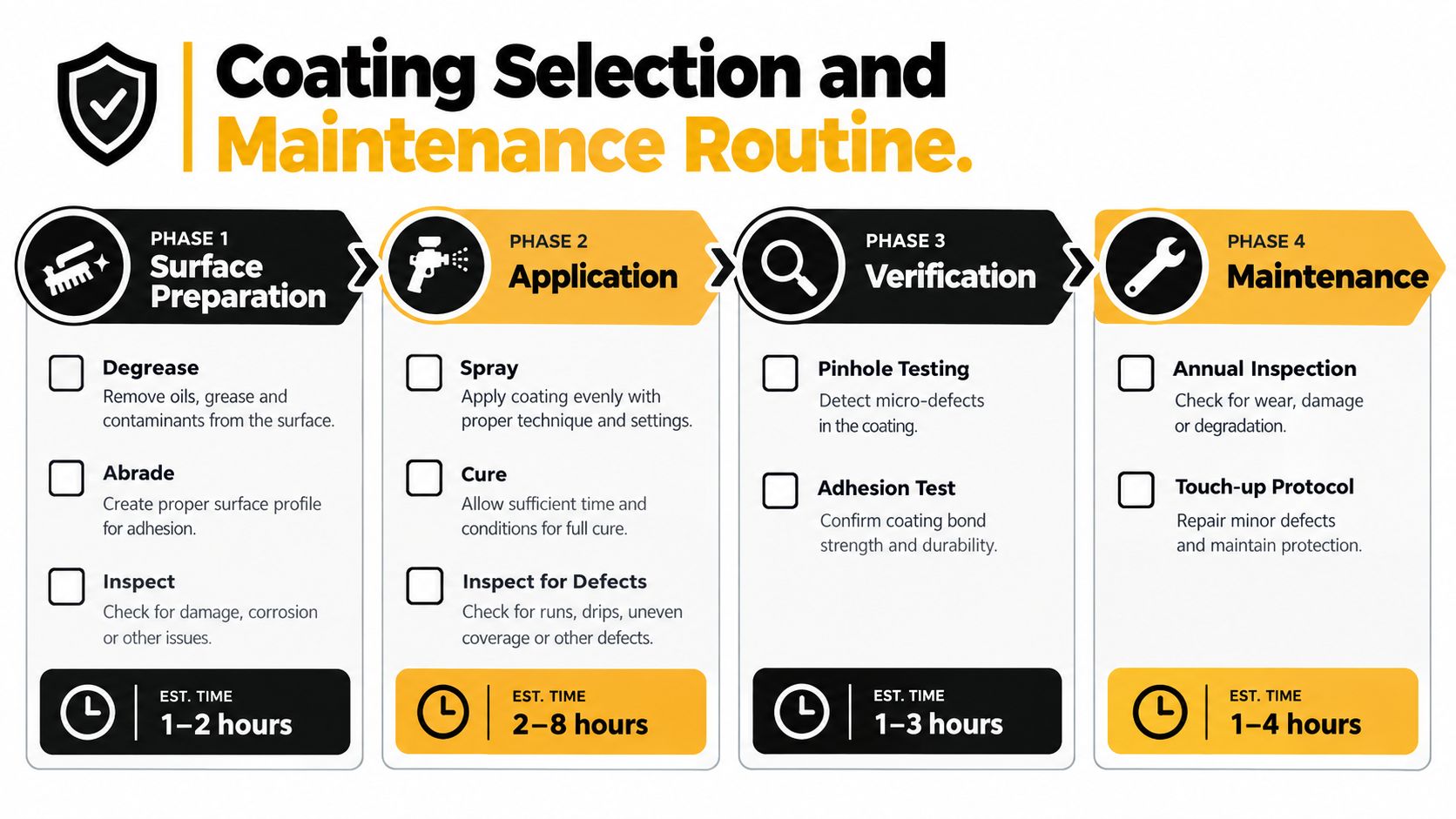
Good coating performance begins before the bottle is opened. Decontaminate the vehicle, remove oils, inspect the surface, and correct defects that could prevent uniform wetting. A coating can't compensate for embedded contamination or a substrate that has already lost adhesion.
A practical selection routine
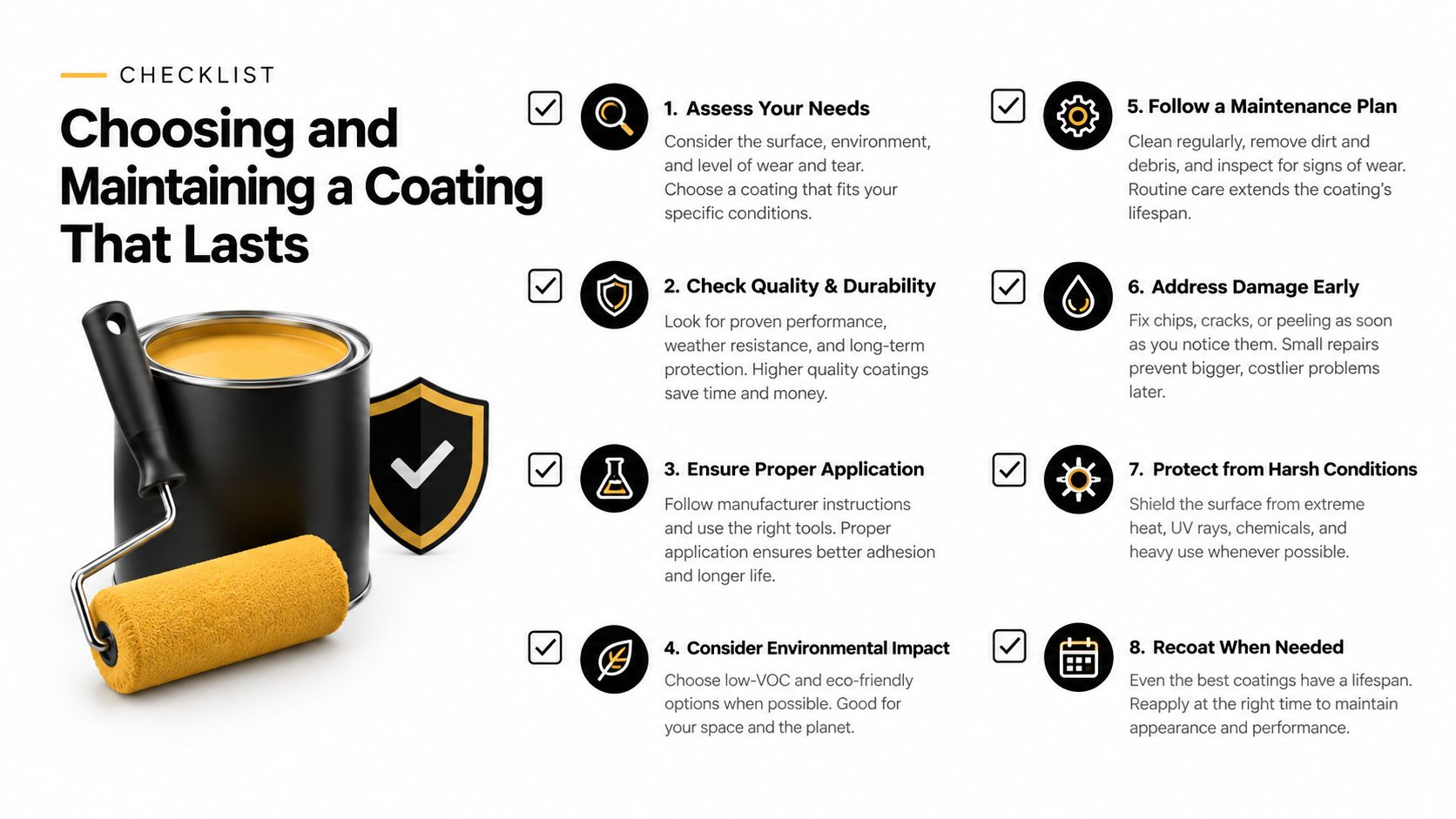
Match the exposure first. List what the vehicle encounters, including road salts, brake dust, acidic bird droppings, fuel vapors, washer fluid, bug residue, and cleaning products. Then confirm that the selected product is rated for those conditions rather than relying on the general phrase “chemical resistant.”
Control the application. Film uniformity depends on surface preparation, ambient humidity, application technique, cure conditions, and the number of layers. Follow the product's instructions and respect the full-cure window. A coating that feels dry may not yet have reached its intended final properties.
Choose by surface. For high-gloss paint on a daily-driven vehicle, Titan positions Alpha Quartz as an elastomer ceramic coating designed for all surfaces, with protection against UV, chemicals, and abrasion. For glass and windshields, APEX Glass is described as a hydrophobic coating with deep pore bonding that enhances visibility and reduces wiper use, making rain driving less stressful when applied according to its instructions.
Maintenance protects the film
Use a pH-neutral wash soap and avoid abrasive polishing that can thin or disturb the protective layer. A compatible topper can refresh water behavior periodically, but the correct interval depends on the product and use conditions, so follow the manufacturer's directions rather than treating six to twelve months as a universal rule.
For a quick refresh on wheels, trim, paint systems, wraps, PPF, and glass, ULTRA Ceramic Spray is described by Titan as a highly concentrated, water-based flexible membrane sealant for those surfaces and for household and personal items.
Use Titan's coating flexibility information when evaluating how a product is intended to respond to substrate movement. Inspect regularly for three warning signs:
- Water behavior changes: Beading or sheeting drops noticeably after washing.
- Staining appears beneath the film: Contamination may have reached a defect or interface.
- Edges lift or peel: Adhesion has been compromised and the exposed area can expand.
The detailer's original solvent spill offers the final lesson. PTFE's chemistry can provide an excellent resistance foundation, but durable vehicle protection requires a continuous, well-adhered, flexible film that receives appropriate care.
APEX NANO – Titan Coatings offers coating options for automotive surfaces, including elastomer protection designed to combine a hard finish with flexibility, plus dedicated glass and surface products. Visit APEX NANO – Titan Coatings to compare the available systems and choose a product that matches your vehicle's chemical exposure, surface movement, and maintenance routine.
0 Comments